Emperors of the Former Qin dynasty 前秦
The emperors of Former Qin (352–394) in order of accession, from Fu Jian to Fu Chong.
- Rulers
- 7 rulers
Rulers in order
- 1stFu Hong苻洪350 · Did not take the title of emperor350Did not take the title of emperor
- 2ndFu Jian前秦景明帝 Qián Qín Jǐngmíngdì苻健 Fú Jiàn352–355 · 3 years · Natural causes, age 37–38352–3553 yearsNatural causes, age 37–38
- 3rdFu Sheng前秦厲王 Qián Qín Lìwáng苻生 Fú Shēng356–357 · 1 year · Assassinated, age 21–22356–3571 yearAssassinated, age 21–22
- 4thFu Jian苻堅357–385 · Did not take the title of emperor357–385Did not take the title of emperor
- 5thFu Pi前秦哀平帝 Qián Qín Āipíngdì苻丕 Fú Pī385–386 · 1 year · Killed in battle385–3861 yearKilled in battle
- 6thFu Deng前秦高帝 Qián Qín Gāodì苻登 Fú Dēng386–394 · 7 years · Killed in battle, age 50–51386–3947 yearsKilled in battle, age 50–51
- 7thFu Chong前秦末帝 Qián Qín Mòdì苻崇 Fú Chóng394 · 92 days · Killed in battle39492 daysKilled in battle
Rise and fall of the Former Qin dynasty
Rise
Fu Hong, a man of the Di, served Shi Hu, persuaded him to move the powerful clans and the Qiang of Guanzhong to the capital, and was stationed at Fangtou as a general commanding the refugees. In 350 Fu Hong changed his surname to Fu and called himself King of the Three Qin, but he was poisoned and died, and his son Fu Jian, as his father had instructed before dying, entered Guanzhong and made Chang'an his capital. Fu Jian took the titles of Heavenly King and Grand Chanyu in 351, and ascended the imperial throne in 352.
Course
In 354 Huan Wen of Eastern Jin pressed on Chang'an, but Fu Jian had the wheat reaped and the countryside cleared, leaving the Jin army to go hungry. The next ruler, Fu Sheng, carried out killing after killing, such as putting the Chancellor Lei Ruo'er to death together with his sons and grandsons, and in 357 he was killed by his cousin Fu Jian. Fu Sheng's cousin Fu Jian took the title not of emperor but of Heavenly King of Great Qin.
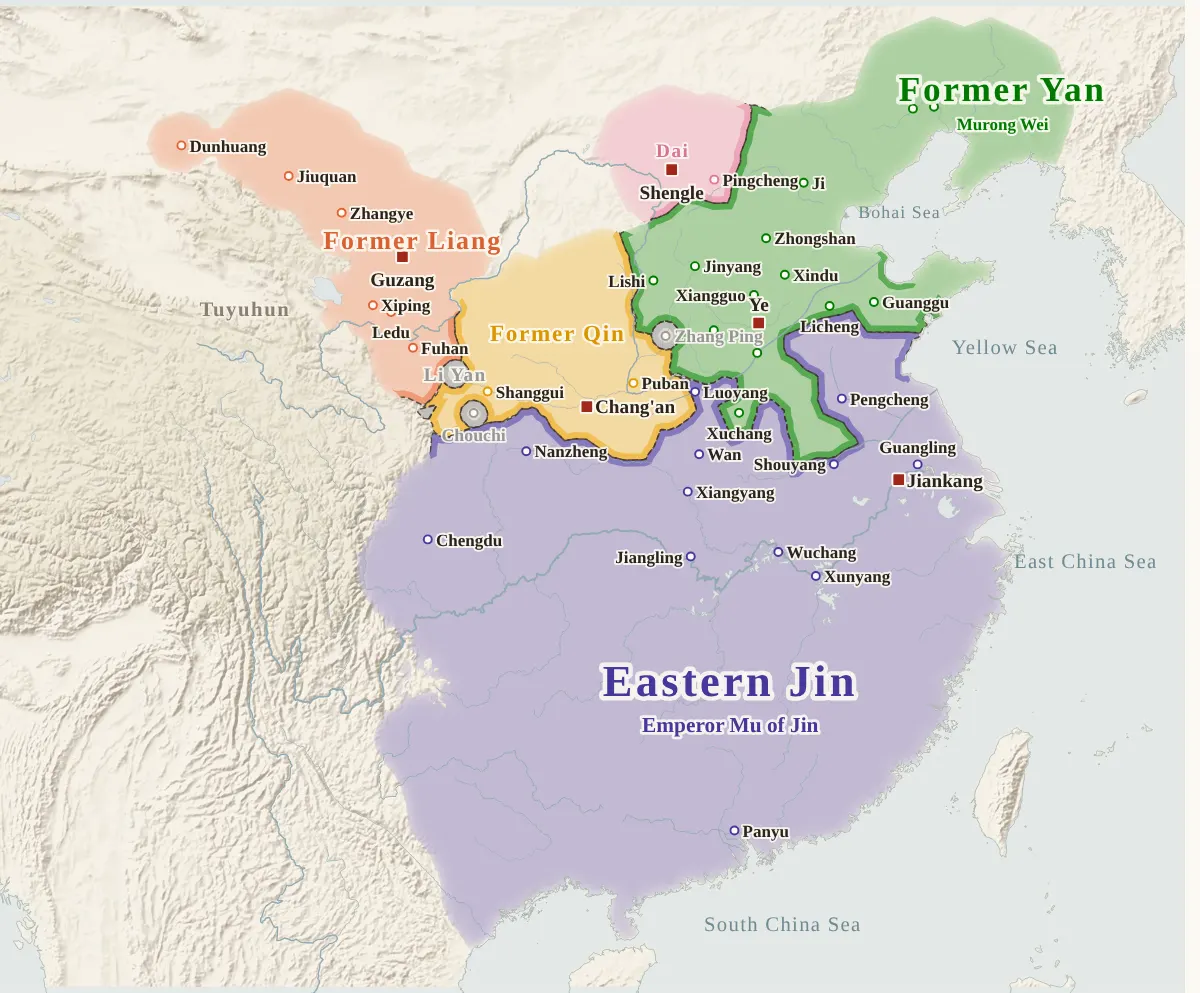
The Heavenly King Fu Jian gave Wang Meng high office and entrusted him with the government, and had Fan Shi, a powerful Di who had defied Wang Meng, beheaded. Wang Meng governed fairly and raised up talent that had been overlooked, put the army in order and encouraged farming and sericulture, and the state grew rich and its army strong. In 370 Former Qin took Ye and made Murong Wei of Former Yan surrender, made Zhang Tianxi at Guzang submit and took Liang Province, and also defeated Sheyijian, King of Dai. Once the realm had grown prosperous, the Heavenly King adorned even his palaces and carriages with pearls and jade.
Wang Meng, on his deathbed, had left word not to attack Jin but to remove the Xianbei and the Qiang little by little. In 383 the Heavenly King raised a great army, taking one soldier from every 10 adult men, and attacked Eastern Jin. At the Fei River, when the lines were drawn back to let the Jin army cross the river and then strike it, the Former Qin army began to fall back and could not be stopped; the Heavenly King's younger brother Fu Rong was killed in the fighting, and the Heavenly King, struck by a stray arrow, fled back to the north of the Huai. Only the army of Murong Chui remained unharmed, and before long Murong Chui asked leave to go to the lands of Yan and left the Heavenly King.
Fall
After that, Murong Chui allied with the Dingling and attacked Ye, Murong Hong raised troops at Huayin, and Yao Chang in Beidi, whom the Heavenly King had set out to subdue, also allied with Murong Hong. In 385 the Heavenly King left Chang'an in the hands of his crown prince Fu Hong and went out to Mount Wujiang, but Murong Chong entered Chang'an, and the Heavenly King was captured by a general of Yao Chang and strangled in a Buddhist temple at Xinping. His son Fu Pi, who had been at Ye, learned of the Heavenly King's death at Jinyang and called himself emperor, but in 386 he was defeated and, while fleeing, was beheaded by a Jin general. Fu Deng, a member of the clan, became emperor and kept up the fight against Yao Chang, but in 394 he was defeated by Yao Xing and killed. The crown prince Fu Chong took the throne at Huangzhong, but within that same year he was driven out by Qifu Gangui and killed together with Yang Ding, and Former Qin came to an end.
Translated from the Japanese text of this site, which is written from the official histories. Years are the Western calendar years of the dates, as in English reference works.