Emperors of the Northern Wei dynasty 北魏
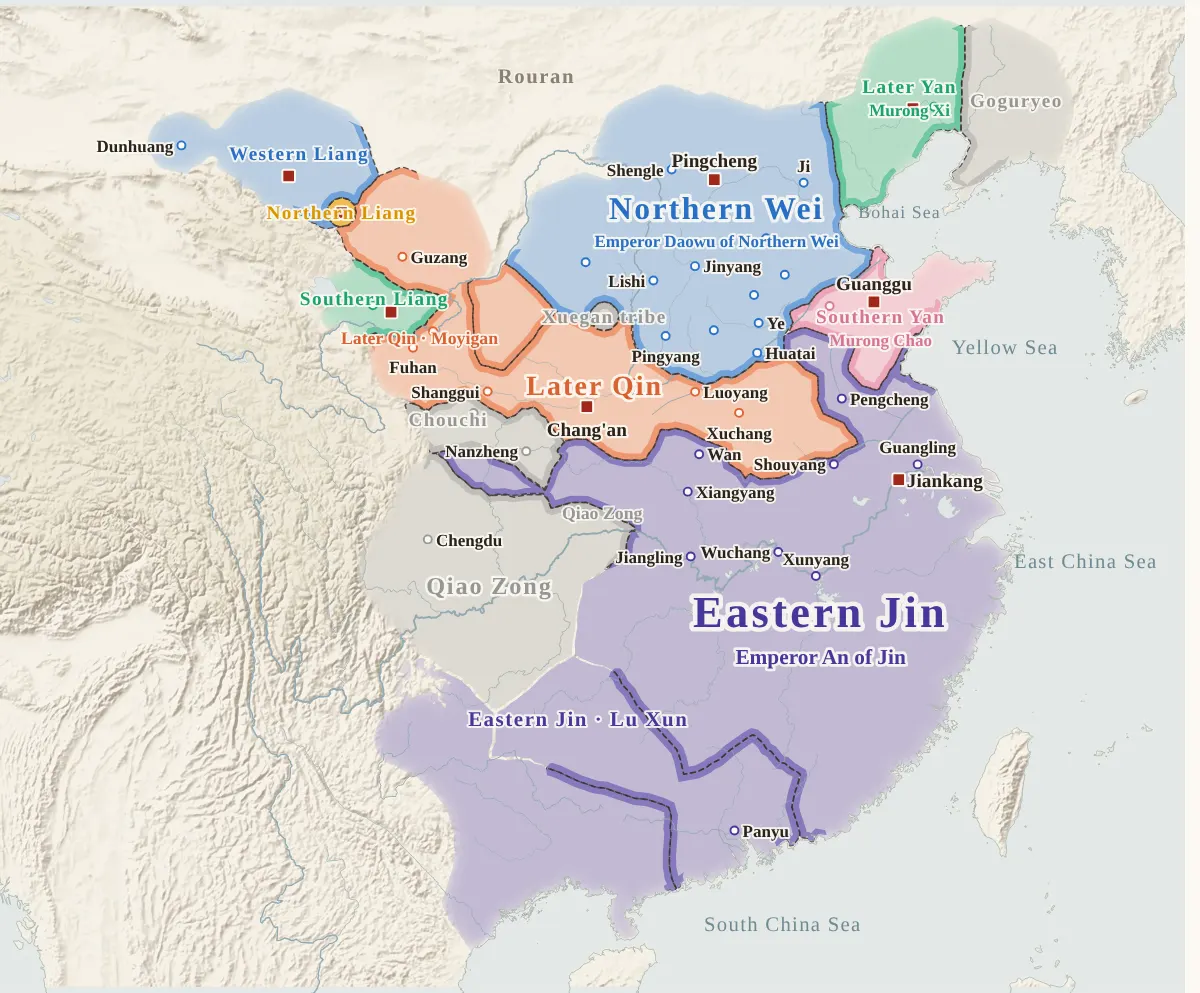
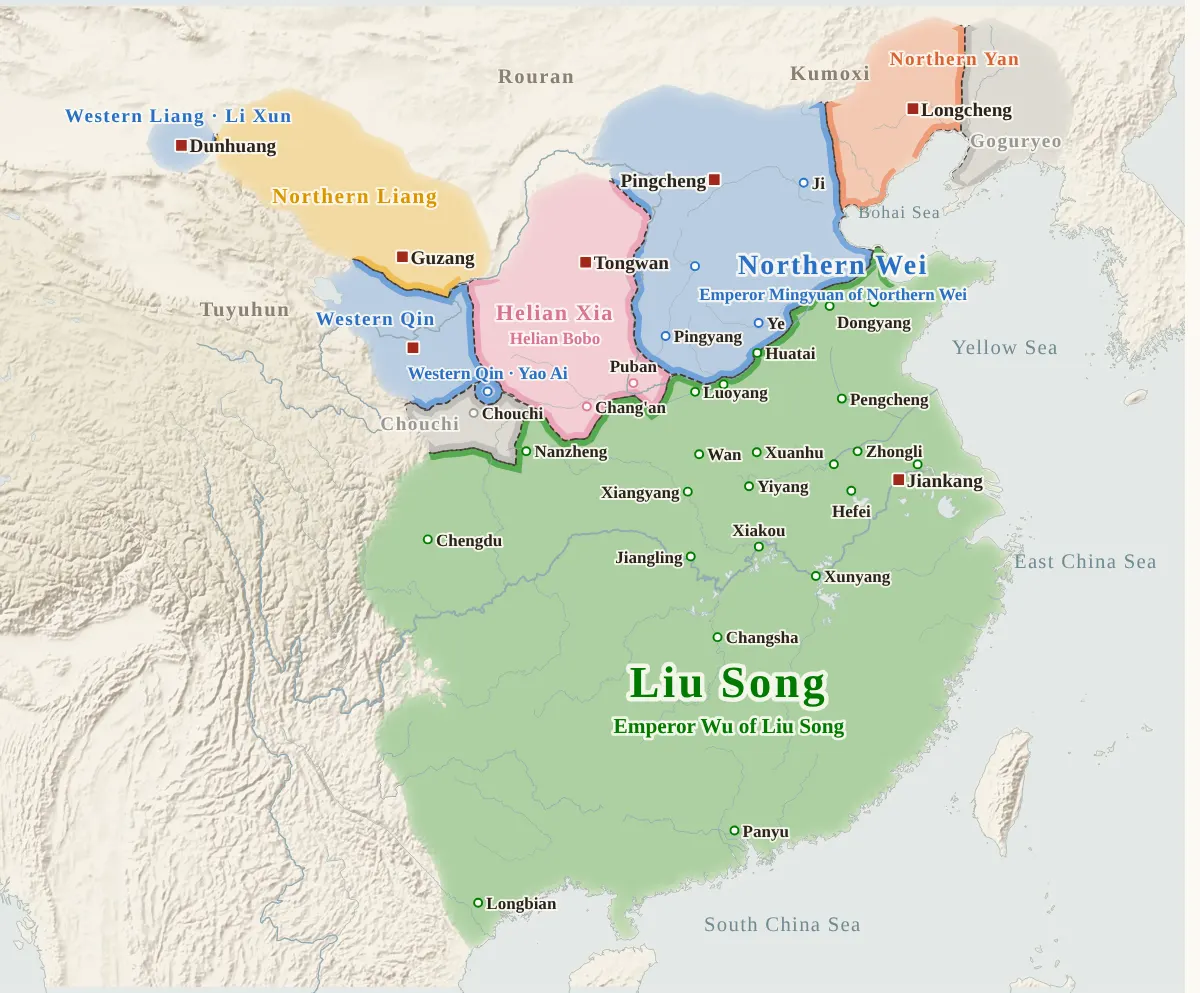
The emperors of Northern Wei (399–535) in order of accession, from Emperor Daowu of Northern Wei to Emperor Xiaowu of Northern Wei.
- Rulers
- 12 rulers
Rulers in order
- 1stEmperor Daowu of Northern Wei北魏道武帝 Běi Wèi Dàowǔdì拓跋珪 Tuòbá Guī399–409 · 10 years · Assassinated, age 38399–40910 yearsAssassinated, age 38
- 2ndEmperor Mingyuan of Northern Wei北魏明元帝 Běi Wèi Míngyuándì拓跋嗣 Tuòbá Sì409–423 · 14 years · Natural causes, age 30–31409–42314 yearsNatural causes, age 30–31
- 3rdEmperor Taiwu of Northern Wei北魏太武帝 Běi Wèi Tàiwǔdì拓跋燾 Tuòbá Tāo423–452 · 28 years · Assassinated, age 43–44423–45228 yearsAssassinated, age 43–44
- Tuoba Yu拓跋余 Tuòbá Yú452 · 211 days · Assassinated452211 daysAssassinated
- 4thEmperor Wencheng of Northern Wei北魏文成帝 Běi Wèi Wénchéngdì拓跋濬 Tuòbá Jùn452–465 · 12 years · Natural causes, age 24452–46512 yearsNatural causes, age 24
- 5thEmperor Xianwen of Northern Wei北魏獻文帝 Běi Wèi Xiànwéndì拓跋弘 Tuòbá Hóng465–471 · 6 years · Assassinated, age 21465–4716 yearsAssassinated, age 21
- 6thEmperor Xiaowen of Northern Wei北魏孝文帝 Běi Wèi Xiàowéndì元宏 Yuán Hóng471–499 · 27 years · Natural causes, age 31471–49927 yearsNatural causes, age 31
- 7thEmperor Xuanwu of Northern Wei北魏宣武帝 Běi Wèi Xuānwǔdì元恪 Yuán Kè499–515 · 15 years · Natural causes, age 31–32499–51515 yearsNatural causes, age 31–32
- Yuan Yu元愉 Yuán Yú508 · 61 days · Disputed, age 19–2050861 daysDisputed, age 19–20
- 8thEmperor Xiaoming of Northern Wei北魏孝明帝 Běi Wèi Xiàomíngdì元詡 Yuán Xǔ515–528 · 13 years · Assassinated, age 17515–52813 yearsAssassinated, age 17
- Yuan Faseng元法僧 Yuán Fǎsēng525 · 30 days · Natural causes, age 81–8252530 daysNatural causes, age 81–82
- Yuan Zhao元釗 Yuán Zhāo528 · 45 days · Assassinated, age 1–252845 daysAssassinated, age 1–2
- 9thEmperor Xiaozhuang of Northern Wei北魏孝莊帝 Běi Wèi Xiàozhuāngdì元子攸 Yuán Zǐyōu528–531 · 2 years · Assassinated, age 22–23528–5312 yearsAssassinated, age 22–23
- Yuan Hao元顥 Yuán Hào529 · 104 days · Killed in battle529104 daysKilled in battle
- Yuan Ye元曄 Yuán Yè530–531 · 117 days · Suicide (incl. forced)530–531117 daysSuicide (incl. forced)
- 10thEmperor Jiemin of Northern Wei北魏節閔帝 Běi Wèi Jiémǐndì元恭 Yuán Gōng531–532 · 1 year · Assassinated, age 33–34531–5321 yearAssassinated, age 33–34
- 11thYuan Lang元朗 Yuán Lǎng531–532 · 219 days · Assassinated, age 18–19531–532219 daysAssassinated, age 18–19
- 12thEmperor Xiaowu of Northern Wei北魏孝武帝 Běi Wèi Xiàowǔdì元脩 Yuán Xiū532–535 · 2 years · Assassinated, age 23–24532–5352 yearsAssassinated, age 23–24
Rise and fall of the Northern Wei dynasty
Rise
After the people of the state of Dai were scattered by the invasion of Fu Jian, Tuoba Gui, a grandson of Emperor Zhaocheng, took the position of King of Dai at Niuchuan in 386, and within the same year changed his title to King of Wei. In 398 Tuoba Gui fixed Wei as the name of the state and moved the capital to Pingcheng, and early in 399 he took the imperial throne as Emperor Daowu of Northern Wei.
Course
In 409 Emperor Daowu died in the palace after his son Shao, Prince of Qinghe, broke into it, and Emperor Mingyuan of Northern Wei did away with Shao and succeeded him. Emperor Taiwu of Northern Wei entered Tongwan, the capital of Helian Xia, in 427, and in 439 he received the surrender of Juqu Mujian of Northern Liang at Guzang. Trusting the arguments of Cui Hao, who disparaged Buddhism, Emperor Taiwu in 446 ordered the provinces to bury Buddhist monks alive and destroy Buddhist images. When Emperor Taiwu died suddenly in 452, the eunuch Zong Ai set up Tuoba Yu, Prince of Nan'an, and later killed him, and Liu Ni, Lu Li and others brought in the emperor's grandson and made him Emperor Wencheng of Northern Wei. Early in the year after he took the throne, Emperor Wencheng restored Buddhism, and later, at the request of Tanyao, five caves were cut into the cliffs of Wuzhou Sai west of the capital and Buddhist images were carved in them.
In 471 Emperor Xianwen of Northern Wei passed the throne to the young Emperor Xiaowen of Northern Wei, and after Emperor Xianwen died in 476, Empress Dowager Feng, the grandmother of Emperor Xiaowen, presided over the court. In the meantime, in 485, an edict was issued to allot the land of the realm equally and have it returned at death, and the next year the three heads of the dang, li and lin were set up and the household registers of the people fixed. After the empress dowager died in 490, Emperor Xiaowen set out on a southern campaign in 493, but at Luoyang his ministers stopped him, and there he settled on moving the capital. In 495 the northern tongue was banned at court and the inner palace and the officials were moved to Luoyang, and the next year the surname was changed to Yuan. On Mount Yique south of Luoyang, the next emperor, Emperor Xuanwu of Northern Wei, had stone caves made for his parents.
When Emperor Xiaoming of Northern Wei took the throne as a child, his mother, Empress Dowager Hu, held power, and later Poluohan Baling rebelled at the Woye garrison, and revolts also broke out at Gaoping and in Qinzhou. From the imperial clan too, Yuan Yu at Jizhou in the reign of Emperor Xuanwu and Yuan Faseng at Pengcheng in the reign of Emperor Xiaoming each set up an era name of his own. In 528, when Emperor Xiaoming died suddenly and Empress Dowager Hu set up the child ruler Yuan Zhao, Erzhu Rong crossed the Yellow River, drowned Empress Dowager Hu and the child ruler in the river, and killed large numbers of imperial clansmen and high officials at Heyin. Emperor Xiaozhuang of Northern Wei, set up by Erzhu Rong, was driven from the capital for a time in 529 by Yuan Hao, who entered Luoyang with Liang troops; in 530 Emperor Xiaozhuang cut down Erzhu Rong in the palace. The Erzhu clan then set up Yuan Ye and attacked Luoyang, captured Emperor Xiaozhuang and killed him at Jinyang, and afterwards set up Emperor Jiemin of Northern Wei in place of Yuan Ye. Gao Huan, contending with the Erzhu clan, set up Yuan Lang. In 532 Gao Huan, having defeated the Erzhu clan, deposed Emperor Jiemin, Yuan Lang also stepped down, and Emperor Xiaowu of Northern Wei was set up.
Fall
In 534 Emperor Xiaowu, at odds with Gao Huan, fled to Yuwen Tai in Guanzhong and entered Chang'an. In the same year Gao Huan set up Yuan Shanjian and moved the capital to Ye, and Northern Wei was split in two. Emperor Xiaowu died in Chang'an early the next year, and in that same year Yuwen Tai set up Yuan Baoju.
Translated from the Japanese text of this site, which is written from the official histories. Years are the Western calendar years of the dates, as in English reference works.