Emperors of the Former Yan dynasty 前燕
The emperors of Former Yan (353–370) in order of accession, from Murong Jun to Murong Wei.
- Rulers
- 3 rulers
Rulers in order
- 1stMurong Huang慕容皝337–348 · Did not take the title of emperor337–348Did not take the title of emperor
- 2ndMurong Jun前燕景昭帝 Qián Yàn Jǐngzhāodì慕容儁 Mùróng Jùn353–360 · 7 years · Natural causes, age 40–41353–3607 yearsNatural causes, age 40–41
- 3rdMurong Wei前燕幽帝 Qián Yàn Yōudì慕容暐 Mùróng Wěi360–370 · 10 years · Executed, age 33–34360–37010 yearsExecuted, age 33–34
Rise and fall of the Former Yan dynasty
Rise
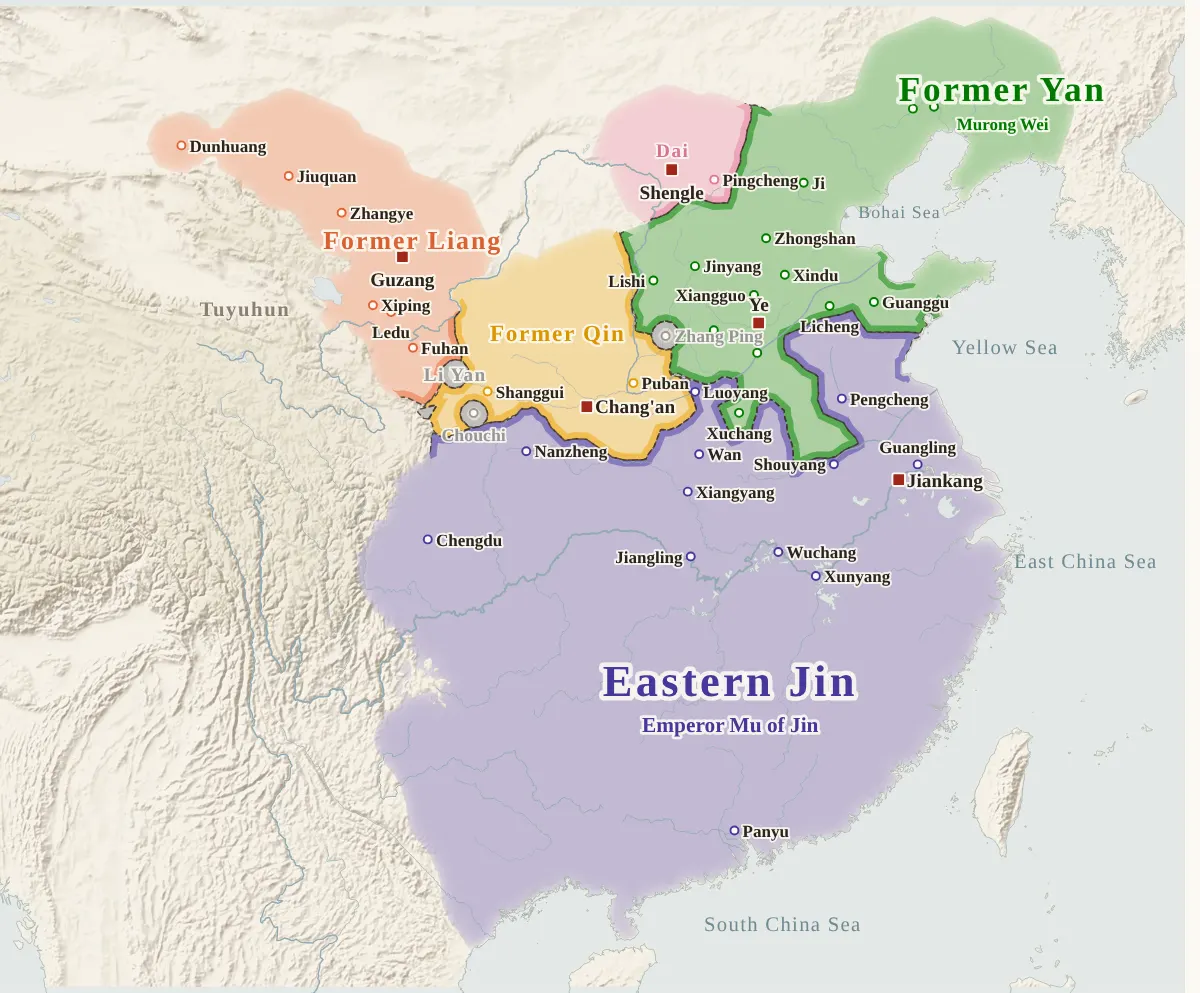
The Murong of the Xianbei were a clan that had entered Liaoxi at the beginning of Cao Wei and founded a state north of Jicheng. Murong Hui divided the people who had fled to him after the fall of Luoyang and Chang'an into commanderies and governed them, and the Eastern Jin court at Jianye enfeoffed him as Duke of Liaodong Commandery. Murong Huang called himself King of Yan in 337, and it was his son Murong Jun who called himself emperor, in 352.
Course
Murong Huang moved his capital to Longcheng, and Murong Jun, in 350, the year after succeeding as King of Yan, took Ji from Later Zhao and made it his capital. In 352 Murong Ke captured Ran Min, and Ran Min was beheaded at Longcheng. In the same year Murong Jun took the imperial throne, claiming that the Imperial Seal of the Realm had been presented to him by Ran Min's wife, and he later moved his capital to Ye.
When Murong Jun died in 360, the young Murong Wei was set up, and his uncle Murong Ke took charge of the government and also took the Jinyong Fortress at Luoyang. After Murong Ke's death, Murong Chui, who had repelled the northern expedition of Huan Wen of Eastern Jin in 369, fled to Former Qin when Murong Ping and the empress dowager plotted to kill him.
Fall
In 370, when Wang Meng of Former Qin advanced, Murong Ping suffered a great defeat at Luchuan, and Ye fell when its city gates were opened at night. Murong Wei was overtaken at Gaoyang and surrendered to Fu Jian, and he was moved to Chang'an together with the princes and dukes and those below them and more than 40,000 Xianbei households. Later, when Murong Chui and others turned against Former Qin, Murong Wei joined them by plotting to kill Fu Jian, but the plot leaked and he was killed.
Translated from the Japanese text of this site, which is written from the official histories. Years are the Western calendar years of the dates, as in English reference works.