Emperors of the Later Han dynasty 後漢
The emperors of Later Han (947–951) in order of accession, from Liu Zhiyuan to Liu Chengyou.
- Emperors
- 2 emperors
Rise and fall of the Later Han dynasty
Rise
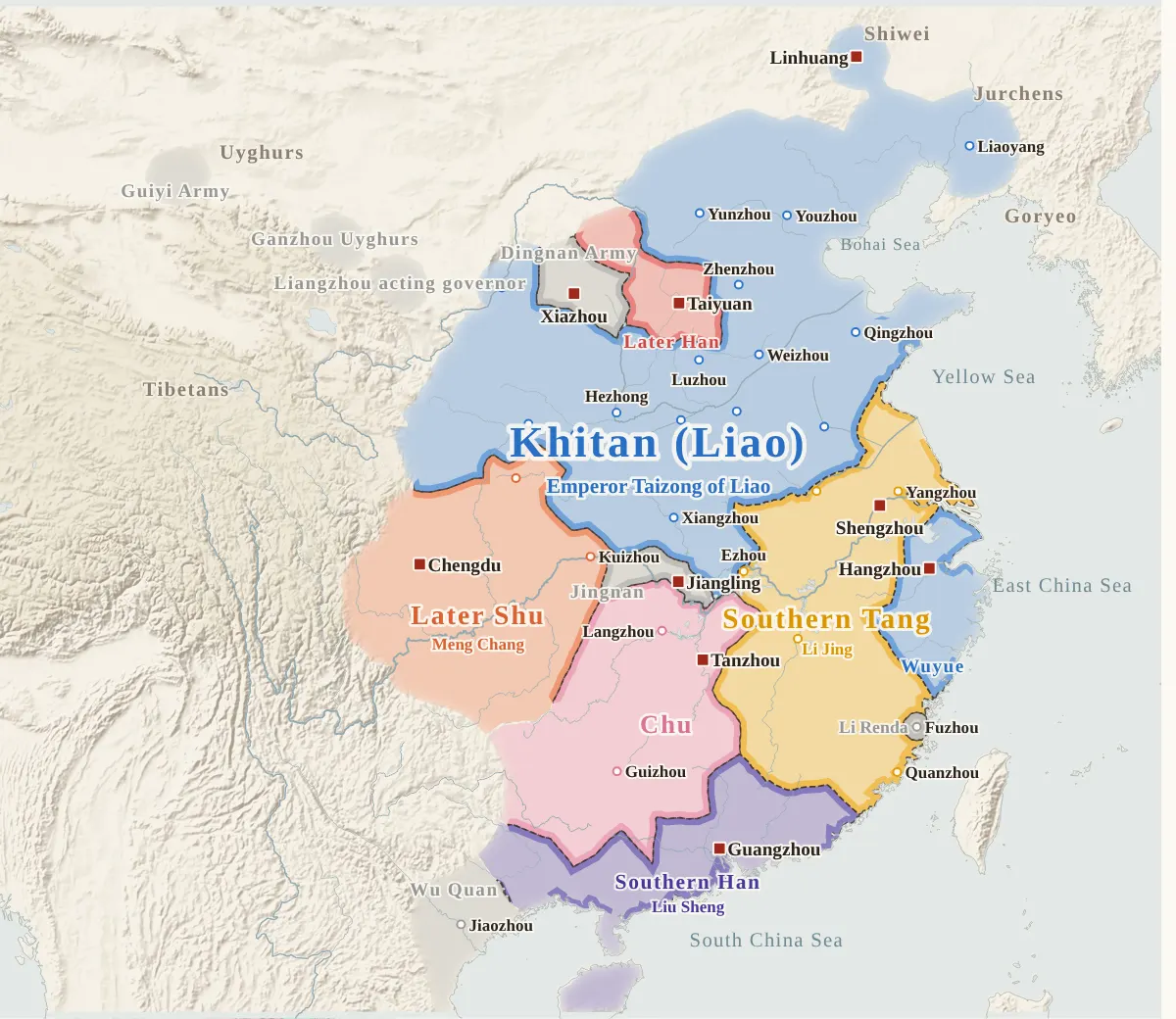
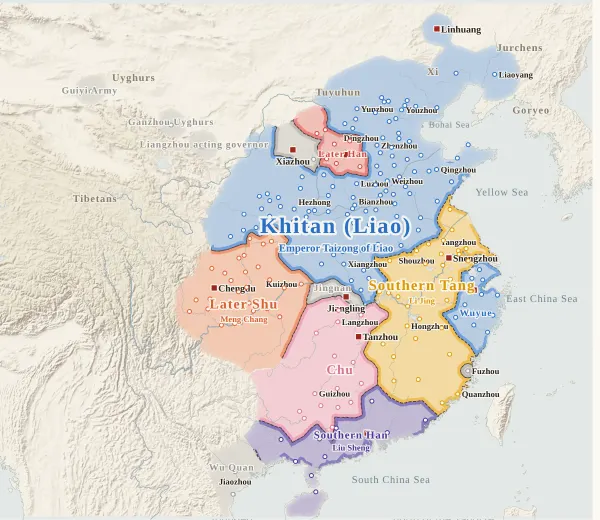
Liu Zhiyuan, who was at Taiyuan as military governor of Hedong for the Later Jin, did not move to its rescue even when Zhang Yanze, acting on the orders of the Khitan, took Kaifeng in 947. In 947, while the Khitan ruler was still at Kaifeng, Liu Zhiyuan took the throne as emperor at Taiyuan after repeated urging from his subordinates.
Course
In the same year Liu Zhiyuan set out from Taiyuan, and before entering Kaifeng he had Li Congyi of the Later Tang and Pure Consort Wang, whom the Khitan side had set up, put to death; after entering Kaifeng he fixed the name of the state as Han. At Kaifeng he had 1500 Youzhou soldiers, who had been reported as suspected of planning a revolt, killed to the last man, and for this reason the Youzhou soldiers who had joined Du Chongwei when he rebelled at Yedu refused to surrender, and the city held out for a long time. Du Chongwei surrendered and was pardoned, but when Liu Zhiyuan died in 948, the ministers kept his death secret and beheaded Du Chongwei and his sons, and Liu Zhiyuan's son Liu Chengyou succeeded to the throne.
As soon as Liu Chengyou took the throne, Li Shouzhen rebelled at Hezhong and Yongxing and Fengxiang joined him, but in 949 Guo Wei took Hezhong. In 950 Liu Chengyou had Yang Bin, Shi Hongzhao and Wang Zhang killed and their clans wiped out, and a secret edict was also sent ordering the killing of Guo Wei at Yedu.
Fall
Guo Wei, urged on by his officers, turned his troops toward the capital, and on the day after the government army was defeated at Liuzipo, Liu Chengyou was killed in a commoner's house in the village where he had taken refuge. In 951 Guo Wei took the throne and named his state Zhou.
Translated from the Japanese text of this site, which is written from the official histories. Years are the Western calendar years of the dates, as in English reference works.