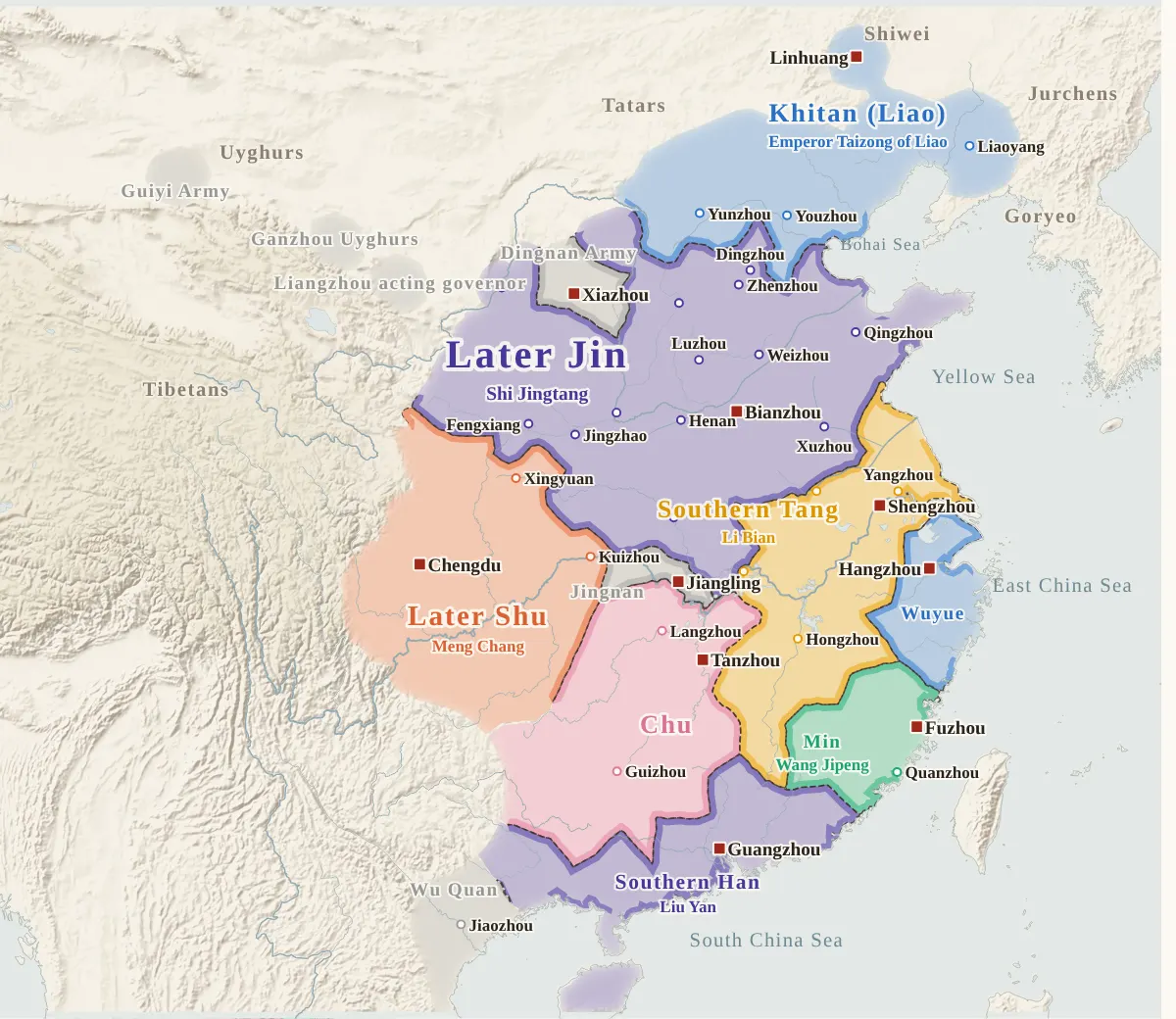
Emperors of the Later Jin dynasty 後晉
The emperors of Later Jin (936–947) in order of accession, from Shi Jingtang to Shi Chonggui.
- Emperors
- 2 emperors
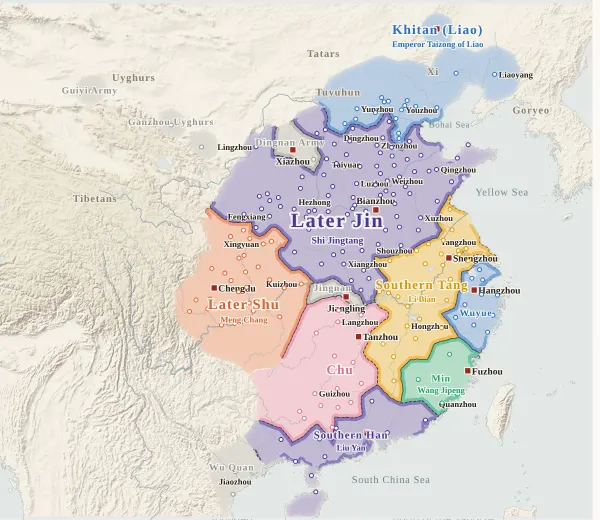
Rise and fall of the Later Jin dynasty
Rise
Shi Jingtang, the Military Commissioner of Hedong and a son-in-law of Li Siyuan of Later Tang, refused an order in 936 to move to another command, was besieged in Jinyang, and sought help from the Khitan. The Khitan ruler defeated the Later Tang army, and in the same year he had an altar built and set up Shi Jingtang as Emperor of the Great Jin. Shi Jingtang offered the Khitan the lands north of Yanmen and the land of Youzhou, and promised to send 300,000 bolts of silk every year.
Course
Early the next year, on the evening when Li Congke burned to death with his family in Luoyang, Shi Jingtang entered Luoyang. In 938 he made Bianzhou the Eastern Capital and set up Kaifeng Prefecture there. The Khitan ruler asked Shi Jingtang not to call himself a subject but only to style himself the son emperor, and Shi Jingtang thanked him with generous gifts of gold and silk.
When Shi Jingtang died in 942, his elder brother's son and adopted son Shi Chonggui succeeded to the throne. Following the counsel of Jing Yanguang, Shi Chonggui sent the Khitan a letter in which he called himself not a subject but a grandson, angering the Khitan ruler. In 944 Shi Chonggui himself led troops to rescue his own forces surrounded at Qicheng, and in 945 his generals crushed the Khitan army at Yangcheng.
Fall
Early in 947 Du Wei, Li Shouzhen and others surrendered to the Khitan, and Zhang Yanze, acting on Khitan orders, burst into the capital. Shi Chonggui was reduced to Marquis Fuyi and sent north to Huanglong Prefecture, and he was later moved to Jianzhou.
Translated from the Japanese text of this site, which is written from the official histories. Years are the Western calendar years of the dates, as in English reference works.