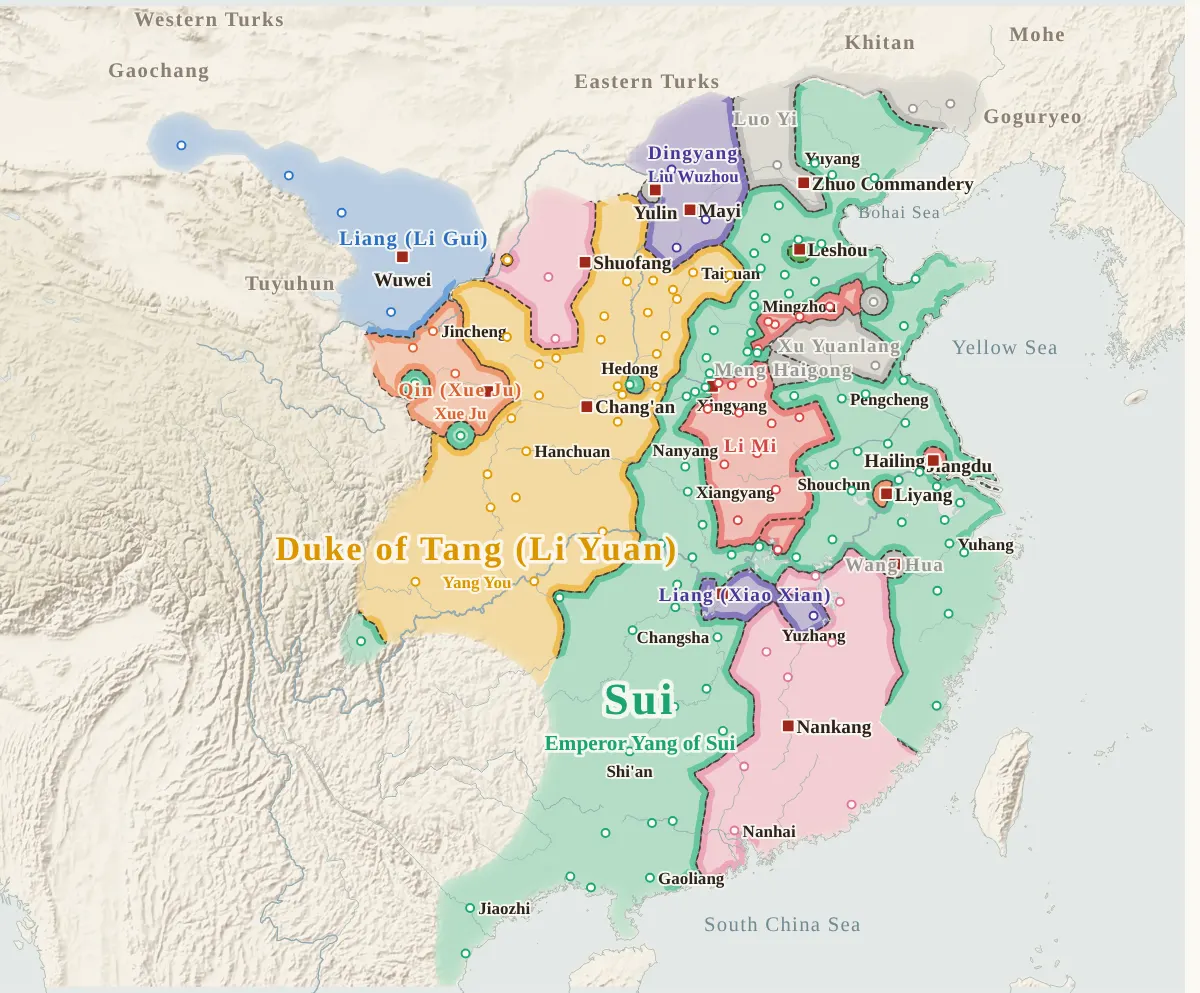
Emperors of Qin (Xue Ju) 秦
The emperors of Qin (Xue Ju) (617–618) in order of accession, from Xue Ju to Xue Rengao.
- Emperors
- 2 emperors
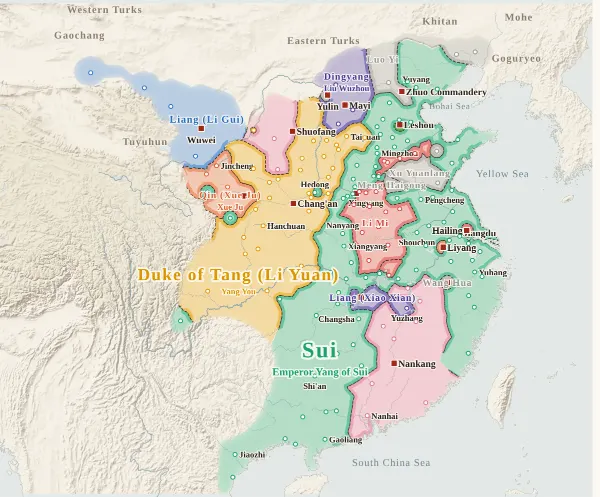
Rise and fall of Qin (Xue Ju)
Rise
At the end of the Sui, Xue Ju, a commandant of the Jincheng garrison, was given the task of suppressing bandits in 617, but together with his son Xue Rengao and others he seized Hao Yuan, the magistrate of Jincheng, raised troops, and called himself Hegemon King of Western Qin. Within the same year he took the title of emperor, and when Xue Rengao took Qinzhou, Xue Ju moved his capital from Lanzhou to Qinzhou.
Course
Having taken the commanderies of Longyou, Xue Ju was defeated by the army of Emperor Taizong of Tang at Fufeng and asked his ministers for a precedent of a Son of Heaven surrendering, but when Hao Yuan remonstrated with him, he made Hao Yuan his chief strategist. In 618 he struck the Tang army from behind near Gaozhi and inflicted heavy losses, but just before sending out troops to take Chang'an he fell ill and died. Xue Rengao, who succeeded him, had long been on bad terms with the generals, and when he took the throne everyone grew suspicious and afraid; the chief strategist Hao Yuan also took to his sickbed, and the strength of the army declined.
Fall
Taizong strengthened his fortifications at Gaozhi and did not move for a long time, and from the army of Xue Rengao, which could not keep up its supplies, some men went over to the Tang. When Taizong defeated Zong Luohou at Qianshuiyuan and closed in on Zhezhi City, Xue Rengao opened the gates and surrendered, and he was beheaded at Chang'an. Longxi passed to the Tang.
Translated from the Japanese text of this site, which is written from the official histories. Years are the Western calendar years of the dates, as in English reference works.