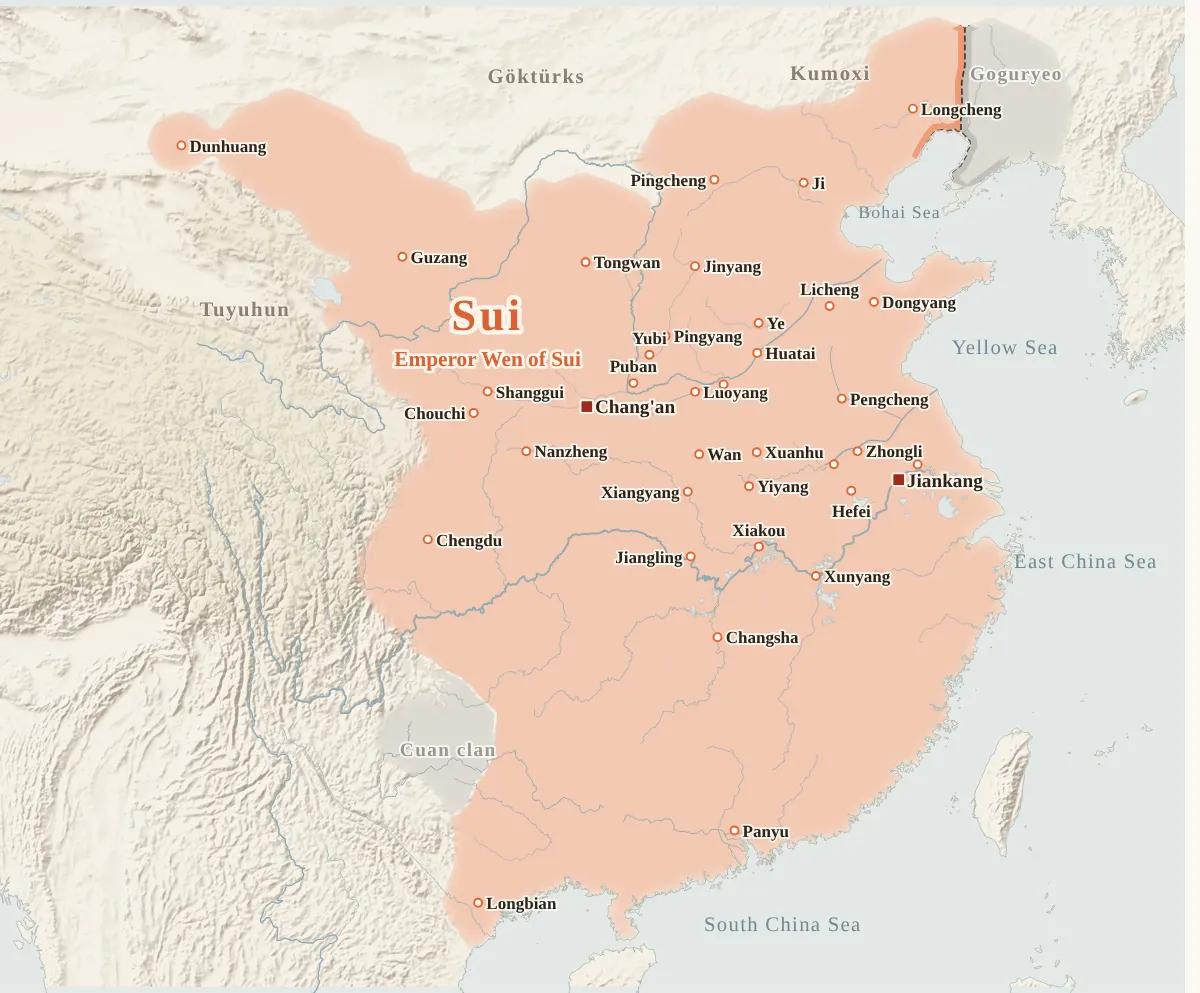
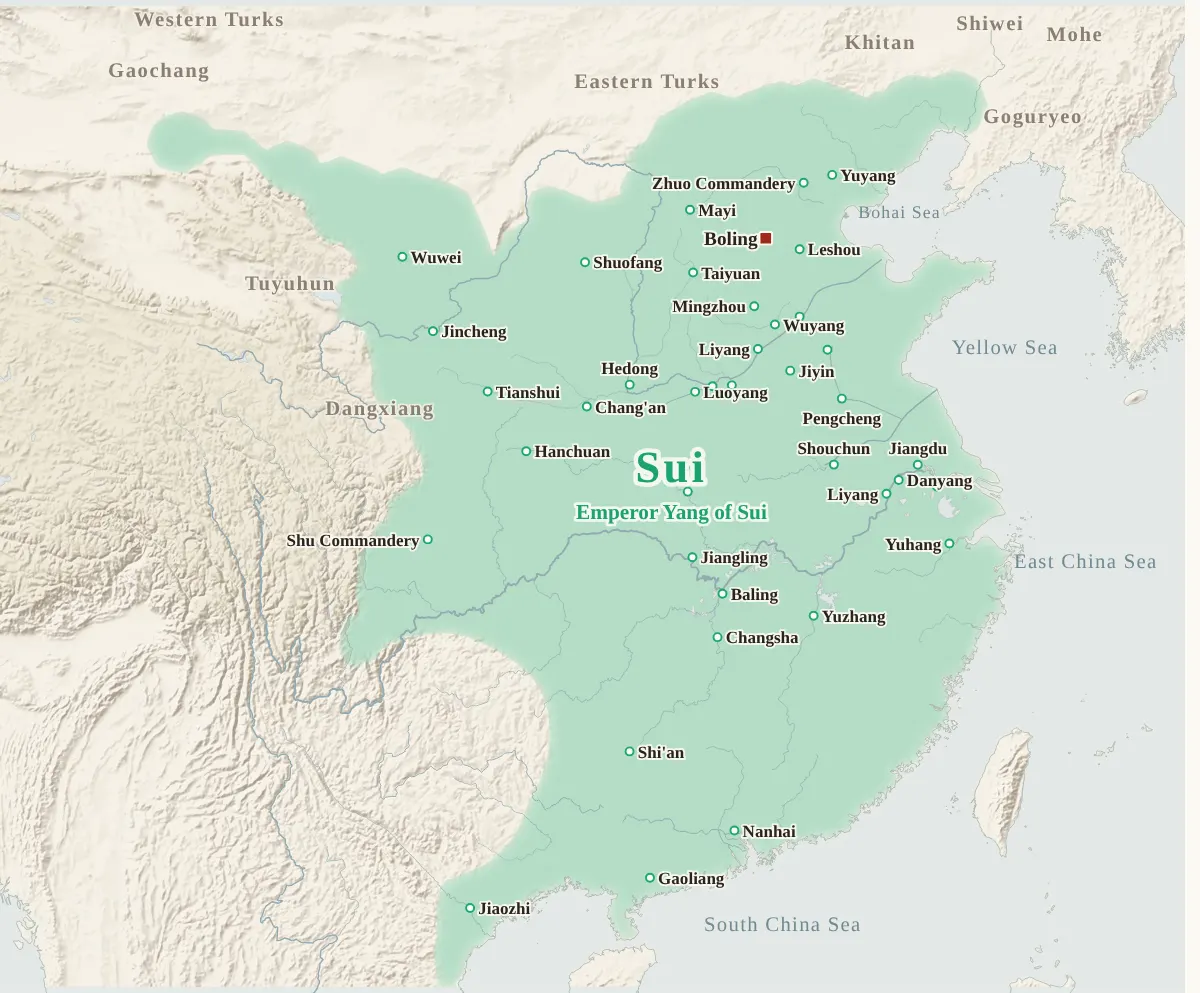
Emperors of the Sui dynasty 隋
The emperors of Sui (581–619) in order of accession, from Emperor Wen of Sui to Yang Hao, including Emperor Yang of Sui.
- Rulers
- 3 rulers
Rulers in order
- 1stEmperor Wen of Sui隋文帝 Suí Wéndì楊堅 Yáng Jiān581–604 · 23 years · Disputed, age 63581–60423 yearsDisputed, age 63
- 2ndEmperor Yang of Sui隋煬帝 Suí Yángdì楊廣 Yáng Guǎng604–618 · 13 years · Assassinated, age 48–49604–61813 yearsAssassinated, age 48–49
- 3rdYang You楊侑 Yáng Yòu617–618 · 176 days · Unknown, age 13–14617–618176 daysUnknown, age 13–14
- Yang Tong楊侗 Yáng Tóng618–619 · 335 days · Assassinated618–619335 daysAssassinated
- Yang Hao楊浩 Yáng Hào618 · 195 days · Assassinated618195 daysAssassinated
Rise and fall of the Sui dynasty
Rise
Emperor Wen of Sui, the founder of the Sui, was a relative of the imperial house by marriage, for his daughter had become the empress of Emperor Xuan of Northern Zhou. In 580, when Emperor Xuan died, Liu Fang and Zheng Yi forged an edict that placed Emperor Wen in charge of the government under the young Emperor Jing of Northern Zhou, and Emperor Wen put down the uprisings of Yuchi Jiong and others. In 581 Emperor Wen took the throne in the Linguang Hall, and he changed the official system of the Northern Zhou back to the old system of the Han and Wei.
Course
In 582, the next year, Emperor Wen had a new capital built on the land of Mount Longshou, because the city of Chang'an that had stood since the Han had fallen into decay, and he named it Daxing City. In 589 He Ruobi defeated the Chen army at Mount Jiang, and the army of Han Qinhu entered Jianye and captured Chen Shubao. In his testamentary edict Emperor Wen later stated that the realm, which had been divided for nearly 300 years since the Western Jin court was driven from its capital, had become one in his own reign, under the mandate he had received from Heaven. Emperor Wen lightened taxes and eased punishments, and he himself practised frugality, but he was deeply suspicious, put to death or dismissed many of the meritorious officials of the founding, and in his last years the law was harsh and he killed many.
In 600 the crown prince, Yang Yong, was reduced to commoner status, and Emperor Yang of Sui, then Prince of Jin, became crown prince. In 601, the next year, Emperor Wen kept only 70 students at the Guozixue and abolished the Taixue, the Simenxue, and the schools of the prefectures and counties. In 604 Emperor Wen died at the Renshou Palace, and Emperor Yang took the throne. In 605 Emperor Yang had an Eastern Capital built at Luoyang, called out more than a million people of Henan to dig the Tongji Canal, and in the same year went down to Jiangdu in a dragon boat. In 608 he called out more than a million people of Hebei to dig the Yongji Canal, which reached as far as Zhuo Commandery.
In 612 Emperor Yang gathered a great army at Zhuo Commandery and attacked Goguryeo, but nine armies under Yuwen Shu and others were defeated at the Sa River, and more than two thousand horsemen made it back. In 613, the next year, he also crossed the Liao River, but Yang Xuangan rebelled at Liyang and closed in on the Eastern Capital, and Emperor Yang turned his army back. In that year men in many places gathered followings of tens of thousands and became bandits, and in 614 some even raised up a Son of Heaven or called themselves Emperor-King. On the third expedition, in 614, Goguryeo asked to surrender, and Emperor Yang withdrew his troops. In time Emperor Yang moved to Jiangdu, leaving Luoyang in the keeping of his grandson Yang Tong, Prince of Yue, and others.
Fall
In 617 Emperor Gaozu of Tang, then Duke of Tang, entered Chang'an, honoured Emperor Yang as retired emperor, and set up Emperor Yang's grandson Yang You as emperor. In 618 Yuwen Huaji and others killed Emperor Yang at Jiangdu and set up Yang Hao, Prince of Qin, while at Luoyang Yuan Wendu and others set up Yang Tong. In the same year Yang You in Chang'an yielded the throne to Emperor Gaozu of Tang, then Prince of Tang, and Yuwen Huaji also killed Yang Hao and proclaimed himself emperor. At Luoyang Wang Shichong took real power, and in 619 he made Yang Tong yield the throne to him and soon afterwards had him killed.
Translated from the Japanese text of this site, which is written from the official histories. Years are the Western calendar years of the dates, as in English reference works.