Liu Wuzhou
Liu Wuzhou rose in arms at Mayi at the end of the Sui, was made Dingyang Qaghan by the Turks and proclaimed himself emperor, and for a time held Taiyuan, but after his defeat by the Tang he fled to the Turks, who killed him.
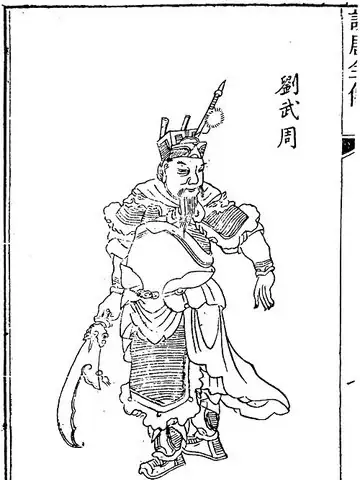
Facts
Liu Wuzhou reigned for 5 years (617–622) and was executed. 1st ruler of Dingyang.
- Reign
- April 617 – 28 August 622 (1st ruler of Dingyang)
- Length of reign
- 5 years
- Born
- Unknown
- Died
- 622
- Age at accession
- Unknown
- Age at death
- Unknown
- Cause of death
- ExecutedPut to death by a hostile power, a successor regime or a conqueror, as a public act
- Path to the throne
- Self-proclaimedFounded the titleClaimed the imperial title without receiving the throne from an earlier ruler (e.g. Emperor Gaozu of Han, Emperor Guangwu of Han, Hongwu Emperor)
- Era names
- 天興 Tiānxīng (proclaimed 617)
- Personal name
- 劉武周 Liú Wǔzhōu
- Wade–Giles
- Liu Wu-chou
Life
In brief
The historians' comment in the Old Book of Tang says that he began as a petty thief like a rat, by chance made a show of strength, and in the end was killed by the Turks.
Road to the throne
He came from Jingcheng in Hejian, and his father moved to Mayi. He was brave and fierce, a skilled archer, and kept company with knights-errant. His elder brother Shanbo repeatedly berated Wuzhou for not choosing whom he kept company with, and warned him that he would one day bring ruin on their clan. Wuzhou left home, answered the call for the Sui expedition to Liaodong, and was granted the rank of Jianjie Xiaowei. He was treated generously by Wang Rengong, the governor of Mayi, but he had an affair with one of Wang Rengong's maids, and fearing that it would come to light, and seeing the realm in disorder, he began to harbor disloyal designs. The Old Book of Tang, the New Book of Tang and the Zizhi Tongjian all write that Wuzhou roused the crowd to anger by spreading word that the governor kept the granaries shut and would not relieve the people (the New Book of Tang says it was the army that was angered), and the Zizhi Tongjian also says in its own narrative that Wang Rengong took bribes and failed to relieve the people. In 617 Wuzhou and his companions, among them Zhang Wansui, lay in wait for the governor, and while Wuzhou was presenting himself, Zhang Wansui came in from behind and beheaded Wang Rengong. Wuzhou opened the granaries to relieve the destitute, styled himself governor and submitted to the Turks. Together with the Turks he defeated Wang Zhibian of the Sui, and went on to take the Fenyang Palace. When the Turks made him Dingyang Qaghan, he proclaimed himself emperor and adopted Tianxing as his era name.
Reign and death
He made Song Jingang, who had taken refuge with him after a defeat, Prince of Song, entrusted him with military affairs and gave him half of his family property. Yuan Junzhang urged him not to march south but to come to terms with both the Turks and the Tang, but Wuzhou would not listen. In 619 Song Jingang defeated the Tang army, and when Yuanji, Prince of Qi, abandoned Jinyang and fled, Wuzhou occupied Taiyuan. In 620 Song Jingang was defeated by Li Shimin at the Queshu Valley and again at Jiezhou, and Yuchi Jingde and others surrendered to the Tang. Wuzhou, greatly afraid, abandoned Bingzhou and fled to the Turks. After his defeat, it is said, he wept that he regretted not having followed Yuan Junzhang's advice. He plotted to return to Mayi, but the plan was discovered and he was killed by the Turks. The annals of Gaozu in the Old Book of Tang place this in 620, but the number of years from his rising to his death given in his biography in the same Old Book of Tang agrees with 622 in the annals of Gaozu in the New Book of Tang.
Translated from the Japanese text of this site, which is written from the official histories. Years are the Western calendar years of the dates, as in English reference works. Months are omitted because the histories use the Chinese lunar calendar.
During the reign
Number of times each event is recorded in the official histories. How each item is counted
- Era name changes
- 1
- General amnesties
- 0
- Empresses installed
- 1
- Crown princes deposed
- 0
- Personal campaigns
- 2
- Rebellions suppressed
- 0
- Rebellions faced
- 0
- Capital relocations
- 0