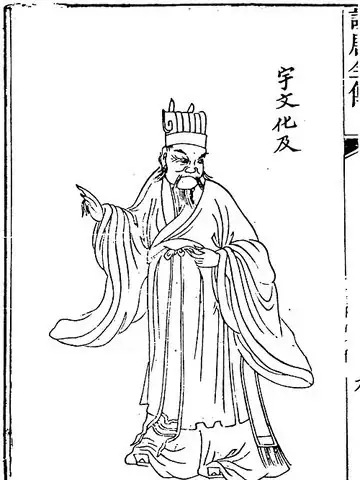
Yuwen Huaji
Yuwen Huaji was the son of the Sui grand general Yuwen Shu; he was put forward as leader of the rebellion at Jiangdu that killed Emperor Yang of Sui, later proclaimed himself emperor of Xu, and was captured and beheaded by Dou Jiande.
Facts
Yuwen Huaji reigned for 146 days (618–619) and was executed. 1st ruler of Xu.
- Reign
- 23 October 618 – 619 (1st ruler of Xu)
- Length of reign
- 146 days
- Born
- Unknown
- Died
- 619
- Age at accession
- Unknown
- Age at death
- Unknown
- Cause of death
- ExecutedPut to death by a hostile power, a successor regime or a conqueror, as a public act
- Path to the throne
- Self-proclaimedFounded the titleClaimed the imperial title without receiving the throne from an earlier ruler (e.g. Emperor Gaozu of Han, Emperor Guangwu of Han, Hongwu Emperor)
- Era names
- 天壽 Tiānshòu (proclaimed 618)
- Personal name
- 宇文化及 Yǔwén Huàjí
- Wade–Giles
- Yü-wen Hua-chi
Life
In brief
The historians' comment in the Book of Sui condemns him as a mediocre man of low talent who betrayed favour received over generations, and, setting him beside Wang Shichong, says that they seized on advantage to stir up disorder.
Road to the throne
According to the Book of Sui, he was vicious by nature and ignored the rules, and the people of Chang'an called him the frivolous young lord. In 618, Sima Dekan and others plotted a mutiny at Jiangdu, and Zhao Xingshu and Xue Liang proposed Huaji as its leader. When Huaji heard of it he was terrified and broke into a sweat, but after a while he calmed down. When he was fetched at dawn he trembled and could not speak, and Sima Dekan led him in to be styled Chancellor. The biography of Yuwen Huaji in the Book of Sui says that Huaji had Emperor Yang taken out and then brought back in, and had Linghu Xingda kill him, while the Zizhi Tongjian says that Huaji declared that Emperor Yang, whom Pei Qiantong had brought out, should be taken back quickly and finished off, and that, under Ma Wenju and others, Linghu Xingda strangled Emperor Yang with his own silk scarf. He killed the court officials who objected and set up Yang Hao, son of Prince Xiao of Qin, as emperor. After leaving Jiangdu he moved into the imperial harem and had himself provided for just as Emperor Yang had been; when people brought matters to him he sat silent without answering, and only after withdrawing did he decide them with his close associates.
Reign and death
On the way back west, Sima Dekan plotted to attack Huaji and make himself master, but the plot leaked, and Huaji had his younger brother Yuwen Shiji seize him. When Huaji demanded to know why he had turned against him, Sima Dekan retorted that Huaji, whom he had put forward, was even worse than Emperor Yang, and Huaji, without replying, had him strangled. He fought Li Mi at Liyang. According to the biography of Li Mi in the Book of Sui, when Li Mi denounced him for killing his sovereign, Huaji shouted, asking why Li Mi used bookish language when talking about killing each other, and Li Mi told his attendants that Huaji was mediocre and cowardly. After he fled to Wei County and his military strength waned, the brothers held one drinking feast after another; drunk, Huaji reproached his younger brother Yuwen Zhiji for having forced him into being set up, and wept holding his sons, and Zhiji retorted by asking why Huaji did not kill him and surrender. Lamenting that all men must die and asking whether he should not be emperor for even a single day, he poisoned Yang Hao, took the imperial throne, and named his state Xu. In 619, he was captured alive by Dou Jiande at Liaocheng and beheaded together with his two sons. As for where he was killed, the annals in the Old and New Books of Tang give Liaocheng, the Book of Sui gives Hejian, the History of the Northern Dynasties and the biographies of Dou Jiande in the Old and New Books of Tang give Dalu County, and the Zizhi Tongjian gives Xiangguo.
Translated from the Japanese text of this site, which is written from the official histories. Years are the Western calendar years of the dates, as in English reference works. Months are omitted because the histories use the Chinese lunar calendar.
During the reign
Number of times each event is recorded in the official histories. How each item is counted
- Era name changes
- 1
- General amnesties
- 0
- Empresses installed
- 0
- Crown princes deposed
- 0
- Personal campaigns
- 0
- Rebellions suppressed
- 0
- Rebellions faced
- 0
- Capital relocations
- 0