Zhu Can
Zhu Can rose from the bandit gangs of the late Sui to proclaim himself Emperor of Chu, led an army that ate human flesh as it ravaged one region after another, and was finally beheaded on the banks of the Luo River.
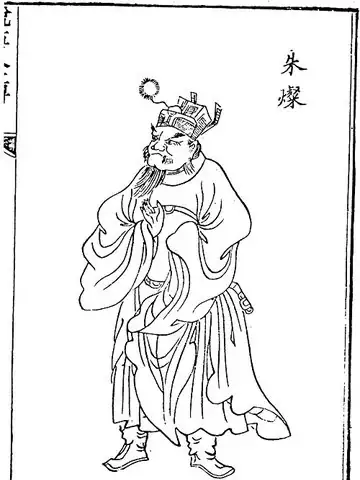
Facts
Zhu Can reigned for 141 days (618–619) and was executed. 1st ruler of Chu (Zhu Can).
- Reign
- November 618 – 22 March 619 (1st ruler of Chu (Zhu Can))
- Length of reign
- 141 days
- Born
- Unknown
- Died
- 5 June 621
- Age at accession
- Unknown
- Age at death
- Unknown
- Cause of death
- ExecutedPut to death by a hostile power, a successor regime or a conqueror, as a public act
- Path to the throne
- Self-proclaimedFounded the titleClaimed the imperial title without receiving the throne from an earlier ruler (e.g. Emperor Gaozu of Han, Emperor Guangwu of Han, Hongwu Emperor)
- Era names
- 昌達 Chāngdá (proclaimed 618)
- Personal name
- 朱粲 Zhū Càn
- Wade–Giles
- Chu Ts'an
Life
Road to the throne
He was a native of Chengfu in Bozhou and at first served as a county clerk. At the end of the Daye era he joined a campaign against the bandits of Mount Changbai, but then became a bandit himself, calling his band the Kedahan Bandits and styling himself King Garuda, and his followers came to number more than a hundred thousand. He was later defeated by the pacification commissioner Ma Yuangui, but he gathered his followers again, proclaimed himself Emperor of Chu at Guanjun, and adopted the era name Changda. The Zizhi Tongjian places this in 618, while the annals of Emperor Yang of Sui in the Book of Sui record it at the end of the eleventh year of Daye. The New Book of Tang places his claim to the title of Emperor of Chu before his defeat by Ma Yuangui.
Reign and death
He went on to attack Dengzhou. According to the biography of Lü Zizang in the Old Book of Tang, Lü Zizang, who was holding Nanyang, refused to surrender and died charging into the enemy, after which the city fell and Ma Yuangui was also killed. According to his biography in the Old Book of Tang, Zhu Can's army ate up the stores of each prefecture and county and then moved on, living by plunder rather than farming, so the people starved and turned to eating one another. When there was nothing left to seize, Zhu Can steamed and ate infants, told his soldiers that nothing tasted as fine as human flesh, had captured women and children boiled and shared out, and levied young boys and girls from the towns as a tax. The Zizhi Tongjian writes that Zhu Can taught his soldiers to boil women and infants and eat them. Lu Congdian and Yan Minchu of the Sui, whom he had taken in as guests, were also eaten along with their whole households when famine later struck. When Yang Shilin, a chieftain of Xianzhou, rebelled with others, Zhu Can was defeated, fled to Jutan, and sent to Tang asking to surrender. According to the Zizhi Tongjian, Tang made him Prince of Chu, but his biography in the Old Book of Tang does not mention this. In 619, Duan Que, who had been sent by Tang to welcome him, got drunk and asked what human flesh tasted like, and Zhu Can answered that a person fond of drink tasted like pork pickled in wine lees. When Duan Que railed that once Zhu Can went to court he would be nothing but a slave, Zhu Can took fright, seized Duan Que and several dozen of his attendants, and fled to Wang Shichong. The New Book of Tang and the Zizhi Tongjian write that he boiled Duan Que and the others and fed them to those around him; his biography in the Old Book of Tang does not say they were killed, but the annals of Emperor Gaozu of Tang in the same Old Book of Tang say that he killed Duan Que. In 621, when Tang pacified Luoyang, he was captured and beheaded on the banks of the Luo River. According to his biography in the Old Book of Tang, people hated his cruelty so much that they pelted his corpse with rubble, and it was soon heaped over like a burial mound.
Translated from the Japanese text of this site, which is written from the official histories. Years are the Western calendar years of the dates, as in English reference works. Months are omitted because the histories use the Chinese lunar calendar.
During the reign
Number of times each event is recorded in the official histories. How each item is counted
- Era name changes
- 1
- General amnesties
- 0
- Empresses installed
- 0
- Crown princes deposed
- 0
- Personal campaigns
- 1
- Rebellions suppressed
- 1
- Rebellions faced
- 1
- Capital relocations
- 0