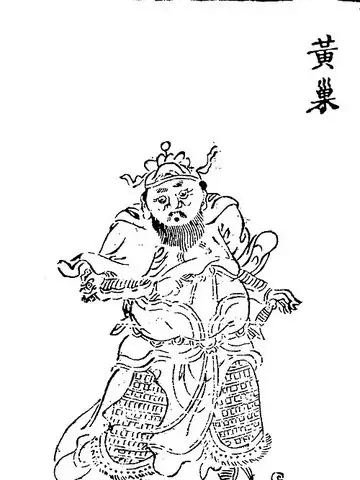
Huang Chao
He was a figure who rose from selling salt, led the great rebellion at the end of Tang, entered Chang'an, founded the Great Qi and proclaimed himself emperor, but was pursued by government forces and died at Langhu Valley.
Facts
Huang Chao reigned for 3 years (881–884); the age at death and cause of death are uncertain. 1st ruler of Qi (Huang Chao).
- Reign
- 16 January 881 – 13 July 884 (1st ruler of Qi (Huang Chao))
- Length of reign
- 3 years
- Born
- Unknown
- Died
- 13 July 884
- Age at accession
- Unknown
- Age at death
- Unknown
- Cause of death
- DisputedPrimary sources or accepted accounts conflict and cannot be narrowed to one
- Path to the throne
- Self-proclaimedFounded the titleClaimed the imperial title without receiving the throne from an earlier ruler (e.g. Emperor Gaozu of Han, Emperor Guangwu of Han, Hongwu Emperor)
- Era names
- 金統 Jīntǒng (proclaimed 881)
- Personal name
- 黃巢 Huáng Cháo
- Wade–Giles
- Huang Ch'ao
Life
In brief
The historians' comment in the Old Book of Tang appraises him as an insignificant and lowly man whose plans were not far-reaching.
Road to the throne
According to the biography in the New Book of Tang, his family had sold salt for generations and was wealthy, he was skilled at swordsmanship and mounted archery, and he liked to take in fugitives. In the Qianfu era, when Wang Xianzhi and others rose in revolt, Huang Chao, according to the biography in the New Book of Tang, gathered his kinsmen and several thousand men and joined Xianzhi. According to the same biography, when Wang Xianzhi alone was appointed to an office by edict and rejoiced, Huang Chao asked what would become of the five thousand men and struck Xianzhi, and Xianzhi, fearing the anger of his men, did not accept the appointment. As for how he came to be put forward as king, the biography in the Old Book of Tang has Huang Chao and his brothers joining Shang Rang and being put forward, while the biography in the New Book of Tang has Shang Rang leading the remaining followers to Huang Chao after Xianzhi's death and putting him forward. In 880 he took Luoyang, and after Emperor Xizong of Tang fled Chang'an by night, early in 881 he entered the capital, ascended the throne at Hanyuan Hall, and named his state the Great Qi. According to the biography in the New Book of Tang, he was welcomed by the palace women as King Huang and rejoiced that it might be heaven's will, but his followers began plundering within a few days and later did not obey even when an order forbidding wanton killing was issued.
Reign and death
In 883, when Li Keyong and others heavily defeated him at Weinan, Huang Chao fled to Guandong and for a long time besieged Chenzhou, where his favored general had been killed; the biography in the Old Book of Tang says a hundred days, while the Zizhi Tongjian says about three hundred days. In 884, defeated by Li Keyong and with his subordinate commanders surrendering one after another, Huang Chao, according to the biography in the New Book of Tang, grew suspicious and angry and often killed his senior generals. In the biography in the New Book of Tang, cornered at Langhu Valley, Huang Chao told his nephew Lin Yan that he had tried to punish the treacherous ministers of the state but that it was a mistake not to have withdrawn even after the deed was done, and said that if his head were taken and presented to the Son of Heaven, wealth and honor could be won. When Lin Yan could not bring himself to do it, Huang Chao cut his own throat but did not die, and Lin Yan cut off his head. The annals of the Old Book of Tang say that Lin Yan, fearing that the pursuers would kill him along with Huang Chao, cut Huang Chao down, while the Zizhi Tongjian says that Lin Yan cut him down and does not touch on his cutting his own throat. The Zizhi Tongjian Kaoyi sets the Xu Baoyun Lu, which has him cutting his own throat, alongside the annals and biographies of both Books of Tang, and follows the biography in the New Book of Tang. The table gives his cause of death as disputed, because one account has him cut his own throat and another has Lin Yan behead him.
Translated from the Japanese text of this site, which is written from the official histories. Years are the Western calendar years of the dates, as in English reference works. Months are omitted because the histories use the Chinese lunar calendar.
During the reign
Number of times each event is recorded in the official histories. How each item is counted
- Era name changes
- 1
- General amnesties
- 1
- Empresses installed
- 1
- Crown princes deposed
- 0
- Personal campaigns
- 1
- Rebellions suppressed
- 0
- Rebellions faced
- 0
- Capital relocations
- 0