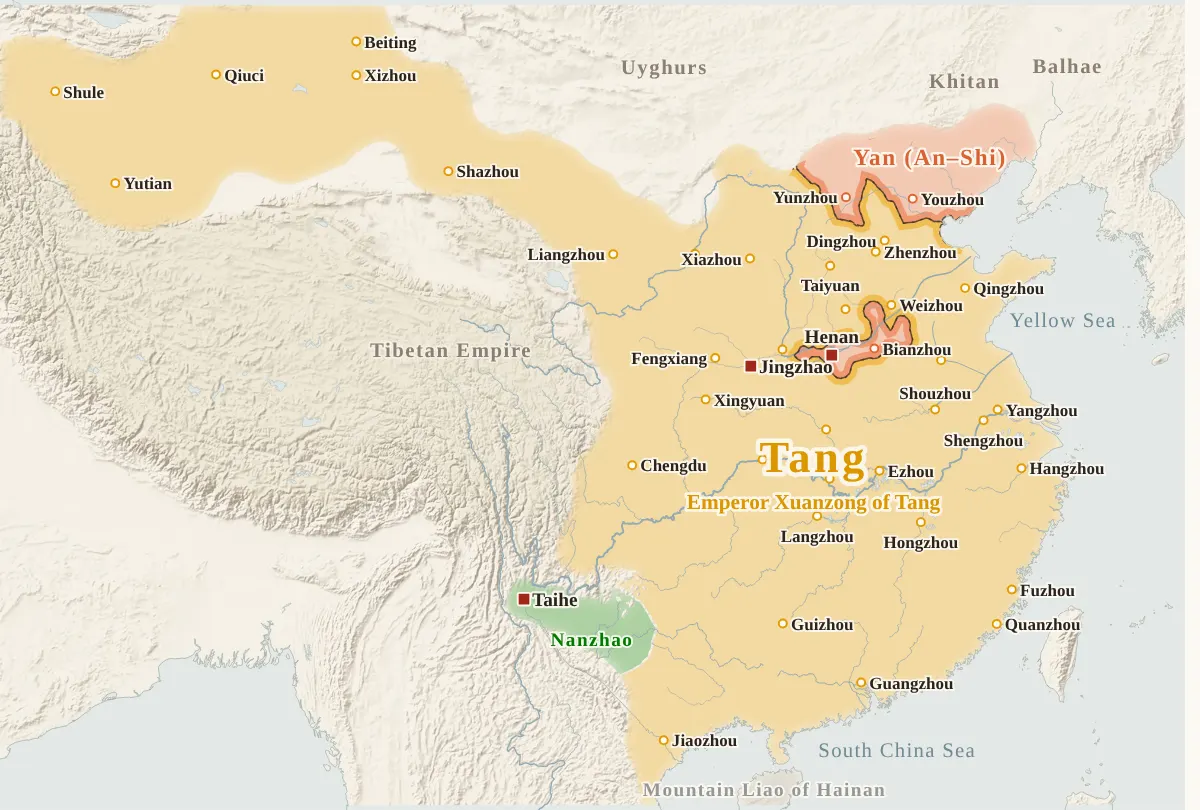
Emperors of Yan (An–Shi) 燕
The emperors of Yan (An–Shi) (756–763) in order of accession, from An Lushan to Shi Chaoyi.
- Emperors
- 4 emperors
Emperors in order
- 1stAn Lushan安祿山 Ān Lùshān756–757 · 355 days · Assassinated756–757355 daysAssassinated
- 2ndAn Qingxu安慶緒 Ān Qìngxù757–759 · 2 years · Assassinated757–7592 yearsAssassinated
- 3rdShi Siming史思明 Shǐ Sīmíng759–761 · 1 year · Assassinated759–7611 yearAssassinated
- 4thShi Chaoyi史朝義 Shǐ Cháoyì761–763 · 1 year · Disputed761–7631 yearDisputed
Rise and fall of Yan (An–Shi)
Rise
In 755 An Lushan, who was at Fanyang, raised troops, claiming to be moving against Yang Guozhong, and early in 756 he took Luoyang. In 756 An Lushan proclaimed himself emperor at Luoyang, naming his state Yan and his era Shengwu.
Course
In 757, through a plot of Yan Zhuang and An Qingxu, An Lushan was killed in his tent when the eunuch Li Zhu'er slashed his belly, and Yan Zhuang announced that the throne had been passed to An Qingxu. In the same year, when the army of Yan Zhuang was badly defeated by Emperor Daizong of Tang, then Prince of Guangping, and others, An Qingxu abandoned Luoyang and fled to Ye Commandery in Hebei. Shi Siming at Fanyang would not obey the orders of An Qingxu, and together with 80,000 troops he went over to the Tang for a time.
In 758, when the Tang surrounded Ye with the armies of nine military governors, An Qingxu asked Shi Siming for help and even offered to yield the throne to him. In 759 Shi Siming called himself king at Weizhou, and when the Tang armies besieging Ye were defeated and withdrew, he summoned An Qingxu, killed him, and took over his troops. Shi Siming then proclaimed himself emperor, naming his state Great Yan and his era Shuntian, gave Fanyang the name Yanjing, and in the same year also took Luoyang. In 761 Shi Siming, who had meant to make his youngest son crown prince, was strangled at Liuquan in a plot by officers to which his eldest son Shi Chaoyi had agreed, and Shi Chaoyi took the throne.
Fall
In 762 Emperor Dezong of Tang, then Prince of Yong, pressed on Luoyang together with Uyghur troops, and Shi Chaoyi, badly defeated north of Luoyang, fled east. In 763 Shi Chaoyi died while being pursued, and his head was sent to Chang'an. Li Huaixian, who had been a general of Yan, went over to the Tang with Youzhou, and Tian Chengsi with Weizhou.
Translated from the Japanese text of this site, which is written from the official histories. Years are the Western calendar years of the dates, as in English reference works.