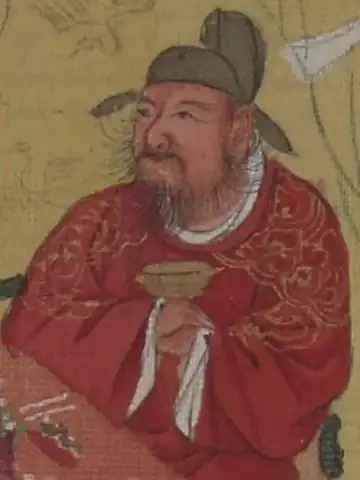
In brief
The appraisal in the New Book of Tang, treating him together with Shi Siming, judges that the killing of these two, subjects who turned against their lord, by their own sons was retribution coming round.
Road to the throne
According to the Old Book of Tang, his mother was a Turkic shaman who later became the wife of An Yanyan. Lushan too in time took the surname An. He was about to be beaten to death for stealing sheep, but Zhang Shougui, struck by the force of his words, let him go, and he later became Zhang's adopted son. He asked to become the adopted son of Yang Guifei, and in front of Emperor Xuanzong he bowed to the consort first, explaining that the Hu put their mothers first, which pleased Xuanzong. He was so fat that his belly hung down to his knees, yet when he danced the Huxuan whirling dance he was as fast as the wind. According to the New Book of Tang, when asked what was in his belly, he answered that there was nothing but a loyal heart. According to the Zizhi Tongjian, Yang Guifei wrapped Lushan in huge swaddling clothes and had palace women carry him about. Xuanzong, hearing from his attendants that the consort was giving the baby its third-day bath, went to look and was delighted. Lushan came and went in the palace and the scandal was heard outside, but Xuanzong did not suspect anything. This bathing story does not appear in either Book of Tang. He was repeatedly accused of plotting rebellion by Yang Guozhong, and in 755 he raised troops at Fanyang, claiming he would punish Yang Guozhong. At Chenliu, learning that his son An Qingzong had been killed by Tang, he had the surrendered soldiers killed in anger, and the dead number six or seven thousand in the Old Book of Tang and nearly 10,000 in the Zizhi Tongjian. He then took Luoyang.
Reign and death
In 756 he named his state Yan at Luoyang and adopted the era name Shengwu. The biography in the New Book of Tang says he called himself the Xiongwu Emperor and the Zizhi Tongjian the Emperor of Great Yan, but the annals of Xuanzong and the biography of An Lushan in the Old Book of Tang do not give him the title of emperor. According to the biography of Gao Shang in the Old Book of Tang, when the war reached a deadlock he grew angry with his advisers Gao Shang and others and kept them away, but when Tian Qianzhen talked him round he called them back and sang himself as he pressed wine on them. In 757 the eunuch Li Zhu'er went into his curtained bed and slashed Lushan's belly. In the Old Book of Tang, Yan Zhuang stood An Qingxu outside the door and went in with Zhu'er himself. In the New Book of Tang and the Zizhi Tongjian, Yan Zhuang held weapons with An Qingxu and guarded the outside. Lushan, who was blind, could not even take up his sword, and died crying out that it was a traitor in his own household.
Translated from the Japanese text of this site, which is written from the official histories. Years are the Western calendar years of the dates, as in English reference works. Months are omitted because the histories use the Chinese lunar calendar.