Shi Jingtang
He was the emperor who overthrew Later Tang with Khitan help and, after being invested by the Khitan, founded Later Jin.
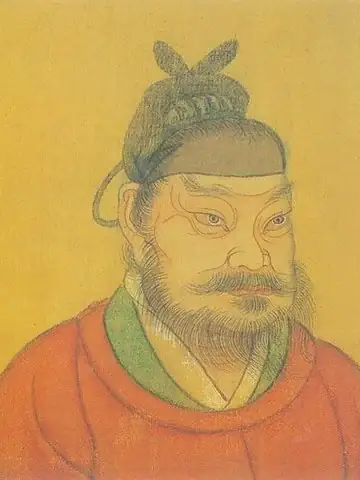
Facts
Shi Jingtang reigned for 5 years (936–942), taking the throne at 44, and died of natural causes at 50. 1st ruler of Later Jin.
- Reign
- 28 November 936 – 28 July 942 (1st ruler of Later Jin)
- Length of reign
- 5 years
- Born
- 30 March 892
- Died
- 28 July 942
- Age at accession
- 44
- Age at death
- 50
- Cause of death
- Natural causesNatural death or illness (including old age)
- Path to the throne
- Proclaimed by supportersFounded the titleDid not receive the throne from an earlier ruler, and did not claim it on their own initiative but was set up by others (e.g. the emperors of the Southern Ming)
- Successor
- Shi Chonggui
- Era names
- 天福 Tiānfú (proclaimed 936)
- Temple name
- 後晉高祖 Hòu Jìn Gāozǔ
- Personal name
- 石敬瑭 Shí Jìngtáng
- Wade–Giles
- Hou Chin Kao-tsu · Shih Ching-t'ang
Life
In brief
The historians' comment in the Old History of the Five Dynasties praises him for working hard at government, treating worthy men with courtesy and heeding remonstrance, but writes that because he received the help of a strong neighbor, the Khitan grew powerful and the people suffered calamity.
Road to the throne
He was born in Taiyuan in 892. According to the Old History of the Five Dynasties, he was calm and detached, and spoke and laughed little. Li Siyuan thought highly of him and gave him his daughter in marriage. In 934 he met Li Conghou, who had fled Luoyang, near Weizhou. Li Conghou's attendants tried to harm Shi Jingtang; the annals of Li Conghou in the Old History of the Five Dynasties and the annals of Jin in the New History of the Five Dynasties say that Shi Jingtang killed the men accompanying Li Conghou, the annals of Liu Zhiyuan in both books and the Zizhi Tongjian say that Liu Zhiyuan killed them, and Shi Jingtang's own annals in the Old History of the Five Dynasties say that he captured them. Shi Jingtang went away leaving Li Conghou behind, and Li Conghou was soon killed by Li Congke; Shi Jingtang's own annals write that he long felt ashamed of this afterward. In 936, when Li Congke of Later Tang ordered him to move to another command, he refused, and when Jinyang was besieged he asked the Khitan for help. Emperor Taizong of Liao defeated the Later Tang army, took Shi Jingtang by the hand and spoke of the bond between father and son. Invested by Taizong, he became emperor of the Great Jin. His own annals in the Old History of the Five Dynasties say that he presented the lands north of Yanmen together with Youzhou, while the New History of the Five Dynasties and the Zizhi Tongjian say that he ceded sixteen prefectures.
Reign and death
When Li Congke set a fire and died by his own hand, Shi Jingtang entered Luoyang that evening. According to the account of the Khitan in the Old History of the Five Dynasties, Taizong asked that Shi Jingtang neither call himself a subject nor submit memorials, but call himself only the son emperor. Shi Jingtang thanked him with generous gifts of gold and silk, and whenever he was rebuked he humbled himself to serve Taizong. In 942 illness made it hard for him to hold court. The Zizhi Tongjian places the start of his illness after he was rebuked by the Khitan and fell into worry and distress, while the Qidan Guozhi cited in the commentary of the Old History of the Five Dynasties says that this was what made him ill. According to the New History of the Five Dynasties, the Zizhi Tongjian and the Qidan Guozhi, from his sickbed he had his young son Chongrui bow to Feng Dao, and had a eunuch carry the boy and place him in Feng Dao's arms. After his death, the annals in the Old History of the Five Dynasties say that Shi Chonggui, the Prince of Qi, took the throne under Shi Jingtang's testamentary edict, while the New History of the Five Dynasties, the Zizhi Tongjian and the Qidan Guozhi say that the ministers deliberated on setting up an older ruler because the state faced many troubles, and the New History of the Five Dynasties says that Chongrui was not set up because Jing Yanguang had secretly promised to set up Shi Chonggui.
Translated from the Japanese text of this site, which is written from the official histories. Years are the Western calendar years of the dates, as in English reference works. Months are omitted because the histories use the Chinese lunar calendar.
During the reign
Number of times each event is recorded in the official histories. How each item is counted
- Era name changes
- 1
- General amnesties
- 4
- Empresses installed
- 0
- Crown princes deposed
- 0
- Personal campaigns
- 0
- Rebellions suppressed
- 9
- Rebellions faced
- 11
- Capital relocations
- 1