Emperors of the Northern Zhou dynasty 北周
The emperors of Northern Zhou (559–581) in order of accession, from Emperor Ming of Northern Zhou to Emperor Jing of Northern Zhou.
- Rulers
- 5 rulers
Rulers in order
- 1stYuwen Jue宇文覺557 · Did not take the title of emperor557Did not take the title of emperor
- 2ndEmperor Ming of Northern Zhou北周明帝 Běi Zhōu Míngdì宇文毓 Yǔwén Yù559–560 · 242 days · Assassinated, age 25–26559–560242 daysAssassinated, age 25–26
- 3rdEmperor Wu of Northern Zhou北周武帝 Běi Zhōu Wǔdì宇文邕 Yǔwén Yōng560–578 · 18 years · Natural causes, age 34–35560–57818 yearsNatural causes, age 34–35
- 4thEmperor Xuan of Northern Zhou北周宣帝 Běi Zhōu Xuāndì宇文贇 Yǔwén Yūn578–579 · 283 days · Natural causes, age 20–21578–579283 daysNatural causes, age 20–21
- 5thEmperor Jing of Northern Zhou北周靜帝 Běi Zhōu Jìngdì宇文闡 Yǔwén Chǎn579–581 · 1 year · Assassinated, age 7–8579–5811 yearAssassinated, age 7–8
Rise and fall of the Northern Zhou dynasty
Rise
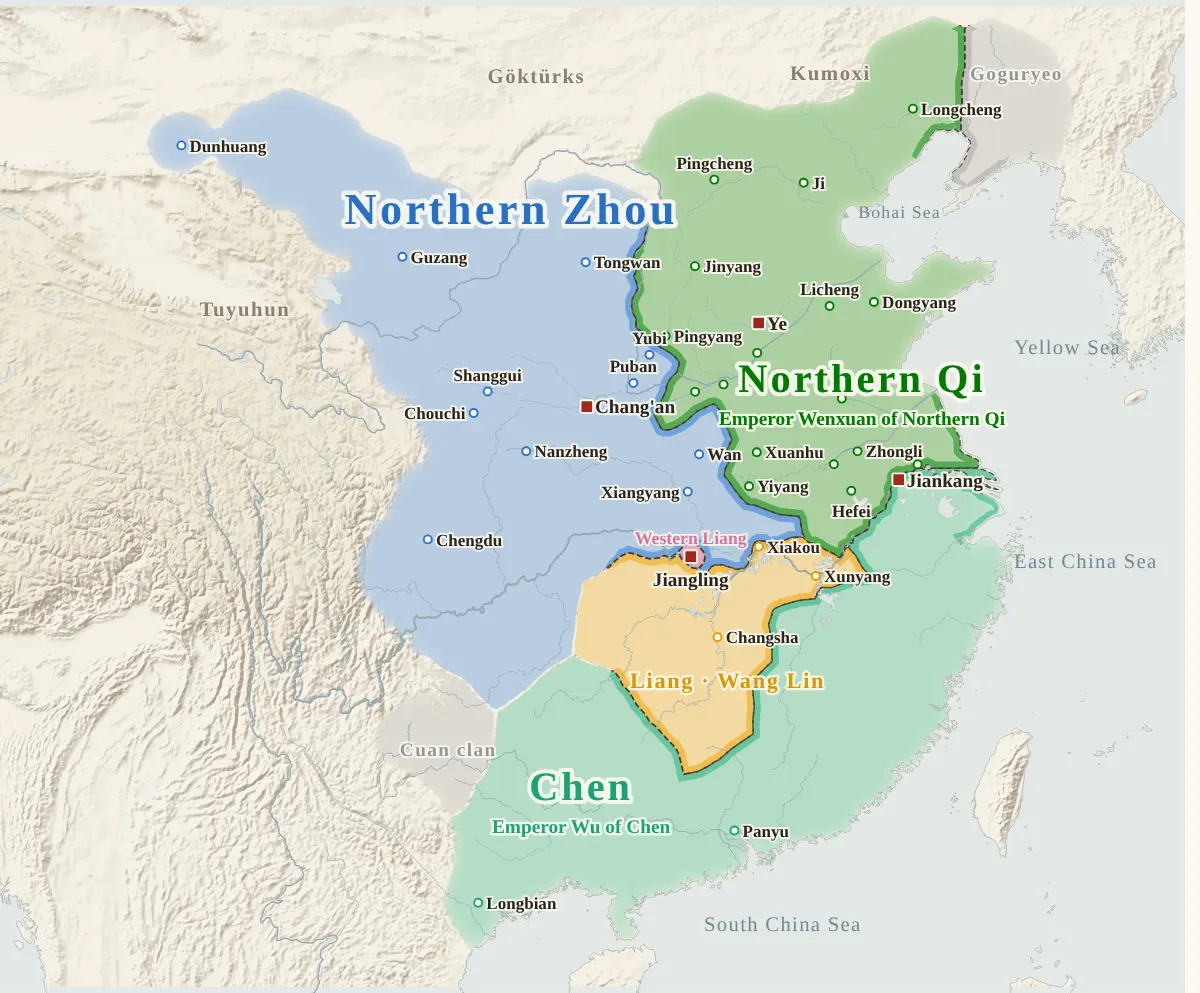
In 556 Yuwen Tai, who had held real power in Western Wei, died, and his son Yuwen Jue succeeded him as Grand Preceptor and Chief Minister, and early in 557 Yuwen Jue received the throne from Emperor Gong of Western Wei. Yuwen Jue then took the position of Heavenly King of Zhou in 557. Following the Rites of Zhou, Northern Zhou called its ruler Heavenly King rather than emperor, and it did not establish era names. Within that year Yuwen Hu deposed Yuwen Jue, whose elder brother, Emperor Ming of Northern Zhou, was brought in and became Heavenly King, and Yuwen Jue was killed soon afterwards. Later Cui You asked that the ruler be called emperor and that an era name be established, the court deliberations agreed, and in 559 Emperor Ming changed the title of Heavenly King to emperor.
Course
Real power over the government lay with Yuwen Hu, and although Emperor Ming began to rule in person in 559, Yuwen Hu still directed military affairs, and in 560 Emperor Ming was poisoned through his food and died. His younger brother and successor, Emperor Wu of Northern Zhou, hid his abilities while Yuwen Hu held power, and in 572 he struck Yuwen Hu down with his own hand and had him put to death, after which he began to rule in person. In 574 he abolished Buddhism and Daoism and made Buddhist monks and nuns and Daoist priests return to lay life.
From 575 Emperor Wu attacked Northern Qi in person, and after crushing the Northern Qi army in the decisive battle at Jinzhou early in 577, he took Ye in the same year and captured Gao Wei of Northern Qi, who had fled. Emperor Wu then set out north in person to attack the Turks, but in 578 he fell ill at the Yunyang Palace and died in his carriage on the way back to the capital.
His successor, Emperor Xuan of Northern Zhou, put his uncle Yuwen Xian to death, and in 579 he began building the Luoyang Palace, always keeping forty thousand people at work on it, and he passed the throne to the young Emperor Jing of Northern Zhou and styled himself Emperor Tianyuan. In 580, as Emperor Xuan lay dying, Liu Fang and Zheng Yi forged an edict and installed Yang Jian, the empress's father, to assist in the government. Yang Jian directed the officials as Grand Chancellor of the Left.
Fall
In the same year Yuchi Jiong at Xiangzhou, Sima Xiaonan at Yunzhou and Wang Qian at Yizhou rose in arms one after another but were defeated, and members of the imperial clan such as the Princes of Zhao and Yue were also put to death for plotting to remove Yang Jian, who held the government. In 581 Yang Jian, who had become Prince of Sui, took the imperial throne as Emperor Wen of Sui, and Emperor Jing withdrew to a separate palace and was made Duke of Jie, and he died within the same year.
Translated from the Japanese text of this site, which is written from the official histories. Years are the Western calendar years of the dates, as in English reference works.