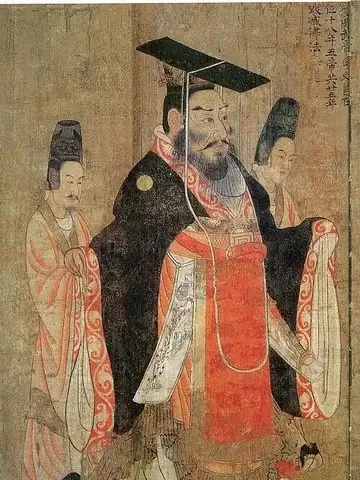
In brief
The annals in the Book of Zhou say that he lived simply and stood in the battle lines himself in war, and also write that his use of the law was harsh, that he put many to death, and that he showed little kindness.
Road to the throne
In 560 his elder brother Emperor Ming of Northern Zhou, near death from poison, named his younger brother, Emperor Wu, as successor in his testamentary edict, saying that his own sons were too young. The biography of Yuwen Hu says it was Yuwen Hu who had the poison given. Emperor Wu took the throne after declining it firmly. Real power lay with Yuwen Hu. According to the biography of Yuwen Xiaobo, the emperor kept Yuwen Xiaobo, with whom he had studied the classics, at his side on the pretext that they wished to learn from each other, and Yuwen Hu had no suspicions. The assessment at the end of the annals writes that he hid his abilities so that no one could gauge how deep they ran.
Reign and death
In 572, as Yuwen Hu was reading the Jiugao aloud to the emperor's mother, Empress Dowager Chinu, the emperor struck him down from behind with a jade tablet, and the emperor's younger brother Yuwen Zhi, Prince of Wei, who had been in hiding, cut Yuwen Hu down. When his mother died in 574, he ate only a little rice, walked barefoot to the tomb at the burial, and observed three years of mourning even though he was urged not to. The same year he abolished Buddhism and Daoism and returned monks, nuns and Daoist priests to lay life. His younger brother Yuwen Zhi rose in arms in the capital but was defeated and made a commoner, and according to the biography of Yuwen Zhi, Prince of Wei, he was later put to death along with his sons for again harbouring disloyal designs. On his personal campaign of 575 he fell ill and withdrew his army. Early in 577, before the decisive battle at Jinzhou, he rode around the lines calling out the names of the commanders, and when he was asked to change to another horse, he replied by asking where he would be going if he alone rode a fine horse. After the siege of Jinzhou was lifted, according to the biography of Liang Shiyan, he was about to turn back but gave way when Liang Shiyan remonstrated with him, and according to the annals, when his generals asked to withdraw as he entered Jinzhou and pressed the pursuit, he told them that if they had doubts he would go on alone. Later in 577 Emperor Wu took Ye. Gao Wei, the Later Ruler of Northern Qi, fled to Qingzhou and was captured by the Northern Zhou pursuers. Anxious about the crown prince, the future Emperor Xuan of Northern Zhou, he treated him strictly and beat him whenever he did wrong. According to the biography of Wang Gui, he nodded in agreement when Wang Gui lamented the weakness of the emperor's heir, but his other sons were either without talent or young, and he could not act on that advice. In 578, during a northern campaign against the Turks, he fell ill, took Yuwen Xiaobo by the hand and entrusted him with affairs after his death, and died in his carriage on the way back to the capital.
Translated from the Japanese text of this site, which is written from the official histories. Years are the Western calendar years of the dates, as in English reference works. Months are omitted because the histories use the Chinese lunar calendar.