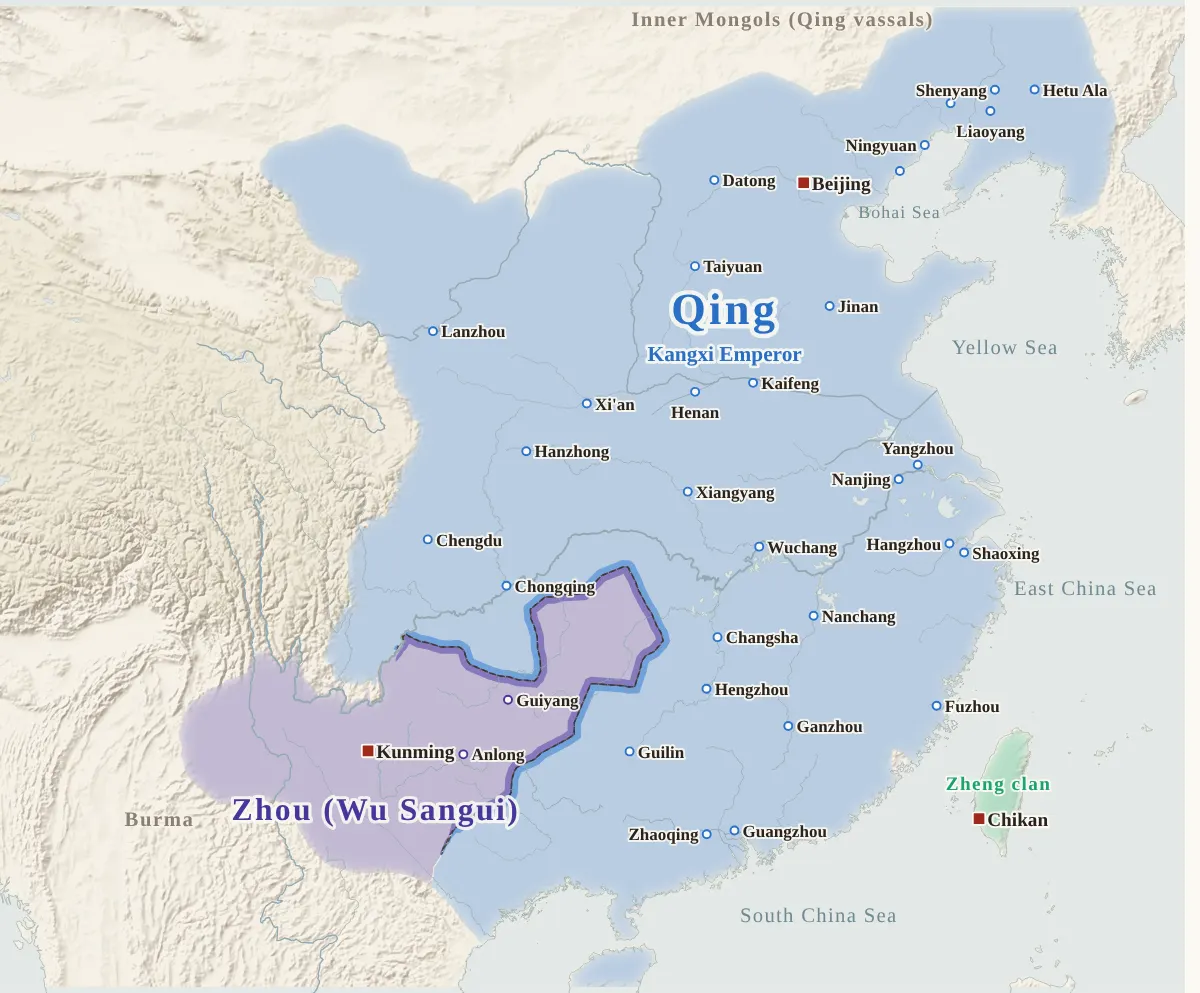
Emperors of Zhou (Wu Sangui) 周
The emperors of Zhou (Wu Sangui) (1678–1681) in order of accession, from Wu Sangui to Wu Shifan.
- Emperors
- 2 emperors
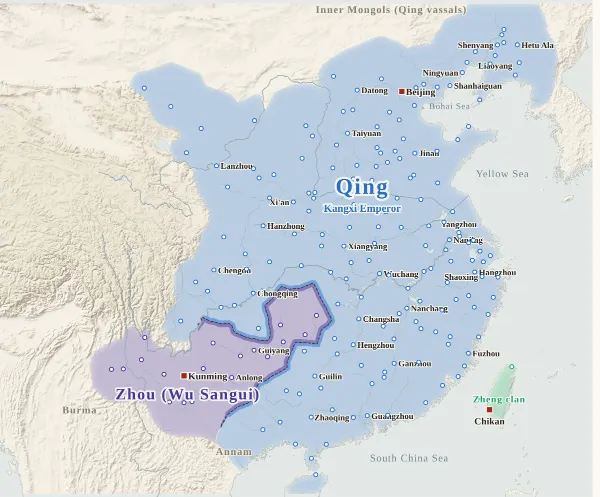
Rise and fall of Zhou (Wu Sangui)
Rise
Wu Sangui, who was guarding Ningyuan as a regional commander of the Ming, welcomed the Qing armies in 1644 and defeated Li Zicheng's army, and the Qing made him the Prince of Pingxi. Later stationed in Yunnan as one of the Three Feudatories, Wu Sangui was granted his request to move his fief in 1673, whereupon he killed the governor of Yunnan, Zhu Guozhi, raised troops and called himself the Prince of Zhou, and in 1678 he declared himself emperor at Hengzhou.
Course
At the start of the uprising, revolts in support of him broke out one after another in Sichuan, Guangxi, Fujian and elsewhere, but Wu Sangui did not adopt plans such as crossing the Yangtze and heading north, and instead faced the Qing army across the Yangtze at Songzi. By 1678, six years after he had raised troops, his territory was shrinking day by day and his reinforcements were dwindling day by day.
Wu Sangui died of illness the same year. His grandson Wu Shifan was set up as emperor by his subordinates and took the era name Honghua.
Fall
In 1680, as the Qing armies closed in on Guiyang, Wu Shifan fled back to Yunnan, and the next year, 1681, when Kunming was besieged, Ma Bao and Xia Guoxiang, whom he had called back, also surrendered to the Qing. When Xian Yu and others inside the city plotted to seize Wu Shifan and surrender, he took his own life, and Kunming surrendered to the Qing. Wu Sangui's remains were later broken up and shown throughout the realm.
Translated from the Japanese text of this site, which is written from the official histories. Years are the Western calendar years of the dates, as in English reference works.