Wu Sangui
He was the emperor of Zhou (Wu Sangui) who opened the Shanhai Pass and let in the Qing armies, and later raised the Revolt of the Three Feudatories and declared himself emperor.
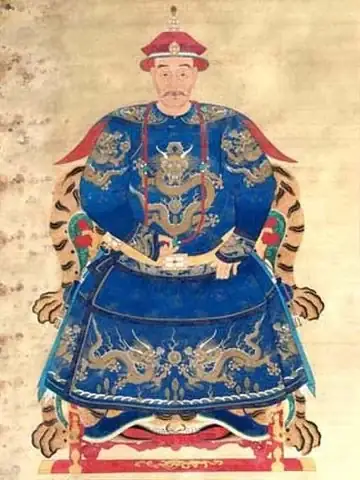
Facts
Wu Sangui reigned for 193 days (1678), taking the throne at 65 or 66, and died of natural causes at 65 or 66. 1st ruler of Zhou (Wu Sangui).
- Reign
- 23 March 1678 – 2 October 1678 (1st ruler of Zhou (Wu Sangui))
- Length of reign
- 193 days
- Born
- 1612
- Died
- 2 October 1678
- Age at accession
- 65–66
- Age at death
- 65–66
- Cause of death
- Natural causesNatural death or illness (including old age)
- Path to the throne
- Self-proclaimedFounded the titleClaimed the imperial title without receiving the throne from an earlier ruler (e.g. Emperor Gaozu of Han, Emperor Guangwu of Han, Hongwu Emperor)
- Successor
- Wu Shifan
- Era names
- 昭武 Zhāowǔ (proclaimed 1678)
- Chinese name
- 周昭武帝 Zhōu Zhāowǔdì
- Personal name
- 吳三桂 Wú Sānguì
- Wade–Giles
- Chou Chao-wu-ti · Wu San-kuei
Life
Road to the throne
After his father Wu Xiang, a regional commander of Ming, was thrown into prison, he was promoted to regional commander and guarded Ningyuan. The Wu Ni Qu Wang Lu writes that he was steady and bold. In the Battle of Songshan in 1641 he was defeated by the Qing armies; his biography in the Draft History of Qing says that he withdrew his troops at night, while the biography of Cao Bianjiao in the History of Ming says that he fled after Wang Pu and that, though liable to beheading, he was only demoted. According to his biography in the Draft History of Qing, when Li Zicheng took Beijing in 1644 he was summoned by a letter from his father, handed over the pass, and headed west, but when he heard at Luanzhou that his concubine Lady Chen had been seized he turned back, drove off the defending general, and sought reinforcements from the Qing. The biography of Li Zicheng in the History of Ming and the Xiaotian Jinian write that at this time he meant to surrender. The name Chen Yuanyuan and the line about anger that raised the cap for a fair face are in neither the Draft History of Qing nor the History of Ming; the Xiaotian Jinian records both Yuanyuan's name and the anger at Luanzhou, but says that the biographies about how he got Yuanyuan rely on a poem by Wu Weiye. On the day he defeated Li Zicheng together with the Qing armies he was made the Prince of Pingxi, but Li Zicheng killed his father and his family.
Reign and death
Early in 1662, when he appeared before the Yongli Emperor, who had been handed over, according to the Xiaotian Jizhuan and other works he bent his knees and could not stand, but the Draft History of Qing does not record this scene. Later in 1662, according to the Draft History of Qing and the Xiaotian Jinian, he had the Yongli Emperor and his son strangled with a bowstring, while the Wu Ni Qu Wang Lu says that he ordered his generals to present silk, and that the crown prince and the others all hanged themselves. In 1673, expecting to be urged to stay, he asked to move his fief, but the Kangxi Emperor granted it, saying that he would rebel whether it was withdrawn or not, and Wu Sangui was greatly disappointed. The same year he killed the governor of Yunnan, Zhu Guozhi, raised troops, and called himself the Prince of Zhou. In 1674, when his son Wu Yingxiong was executed, according to the annals of the Draft History of Qing, Wu Sangui said that the sovereign was young and yet had been able to do this, and that the matter was settled. In 1678, according to his biography in the Draft History of Qing, amid his decline he sought to console himself with the imperial title, and his subordinates urged him on, and he declared himself emperor and changed the era name to Zhaowu. Soon after he fell ill and summoned his grandson Wu Shifan, but died before Shifan arrived. The discussion in the Draft History of Qing laments that if Wu Sangui and the others had obeyed the decree and disbanded their garrisons, they would have been preserved. In 1681 his grandson Wu Shifan killed himself and Zhou (Wu Sangui) fell, and the next year his remains were broken up and shown throughout the realm.
Translated from the Japanese text of this site, which is written from the official histories. Years are the Western calendar years of the dates, as in English reference works. Months are omitted because the histories use the Chinese lunar calendar.
During the reign
Number of times each event is recorded in the official histories. How each item is counted
- Era name changes
- 1
- General amnesties
- 0
- Empresses installed
- 0
- Crown princes deposed
- 0
- Personal campaigns
- 0
- Rebellions suppressed
- 0
- Rebellions faced
- 0
- Capital relocations
- 0
Emperors of Zhou (Wu Sangui)
- 1stWu Sangui周昭武帝 Zhōu Zhāowǔdì · 吳三桂 Wú Sānguì1678 · 193 days · Natural causes, age 65–661678193 daysNatural causes, age 65–66
- 2ndWu Shifan周洪化帝 Zhōu Hónghuàdì · 吳世璠 Wú Shìfán1678–1681 · 3 years · Suicide (incl. forced), age 14–151678–16813 yearsSuicide (incl. forced), age 14–15