Emperors of the Qing dynasty 清
The emperors of Qing (1636–1912) in order of accession, from Hong Taiji to Puyi, including Kangxi Emperor and Qianlong Emperor.
- Rulers
- 12 rulers
Rulers in order
- 1stNurhaci愛新覺羅努爾哈赤1616–1626 · Did not take the title of emperor1616–1626Did not take the title of emperor
- 2ndHong Taiji清太宗 Qīng Tàizōng愛新覺羅皇太極 Àixīnjuéluó Huángtàijí1636–1643 · 7 years · Unknown, age 501636–16437 yearsUnknown, age 50
- 3rdShunzhi Emperor順治帝 Shùnzhì Dì愛新覺羅福臨 Àixīnjuéluó Fúlín1643–1661 · 17 years · Natural causes, age 221643–166117 yearsNatural causes, age 22
- 4thKangxi Emperor康熙帝 Kāngxī Dì愛新覺羅玄燁 Àixīnjuéluó Xuányè1661–1722 · 61 years · Natural causes, age 681661–172261 yearsNatural causes, age 68
- 5thYongzheng Emperor雍正帝 Yōngzhèng Dì愛新覺羅胤禛 Àixīnjuéluó Yìnzhēn1722–1735 · 12 years · Disputed, age 561722–173512 yearsDisputed, age 56
- 6thQianlong Emperor乾隆帝 Qiánlóng Dì愛新覺羅弘曆 Àixīnjuéluó Hónglì1735–1796 · 60 years · Natural causes, age 871735–179660 yearsNatural causes, age 87
- 7thJiaqing Emperor嘉慶帝 Jiāqìng Dì愛新覺羅顒琰 Àixīnjuéluó Yóngyǎn1796–1820 · 24 years · Natural causes, age 591796–182024 yearsNatural causes, age 59
- 8thDaoguang Emperor道光帝 Dàoguāng Dì愛新覺羅旻寧 Àixīnjuéluó Mínníng1820–1850 · 29 years · Natural causes, age 671820–185029 yearsNatural causes, age 67
- 9thXianfeng Emperor咸豐帝 Xiánfēng Dì愛新覺羅奕詝 Àixīnjuéluó Yìzhǔ1850–1861 · 11 years · Natural causes, age 301850–186111 yearsNatural causes, age 30
- 10thTongzhi Emperor同治帝 Tóngzhì Dì愛新覺羅載淳 Àixīnjuéluó Zàichún1861–1875 · 13 years · Natural causes, age 181861–187513 yearsNatural causes, age 18
- 11thGuangxu Emperor光緒帝 Guāngxù Dì愛新覺羅載湉 Àixīnjuéluó Zàitián1875–1908 · 33 years · Assassinated, age 371875–190833 yearsAssassinated, age 37
- 12thPuyi宣統帝 Xuāntǒng Dì愛新覺羅溥儀 Àixīnjuéluó Pǔyí1908–1912; restored 1917 · 3 years · Natural causes, age 611908–1912; restored 19173 yearsNatural causes, age 61
Rise and fall of the Qing dynasty
Rise
In 1616 Nurhaci took the throne and named his state Jin (Later Jin); in 1618 he announced seven grievances to Heaven and attacked the Ming, in 1621 he took Shenyang and Liaoyang, and in 1625 he moved his capital to Shenyang. In 1626 Hong Taiji succeeded to the throne after Nurhaci's death, and in 1636 he changed the name of the state to the Great Qing and accepted the honorific title of emperor. In 1644, after Li Zicheng took Beijing, Dorgon entered through the Shanhai Pass, which Wu Sangui had opened, and defeated Li Zicheng's army, and the Shunzhi Emperor fixed his capital at Yanjing.
Course
The emperors of the Southern Ming fell one after another, and the last of them, the Yongli Emperor, was killed by Wu Sangui in Yunnan in 1662. In 1681 the Kangxi Emperor put down the Revolt of the Three Feudatories, which had begun when Wu Sangui rebelled in 1673; in 1683 he brought Taiwan to submission, and in 1689 he fixed the border with Russia at Nerchinsk. The Yongzheng Emperor began the rule of sealing the name of the heir and placing it behind the Zhengda Guangming plaque, and he created the post of Grand Councillor. The Qianlong Emperor subdued the Dzungars in 1755 and Huibu in 1759, and in 1773 he had the Siku Quanshu compiled.
In the reign of the Jiaqing Emperor, who received the throne from the Qianlong Emperor in 1796, adherents of a religious sect took up arms in Hubei from the month of his accession. In the reign of the Daoguang Emperor, in 1839 Lin Zexu made the British merchants hand over their opium and burned it; the next year, 1840, British forces took Dinghai, and under a treaty in 1842 the Qing ceded Hong Kong and allowed trade at five ports. In the reign of the Xianfeng Emperor, Hong Xiuquan, who had proclaimed the Taiping Heavenly Kingdom, took Jiangning in 1853, and in 1860 British and French troops closed in on Beijing and burned the Yuanmingyuan. In the reign of the Tongzhi Emperor, two empresses dowager governed from behind the screen, and in 1864 the government armies took Jiangning.
In 1895, in the reign of the Guangxu Emperor, the Qing, defeated in a war with Japan, recognized the independence of Korea by treaty and ceded Taiwan, Penghu and other lands. In 1898 the Guangxu Emperor began reforms, but the same year Empress Dowager Cixi again took up the direction of the government and the arrest of Kang Youwei was ordered, and in 1900 the allied armies of eight nations took Beijing.
Fall
In 1911, when the New Army at Wuchang went over to the revolutionaries, one province after another declared independence, and representatives of the provinces who gathered in Shanghai elected a provisional president and set up a government of the Republic of China in Nanjing. In 1912 the move to a republic was announced by order of the empress dowager of the time and Puyi abdicated, keeping the title of emperor in return for giving up political power. Puyi had to leave the palace in 1924, and in 1934 he took the throne as emperor of Manchukuo.
Translated from the Japanese text of this site, which is written from the official histories. Years are the Western calendar years of the dates, as in English reference works.
Qing year by year on the map
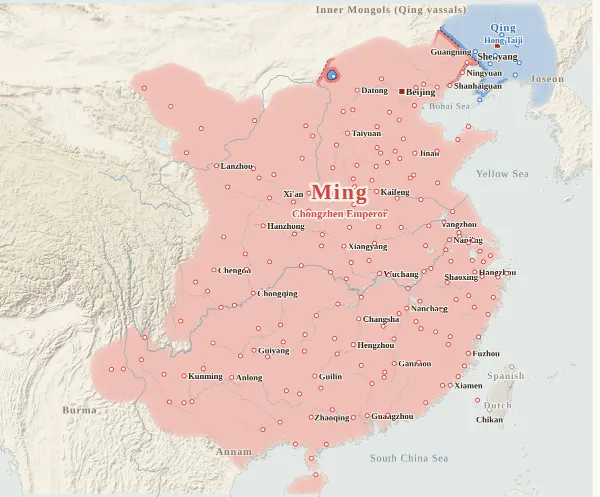
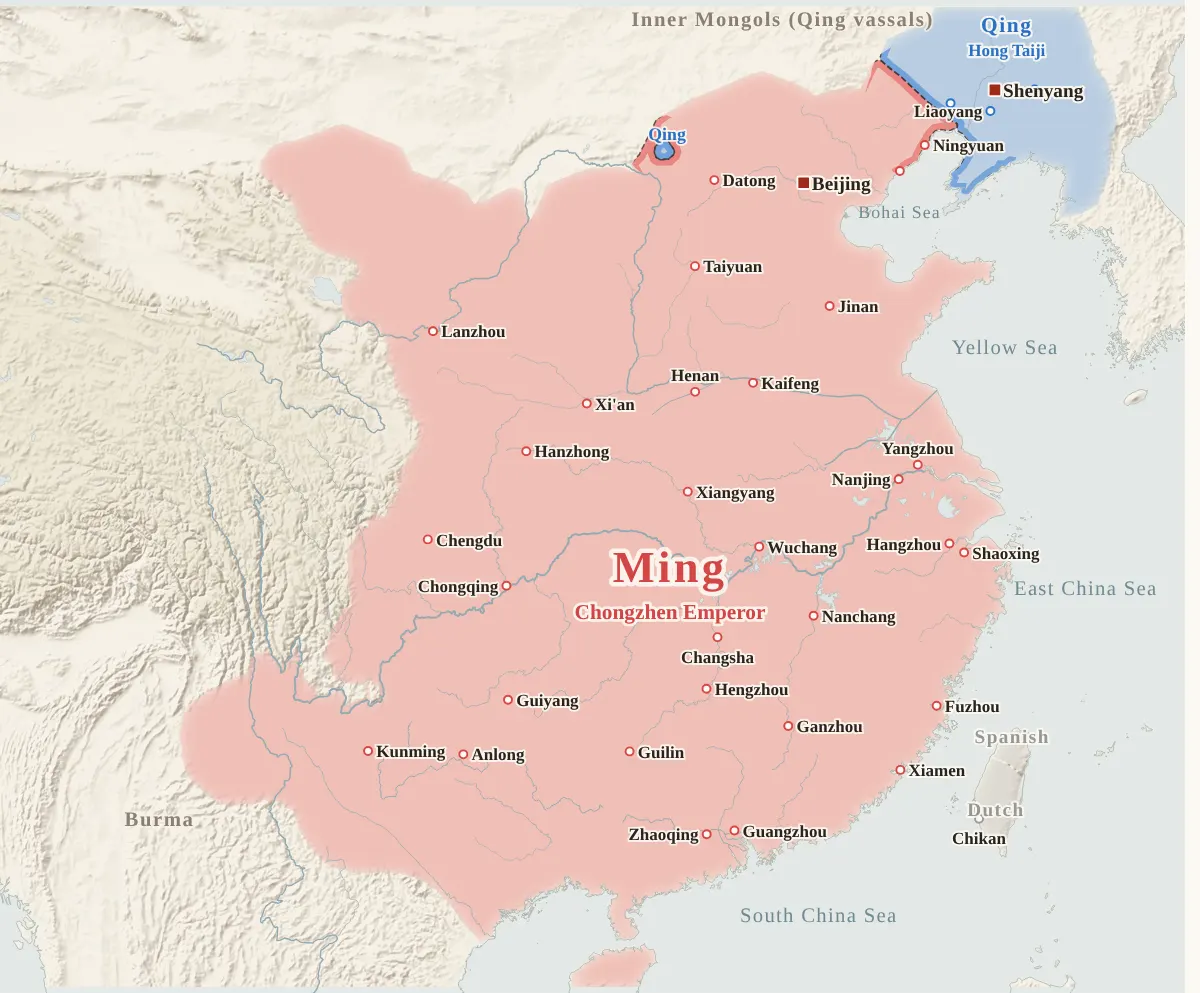 Map of the Ming–Qing Transition1636–1683 · move year by year and see who held each city
- 1636The state is renamed Qing
- 1644Li Zicheng takes Beijing; the Qing enter the Pass
- 1645Nanjing falls
- 1646Longwu dies; Yongli takes the throne
- 1659Yongli flees to Burma
- 1661Zheng Chenggong takes Taiwan
- 1673Revolt of the Three Feudatories
- 1681The Three Feudatories revolt ends
- 1683The Zheng surrender to the Qing
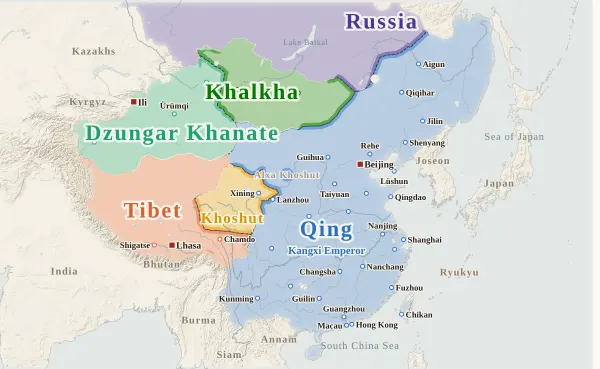
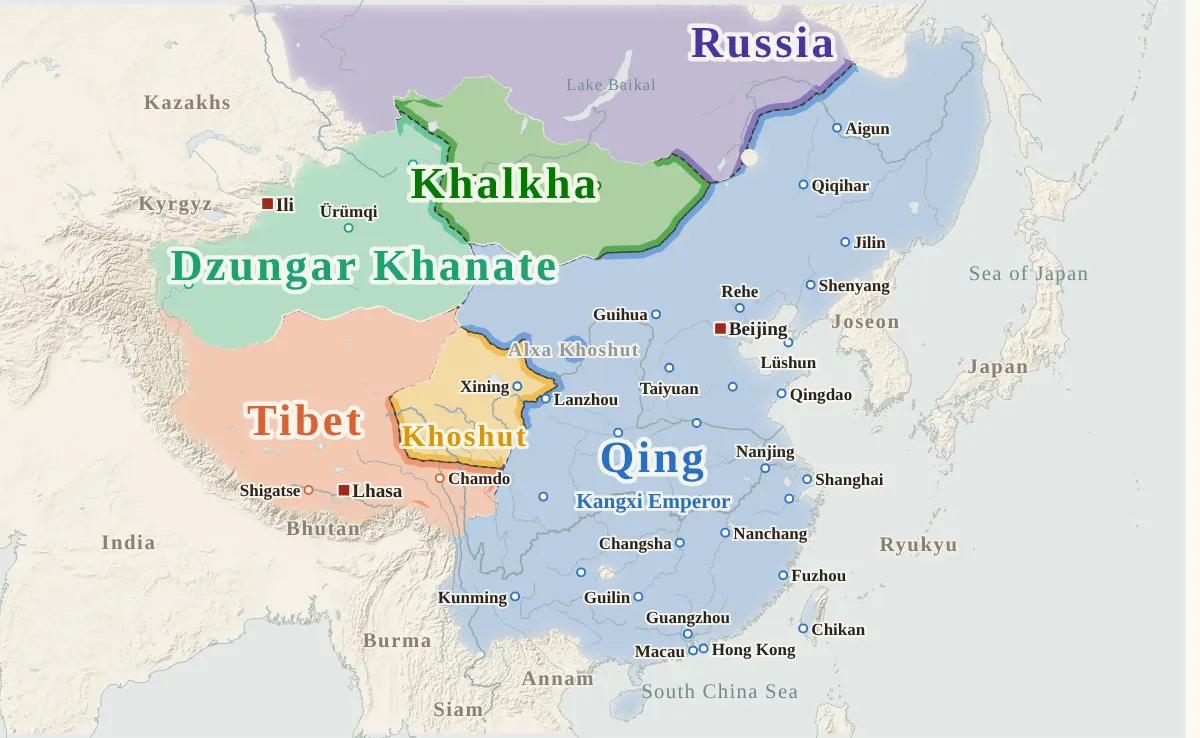 Map of the Qing Dynasty1684–1911 · move year by year and see who held each city
- 1688Galdan invades Khalkha
- 1691Dolon Nor assembly
- 1720Qing troops enter Lhasa
- 1757The Dzungar Khanate destroyed
- 1759The Muslim cities of the Tarim Basin conquered
- 1842Treaty of Nanking; Hong Kong Island to Britain
- 1853The Taiping make Nanjing their capital
- 1860Convention of Peking; the Ussuri coast to Russia
- 1864Fall of the Taiping capital
- 1871Russia occupies Ili
- 1877Fall of Yaqub Beg
- 1895Treaty of Shimonoseki; Taiwan to Japan
- 1898Leased territories of the foreign powers
- 1900The Eight-Nation Alliance enters Beijing
- 1911Xinhai Revolution