Yao Chang
A Qiang general who served Fu Jian of Former Qin, he broke away after the Battle of the Fei River, killed Fu Jian, and founded Later Qin.
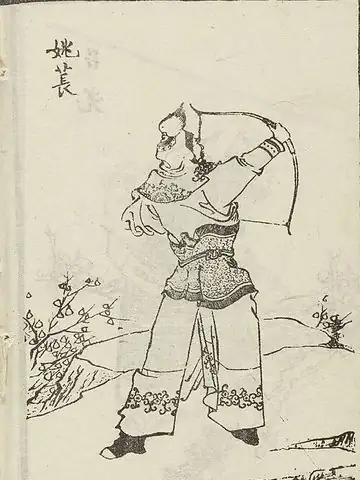
Facts
Yao Chang reigned for 7 years (386–393), taking the throne at 55 or 56, and died of natural causes at 62 or 63. 1st ruler of Later Qin.
- Reign
- May 386 – December 393 (1st ruler of Later Qin)
- Length of reign
- 7 years
- Born
- Unknown
- Died
- December 393
- Age at accession
- 55–56
- Age at death
- 62–63
- Cause of death
- Natural causesNatural death or illness (including old age)
- Path to the throne
- Self-proclaimedFounded the titleClaimed the imperial title without receiving the throne from an earlier ruler (e.g. Emperor Gaozu of Han, Emperor Guangwu of Han, Hongwu Emperor)
- Successor
- Yao Xing
- Era names
- 建初 Jiànchū (proclaimed 386)
- Posthumous name
- 後秦武昭帝 Hòu Qín Wǔzhāodì
- Temple name
- 後秦太祖 Hòu Qín Tàizǔ
- Personal name
- 姚萇 Yáo Cháng
- Wade–Giles
- Hou Ch'in Wu-chao-ti · Yao Ch'ang
Life
In brief
The historians' comment in the Book of Jin says that he rallied the many strongmen and expanded a hegemon's realm, and that in treacherous scheming he stood first among the wicked; it grants that planting trees to mark a new camp could be called an achievement, but asks how inhumane it was to humiliate his former lord by laying him on thorns.
Road to the throne
He was the twenty-fourth son of Yao Yizhong, and his elder brother Yao Xiang judged that he might one day raise their clan to greatness. When Yao Xiang was defeated at Matian and lost his horse, Yao Chang gave him his own, saying that so long as his elder brother got away, the whelps would never dare harm Yao Chang himself. After Yao Xiang's death he led his younger brothers in submitting to Former Qin, and under Fu Jian he won repeated merit as a general. After the defeat at the Fei River, Fu Rui, who had gone out on a punitive campaign, was killed in battle, and when Fu Jian put to death the envoy sent to apologize, Yao Chang fled north of the Wei River and in 384 took the title Wannian King of Qin. Yang Bi and others who had been captured were treated with courtesy and sent back, but at Xinping he tricked the governor, Gou Fu, into leaving the city by promising to let him go home, and then buried alive the men and women who came out with him. In 385, when he asked the captured Fu Jian for the Heirloom Seal of the Realm, Fu Jian berated him, saying that the Qiang had no place in the order of the Five Hu, and refused to abdicate as well, and Yao Chang strangled him in a Buddhist temple at Xinping, according to the chronicle of Fu Jian in the Book of Jin. The chronicle of Yao Chang does not record this, while the Zizhi Tongjian adds that Yao Chang, wishing to hide his name, gave Fu Jian the posthumous title Heavenly King Zhuanglie. In 386 he took the imperial throne at Chang'an.
Reign and death
He dug up Fu Jian's corpse, flogged it, and buried it on a bed of thorns. During a heavy snowfall he blamed himself, turned the treasures of the inner palace over to military use, and ate only one dish himself. According to the chronicles in the Book of Jin, he was repeatedly defeated by Fu Deng, and he prayed to an image of Fu Jian that the guilt lay with his elder brother Yao Xiang, but he still could not win, so he cut off the image's head and sent it to Fu Deng. He sometimes berated his ministers to their faces, and when Quan Yi remonstrated with him he replied that this was his nature, but that without hearing honest words he could not know his faults. When he fell ill and summoned the crown prince, Yao Xing, to his camp, Xing came only after putting Xu Cheng and others to death, and Yao Chang was angered that Xing had killed famous generals of former days on his own authority. According to the chronicle in the Book of Jin, when his illness worsened he dreamed that Fu Jian attacked him at the head of ghost soldiers, and he blurted out that it was his elder brother Yao Xiang who had killed His Majesty, but the Zizhi Tongjian's account of his death does not include this. He died at Chang'an after entrusting his affairs to his leading ministers; the Book of Jin places this in 393, but in the Shiliuguo Chunqiu and the Zizhi Tongjian it may already have fallen in 394.
Translated from the Japanese text of this site, which is written from the official histories. Years are the Western calendar years of the dates, as in English reference works. Months are omitted because the histories use the Chinese lunar calendar.
During the reign
Number of times each event is recorded in the official histories. How each item is counted
- Era name changes
- 1
- General amnesties
- 1
- Empresses installed
- 1
- Crown princes deposed
- 0
- Personal campaigns
- 3
- Rebellions suppressed
- 4
- Rebellions faced
- 5
- Capital relocations
- 0
Emperors of Later Qin
- 1stYao Chang後秦武昭帝 Hòu Qín Wǔzhāodì · 姚萇 Yáo Cháng386–393 · 7 years · Natural causes, age 62–63386–3937 yearsNatural causes, age 62–63
- 2ndYao Xing後秦文桓帝 Hòu Qín Wénhuándì · 姚興 Yáo Xīng394–399 · 5 years · Natural causes, age 49–50394–3995 yearsNatural causes, age 49–50
- 3rdYao Hong姚泓 Yáo Hóng416–417 · 1 year · Executed, age 28–29416–4171 yearExecuted, age 28–29