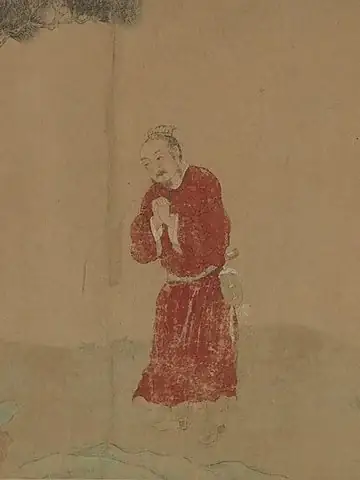
Road to the throne
Before he was sold, while wandering as a refugee, he told Guo Jing of his hunger and cold, and Guo Jing wept and gave him food and clothing. During a famine in Bing Province Hu people were sold off, and Shi Le too became a slave, but his master Shi Huan, struck by his unusual looks, set him free. When he joined the uprising of Gongshi Fan, he was given the surname Shi and the given name Le by Ji Sang, and he later served Liu Yuan. When he meant to kill Shi Hu, who was doing harm in the army, his mother stopped him, saying that a fast ox often breaks the cart while it is still a calf. Later, about to bury surrendered soldiers alive, he recognized Guo Jing there, took his hand and wept, and spared all the surrendered soldiers. He made a surprise attack on You Province and captured Wang Jun, then broke with Liu Yao, and in 319 took the title King of Zhao. At a banquet in Xiangguo for the elders of his home town of Wuxiang, he summoned Li Yang, with whom he had once come to blows, saying it was only a grudge from his days without rank, and he took Li Yang by the arm, laughed, and gave him an office. Both works record that he had scholars read books aloud to him, but the chronicle of Shi Le in the Book of Jin says he loved learning, while the Zizhi Tongjian says he did not study. When he heard of Li Yiji's plan in the Book of Han, Shi Le was startled and said that it would lead to failure. In 329 he took the field himself and defeated Liu Yao at Luoyang, and in 330 he took the imperial throne.
Reign and death
He was about to behead Xu Xian, who had remonstrated against building a palace at Ye, but when Xu Guang remonstrated with him he halted the work and rewarded Xu Xian, and later, when huge logs washed up, he took it as the will of Heaven and had the palace at Ye built. He laughed at Xu Guang's words that he was second only to the Yellow Emperor as going too far, and said that had he met Emperor Gaozu of Han he would have served him as a subject, and had he met Emperor Guangwu of Han he would have contended with him in the Central Plain, but that he would not take the realm by deceiving orphans and widows as Cao Cao and Sima Yi had done. Cheng Xia urged him to do away with Shi Hu early, and Xu Guang also argued that Shi Hu would become a calamity after his death, but he heeded neither of them; he did, however, have the crown prince review the memorials of the Department of State Affairs, and no one came to Shi Hu's gate any longer. When he fell gravely ill, Shi Hu forged orders to keep the crown prince Shi Hong and others away from him, and his testamentary edict warned Shi Hu to think carefully on the examples of the Duke of Zhou and Huo Guang. The chronicle of Shi Le in the Book of Jin places his death in 332, while the annals of Emperor Cheng of Jin in the same work and the Zizhi Tongjian place it in 333, and his body was buried at night in a mountain valley, its location unknown.
Translated from the Japanese text of this site, which is written from the official histories. Years are the Western calendar years of the dates, as in English reference works. Months are omitted because the histories use the Chinese lunar calendar.