Murong De
Murong De was the youngest son of Murong Huang of Former Yan, and he broke away from Later Yan, which was being driven back by Northern Wei, to found Southern Yan.
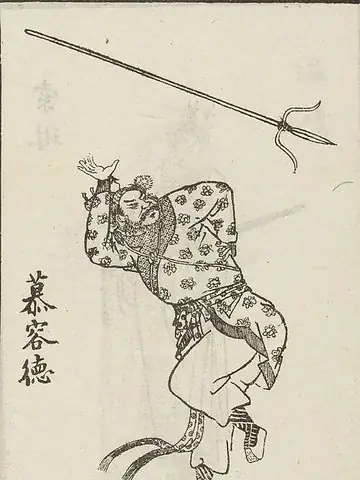
Facts
Murong De reigned for 5 years (400–405), taking the throne at 63 or 64, and died of natural causes at 68 or 69. 1st ruler of Southern Yan.
- Reign
- 400 – 405 (1st ruler of Southern Yan)
- Length of reign
- 5 years
- Born
- Unknown
- Died
- 405
- Age at accession
- 63–64
- Age at death
- 68–69
- Cause of death
- Natural causesNatural death or illness (including old age)
- Path to the throne
- Self-proclaimedFounded the titleClaimed the imperial title without receiving the throne from an earlier ruler (e.g. Emperor Gaozu of Han, Emperor Guangwu of Han, Hongwu Emperor)
- Successor
- Murong Chao
- Era names
- 建平 Jiànpíng (proclaimed 400)
- Posthumous name
- 南燕獻武帝 Nán Yàn Xiànwǔdì
- Temple name
- 南燕世宗 Nán Yàn Shìzōng
- Personal name
- 慕容德 Mùróng Dé
- Wade–Giles
- Nan Yen Hsien-wu-ti · Mu-jung Te
Life
In brief
In 400 he took the imperial throne at Guanggu, and in 405 he named his elder brother's son Murong Chao crown prince and died. The historians' comment in the Book of Jin faults him for taking the throne while his sovereign was still alive, and praises him for honoring Confucian learning and inviting frank advice.
Road to the throne
His elder brother and his own sons were put to death by Fu Chang of Former Qin, but his elder brother's pregnant wife was rescued by a prison official whom Murong De had once spared from a death sentence, and she gave birth to Murong Chao. In 397, when Murong Bao fled to Ji, Murong De did not take an imperial title, and the next year he moved to Huatai and proclaimed a first year of his own reign. The Zizhi Tongjian and his biography in the Book of Wei say that he took the title King of Yan. When Murong Bao fled south toward him, he meant to go out to meet him but was opposed by Zhang Hua. In tears, he sent off Muyu Hu, who had asked to go and learn how things stood with Bao, but Bao had already fled. Murong De had Zhao Si, an envoy who refused to serve him, beheaded. When Northern Wei took Huatai from him, he followed the advice of Pan Cong and advanced south toward Guanggu. He reproached and then killed Zhang Ying, an adjutant of Pilü Hun who had written an insolent proclamation, but according to the Shiliuguo Chunqiu he pardoned a son of Hun's who asked to die with his father, calling him filial. In 400 he took the imperial throne in the southern suburb and changed the era name to Jianping.
Reign and death
He set up educational offices and chose 200 students for the Imperial Academy, and later he gathered the students together and presided over their examination in person. At a banquet he asked which ruler of antiquity he could be compared to; he told Ju Zhong, who answered that he was of the same kind as Emperor Guangwu of Han, that he had rewarded him with empty words, and when Han Fan admonished that ruler and ministers had both erred, he was delighted and rewarded him. He defended Du Hong, an envoy who asked for a stipend for his aged father, as loyal and filial at heart, and when Du Hong was killed he treated his wife and children generously. When he learned of the deaths of his mother and elder brother he vomited blood and fell ill, and Murong Da took the opportunity to rebel, but Murong De entered the palace and put Da's confederates to death, and Da fled to Northern Wei. Having no son, he named Murong Chao, the son born to his elder brother after his brother's death, crown prince. The chronicle of Murong De in the Book of Jin says this was because his father told him to in a dream, while the Zizhi Tongjian says that on the night his illness grew grave Murong De, unable to speak, nodded in answer to a question from Empress Duan. When he died in 405, more than ten coffins were carried out of the four gates at night and he was buried in secret, and where his body lies is not known. The annals of Emperor An in the Book of Jin place this death in 404.
Translated from the Japanese text of this site, which is written from the official histories. Years are the Western calendar years of the dates, as in English reference works. Months are omitted because the histories use the Chinese lunar calendar.
During the reign
Number of times each event is recorded in the official histories. How each item is counted
- Era name changes
- 1
- General amnesties
- 2
- Empresses installed
- 1
- Crown princes deposed
- 0
- Personal campaigns
- 0
- Rebellions suppressed
- 2
- Rebellions faced
- 2
- Capital relocations
- 0