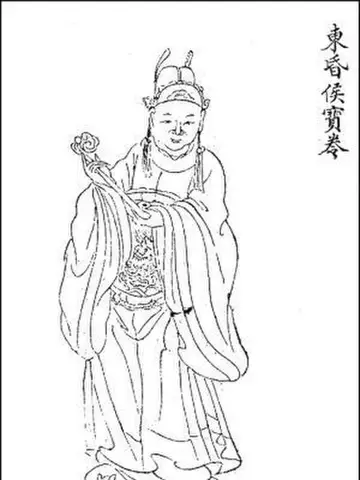
In brief
The appraisal in the Book of Southern Qi ranks him with Jie of Xia and Zhou of Yin and says that, toying with arms and fire, he ended by burning himself.
Road to the throne
He was made crown prince in 494. He loved play and did not like study, but his father, Emperor Ming, did not reproach him and only urged on him the conduct proper to a member of the household. He once spent a whole night catching rats for amusement. He took the throne in 498. The Book of Southern Qi says that because his father had told him on his deathbed not to fall behind others in taking action, he relied on a crowd of petty men and put the chief ministers to death. According to the History of the Southern Dynasties, during the ritual wailing for his father he complained that his throat hurt, and when the bald Yang Chan wailed and his headcloth fell off, he burst out laughing.
Reign and death
In the course of 499, Jiang Shi and others were killed, Xiao Yaoguang, Prince of Shi'an, rebelled and was beheaded, and Xiao Tanzhi, Xu Xiaosi and Shen Wenji were also put to death. Early in 500, Chen Xianda rose in arms at Xunyang and was beheaded the same year. After that, he had the residents along the routes he travelled driven out and their houses emptied. Xu Shibiao, whom he had used to carry out the killings, spoke ill of the emperor; Ru Fazhen and others, who were vying for power, reported it, and in 500 the emperor, who had begun to dislike Xu Shibiao's violence, sent troops to kill him. From then on, Ru Fazhen and Mei Chong'er held power. According to the History of the Southern Dynasties, when soldiers found a sick monk hiding at Dinglin Temple, the emperor rebuffed an attendant who pitied him, asking whether the attendant would not shoot at a river deer or a deer either, and had a hundred arrows loosed at once. In 500, Cui Huijing rose in arms at Guangling and was beheaded. Xiao Yi, who had come to the rescue against Cui Huijing's rebellion, was later killed as well, and according to the Book of Liang, Emperor Wu of Liang raised troops at Xiangyang on hearing of his elder brother's death. He made his favourite, Lady Pan, a Noble Consort and neglected Empress Chu. The History of the Southern Dynasties and the Zizhi Tongjian say that he had golden lotuses laid on the floor for Lady Pan to walk on, but this does not appear in the Book of Southern Qi. In 501, he set up a market in a park, with Lady Pan as market director and himself as market headman carrying out the punishments. According to the History of the Southern Dynasties, Ru Fazhen and others urged him to put all the high ministers to death, and Wang Zhenguo and Zhang Ji, fearing disaster, plotted to side with Emperor Wu of Liang. In 501, when the two men's troops entered the palace halls, the emperor tried to flee, but a eunuch slashed his knee and Zhang Qi cut off his head.
Translated from the Japanese text of this site, which is written from the official histories. Years are the Western calendar years of the dates, as in English reference works. Months are omitted because the histories use the Chinese lunar calendar.