Wang Mang
He was an emperor who, as a member of an empress's family, took control of the Han government, came to the throne on the strength of prophetic signs and founded Xin, but whose reforms stalled, and who was killed as troops broke into Chang'an.
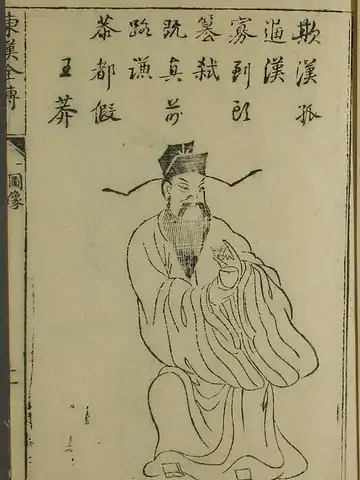
Facts
Wang Mang reigned for 14 years (9–23), taking the throne at 52, and was killed in battle at 66 or 67. 1st ruler of Xin.
- Reign
- 10 January 9 – 6 October 23 (1st ruler of Xin)
- Length of reign
- 14 years
- Born
- 45 BC
- Died
- 6 October 23
- Age at accession
- 52
- Age at death
- 66–67
- Cause of death
- Killed in battleDied in combat, whether on campaign, in defense or while suppressing a revolt
- Path to the throne
- Abdication from another dynastyFounded the titleReceived the throne from an emperor of another family or regime in a change of dynasty led by the new emperor (e.g. Cao Pi, Yang Jian, Zhao Kuangyin)
- Predecessor
- Liu Ying 劉嬰 (did not claim the title of emperor)
- Era names
- 始建國 Shǐjiànguó (proclaimed 9)
- 天鳳 Tiānfèng (proclaimed 14)
- 地皇 Dìhuáng (proclaimed 20)
- Personal name
- 王莽 Wáng Mǎng
- Wade–Giles
- Wang Mang
Life
In brief
The appraisal in the Book of Han asks whether Wang Mang was one who put on a show of benevolence while acting against it, and while granting that the times of Heaven also helped him, declares that no rebel or traitor ever matched him in the size of the disaster he caused.
Road to the throne
He was a nephew of the empress of Emperor Yuan of Han; he lost his father early, and in a lavish clan he alone lived frugally and studied the ritual classics, served his mother and his elder brother's wife, and raised his elder brother's orphaned son. When his uncle Wang Feng fell ill, he tasted the medicine himself and nursed him for months without loosening his belt. While he had withdrawn to his fief of Xindu under Emperor Ai of Han, he rebuked his son Wang Huo for killing a slave and made him kill himself. In AD 1 he received the title Duke Anhan. When his son Wang Yu, in league with the Wei family, the maternal relatives of Emperor Ping of Han, had blood splashed on the gate of his residence, Yu was sent to prison and died by taking poison. Wang Mang put to death the Wei family and even those who had criticized him. When Emperor Ping of Han died, he chose the youngest of the great-great-grandsons of Emperor Xuan of Han, Liu Ying, two years old in the Book of Han (East Asian reckoning), and by an edict of the empress dowager became acting Son of Heaven on the model of the Duke of Zhou. The poisoning of Emperor Ping appears in the main text of the Book of Han only in the proclamation of Zhai Yi and in the words of Han soldiers, while the Zizhi Tongjian states in its own narrative that poison was put in pepper wine. Accepting a golden casket forged by Ai Zhang, he took the throne in AD 9, named his state Xin, and took Liu Ying by the hand and wept that, unlike the Duke of Zhou, he could not give the throne back.
Reign and death
In AD 9 he made all the land in the realm king's land and banned its sale, but on learning of the people's resentment he lifted the ban in AD 12. He put to death an expectant official who said his face was that of a man who eats people, and from then on he hid his face behind mica screens. Believing that the realm would be well governed once its institutions were settled, he lost himself in debate, kept every matter in his own hands, and could not get through them even working through the night. His wife went blind grieving that Wang Mang had killed sons of theirs again and again. In AD 21, on learning that his son Wang Lin had plotted to kill him, he sent him poison, and Lin stabbed himself. In AD 23 the great army of Wang Yi and Wang Xun was defeated at Kunyang by the army of Liu Xiu. In the same year, when the palace caught fire, he turned his seat to follow the handle of the Big Dipper and said that Heaven had given him virtue and that the Han soldiers could do nothing to him. He fled to the Jian Terrace, where he was killed by a merchant named Du Wu, and his head was hung in the market of Wan, where the people struck it.
Translated from the Japanese text of this site, which is written from the official histories. Years are the Western calendar years of the dates, as in English reference works. Months are omitted because the histories use the Chinese lunar calendar.
During the reign
Number of times each event is recorded in the official histories. How each item is counted
- Era name changes
- 3
- General amnesties
- 11
- Empresses installed
- 2
- Crown princes deposed
- 1
- Personal campaigns
- 0
- Rebellions suppressed
- 10
- Rebellions faced
- 10
- Capital relocations
- 0