Yuan Shikai
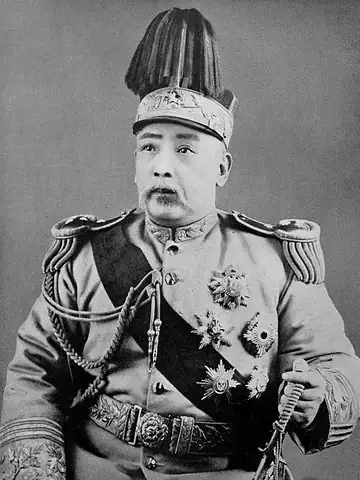
Empire of China · Qing · 1st ruler
中華帝國洪憲帝 Zhōng Huá Dì Guó Hóngxiàndì袁世凱 Yuán Shìkǎi
Wade–Giles: Chung Hua Ti Kuo Hung-hsien-ti · Yüan Shih-k'ai
Reigned 1915–1916 (101 days)
Reigned 101 days (1915–1916). Died at 58 (East Asian reckoning) of natural causes. 1st ruler of Empire of China.
Facts
- Reign
- 12 December 1915 – 22 March 1916 (1st ruler of Empire of China)
- Length of reign
- 101 days
- Born
- 16 September 1859
- Died
- 6 June 1916
- Age at accession
- 57
- Age at death
- 58
- Cause of death
- Natural causesNatural death or illness (including old age)
- Path to the throne
- Self-proclaimedFounded the titleClaimed the imperial title without receiving the throne from an earlier ruler (e.g. Emperor Gaozu of Han, Emperor Guangwu of Han, Hongwu Emperor)
- Era names
- 洪憲 Hóngxiàn (proclaimed 1915)
Ages are given in East Asian reckoning (sui): a person is one year old at birth and gains a year at each New Year, so the figure is one or two years higher than the Western age.
Life
In brief
The Hongxian Emperor was Yuan Shikai, who brought about the abdication of the Qing and became president of the Republic of China, then took the imperial throne himself and gave it up a few months later.
Road to the throne
After the First Sino-Japanese War he was put in charge of training the Newly Created Army, and after the death of Li Hongzhang he served as Viceroy of Zhili and Minister of Beiyang. He was also a grand councillor and head of the Ministry of Foreign Affairs, but he was dismissed when Puyi, the Xuantong Emperor, took the throne. When the revolutionary army rose at Wuchang in 1911 he was recalled as Viceroy of Huguang, and soon became prime minister. After talks with the southern delegates he accepted a republic, was ordered by the Qing abdication edict to organize a provisional republican government, and replaced Sun Yat-sen as provisional president. In 1915, after the National Congress of Representatives voted for a monarchy, he accepted the throne following debate over the proper ceremony, and made the next year the first year of Hongxian.
Reign and death
Around the same time Cai E declared the independence of Yunnan. In 1916 he cancelled the monarchy and returned to the presidency, but Cai E pressed him by telegram to step down. He died later in the same year in which he cancelled it. Two books of the Republican period both say he died in anger: the Jin Bainian Hunan Xuefeng after he was shaken by the rising of the National Protection Army, and the Xin Shishuo less than a month after Cai E's telegram. The Draft History of Qing touches on the monarchy in a single remark in the biography of Zhang Xun, and records his death with only the word zu (died). This site gives his cause of death as natural causes on the strength of modern research; none of the sources at hand names the illness. The Jindai Mingren Yishi Lu preserves a story that two lines in his own hand were found on his desk after his death.
Translated from the Japanese text of this site, which is written from the official histories. Years are given in the Western calendar; months are omitted because the histories use the Chinese lunar calendar.
During the reign
Number of times each event is recorded in the official histories. How each item is counted
- Era name changes
- 1
- General amnesties
- 0
- Empresses installed
- 0
- Crown princes deposed
- 0
- Personal campaigns
- 0
- Rebellions suppressed
- 0
- Rebellions faced
- 1
- Capital relocations
- 0