Puyi
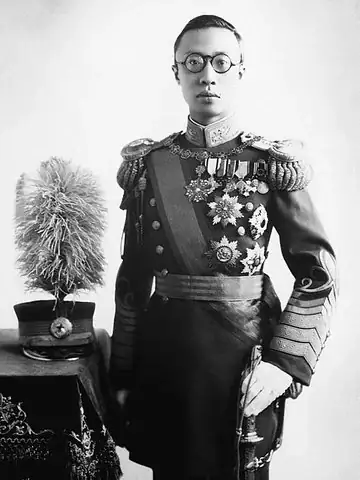
Qing · 12th, 13th and 14th ruler
宣統帝 Xuāntǒng Dì愛新覺羅溥儀 Àixīnjuéluó Pǔyí
Wade–Giles: Hsüan-t'ung Emperor · Ai-hsin-chüeh-lo P'u-i
Reigned 1908–1912; restored 1917; restored 1934–1945 (14 years)
Reigned 14 years (1908–1912; restored 1917; restored 1934–1945). Died at 62 (East Asian reckoning) of natural causes. 12th, 13th and 14th ruler of Qing.
Facts
- Reign (first)
- 2 December 1908 – 12 February 1912 (12th ruler of Qing)
- Reign (restored)
- 1 July 1917 – 12 July 1917 (13th ruler of Qing)
- Reign (restored)
- 1 March 1934 – 18 August 1945 (14th ruler of Qing)
- Length of reign
- 14 years
- Born
- 7 February 1906
- Died
- 17 October 1967
- Age at accession
- 3
- Age at death
- 62
- Cause of death
- Natural causesNatural death or illness (including old age)
- Path to the throne
- Installed by othersRestoredSucceeded the previous ruler of the same regime, but the choice was made by officials, the army, eunuchs, consort kin, an empress dowager or the imperial clan
- Predecessor
- Guangxu Emperor
- Era names
- 宣統 Xuāntǒng (proclaimed 1908)
- 康德 Kāngdé (proclaimed 1934)
Ages are given in East Asian reckoning (sui): a person is one year old at birth and gains a year at each New Year, so the figure is one or two years higher than the Western age.
Life
In brief
Puyi succeeded the Guangxu Emperor as emperor of the Qing, took the throne as a small child, and abdicated by an edict of the empress dowager after the Xinhai Revolution. The assessment at the end of his annals in the Draft History of Qing calls it a wonder unheard of in all history that he handed over power at once and kept his privileged treatment for so long.
Road to the throne
He was a great-grandson of the Daoguang Emperor, and his father was Zaifeng, Prince Chun, which made him the son of the Guangxu Emperor's full younger brother. In 1908, as the Guangxu Emperor's illness grew grave, Cixi ordered that Puyi be raised in the palace; when the Guangxu Emperor died the next day, Puyi was named the succeeding emperor, to be the Tongzhi Emperor's heir and also to carry on the Guangxu Emperor's line. The annals of the Xuantong reign attribute both points to an edict of the grand empress dowager, while the annals of the Guangxu Emperor say that the succession came from the Guangxu Emperor's testamentary edict and the adoption as the Tongzhi Emperor's heir from an edict of the empress dowager. Cixi herself died the following day. His father Zaifeng became Prince Regent and handled military and state affairs, and in the same year Puyi was enthroned in the Hall of Supreme Harmony, with the next year made the first year of Xuantong.
Reign and death
In 1911 the New Army at Wuchang went over to the revolutionaries, Wuchang fell, and one province after another declared independence. In the same year Yuan Shikai became prime minister, and Zaifeng handed back the regent's seal and withdrew to his own residence. Delegates of the provinces met in Shanghai to elect a provisional president, set up a government in Nanjing, and named the state the Republic of China. In 1912 Yuan Shikai, acting on an edict of the empress dowager, proclaimed a constitutional republic, and Puyi abdicated. Under the Articles of Favorable Treatment the emperor gave up political power but kept his imperial title. According to the biography of Zhang Xun, which appears only in the Guanwai edition of the Draft History of Qing, in 1917 Zhang Xun marched north with his troops and restored Puyi, and edicts were issued in Puyi's name, but most provinces did not respond, and Zhang Xun was defeated and took refuge in a foreign legation. The biography of Kang Youwei records that the Articles of Favorable Treatment were revised when Puyi moved out of the palace in 1924, and that he moved to Tianjin the following year. The Draft History of Qing says nothing about his enthronement and abdication in Manchukuo or about his death in 1967.
Translated from the Japanese text of this site, which is written from the official histories. Years are given in the Western calendar; months are omitted because the histories use the Chinese lunar calendar.
During the reign
Number of times each event is recorded in the official histories. How each item is counted
- Era name changes
- 2
- General amnesties
- 2
- Empresses installed
- 0
- Crown princes deposed
- 0
- Personal campaigns
- 0
- Rebellions suppressed
- 12
- Rebellions faced
- 15
- Capital relocations
- 0
Emperors of Qing
- 2ndHong Taiji清太宗 Qīng Tàizōng愛新覺羅皇太極 Àixīnjuéluó Huángtàijí1636–1643 · 7 years · Unknown, age 521636–16437 yearsUnknown, age 52
- 3rdShunzhi Emperor順治帝 Shùnzhì Dì愛新覺羅福臨 Àixīnjuéluó Fúlín1643–1661 · 17 years · Natural causes, age 241643–166117 yearsNatural causes, age 24
- 4thKangxi Emperor康熙帝 Kāngxī Dì愛新覺羅玄燁 Àixīnjuéluó Xuányè1661–1722 · 61 years · Natural causes, age 691661–172261 yearsNatural causes, age 69
- 5thYongzheng Emperor雍正帝 Yōngzhèng Dì愛新覺羅胤禛 Àixīnjuéluó Yìnzhēn1722–1735 · 12 years · Disputed, age 581722–173512 yearsDisputed, age 58
- 6thQianlong Emperor乾隆帝 Qiánlóng Dì愛新覺羅弘曆 Àixīnjuéluó Hónglì1735–1796 · 60 years · Natural causes, age 891735–179660 yearsNatural causes, age 89
- 7thJiaqing Emperor嘉慶帝 Jiāqìng Dì愛新覺羅顒琰 Àixīnjuéluó Yóngyǎn1796–1820 · 24 years · Natural causes, age 611796–182024 yearsNatural causes, age 61
- 8thDaoguang Emperor道光帝 Dàoguāng Dì愛新覺羅旻寧 Àixīnjuéluó Mínníng1820–1850 · 29 years · Natural causes, age 691820–185029 yearsNatural causes, age 69
- 9thXianfeng Emperor咸豐帝 Xiánfēng Dì愛新覺羅奕詝 Àixīnjuéluó Yìzhǔ1850–1861 · 11 years · Natural causes, age 311850–186111 yearsNatural causes, age 31
- 10thTongzhi Emperor同治帝 Tóngzhì Dì愛新覺羅載淳 Àixīnjuéluó Zàichún1861–1875 · 13 years · Natural causes, age 191861–187513 yearsNatural causes, age 19
- 11thGuangxu Emperor光緒帝 Guāngxù Dì愛新覺羅載湉 Àixīnjuéluó Zàitián1875–1908 · 33 years · Assassinated, age 381875–190833 yearsAssassinated, age 38
- 12th, 13th, 14thPuyi宣統帝 Xuāntǒng Dì愛新覺羅溥儀 Àixīnjuéluó Pǔyí1908–1912; restored 1917; restored 1934–1945 · 14 years · Natural causes, age 621908–1912; restored 1917; restored 1934–194514 yearsNatural causes, age 62