Emperors of the Han Zhao dynasty 前趙
The emperors of Han Zhao (308–329) in order of accession, from Liu Yuan to Liu Yao.
- Emperors
- 5 emperors
Emperors in order
- 1stLiu Yuan前趙光文帝 Qián Zhào Guāngwéndì劉淵 Liú Yuān308–310 · 1 year · Natural causes308–3101 yearNatural causes
- 2ndLiu He劉和 Liú Hé310 · 6 days · Assassinated3106 daysAssassinated
- 3rdLiu Cong前趙昭武帝 Qián Zhào Zhāowǔdì劉聰 Liú Cōng310–318 · 7 years · Natural causes310–3187 yearsNatural causes
- 4thLiu Can前趙隱帝 Qián Zhào Yǐndì劉粲 Liú Càn318 · 30 days · Assassinated31830 daysAssassinated
- 5thLiu Yao劉曜 Liú Yào318–329 · 10 years · Executed318–32910 yearsExecuted
Rise and fall of the Han Zhao dynasty
Rise
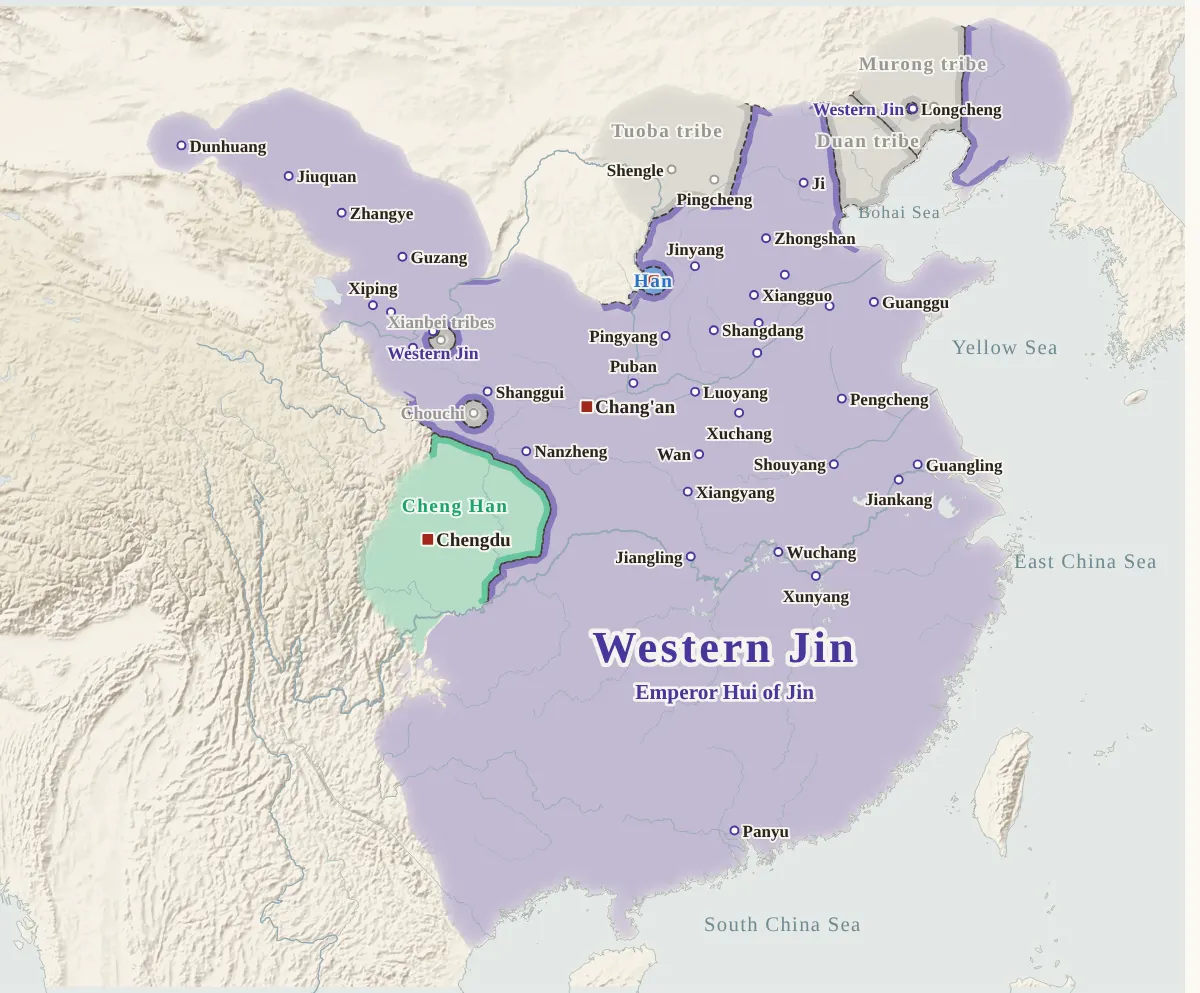
When the War of the Eight Princes broke out in Western Jin, Liu Yuan of the Xiongnu was put forward by his kinsmen as Grand Chanyu, gathered a following of 50,000 and made Lishi his capital. Claiming to be a nephew of the Han imperial house, Liu Yuan named his state Han, called himself King of Han in 304 and emperor in 308, and moved his capital from Puzi to Pingyang.
Course
Liu He, who succeeded after Liu Yuan's death, tried to attack his younger brothers but was instead killed by Liu Cong, and Liu Cong took the throne. In 311 the Han Zhao army broke into Luoyang and carried Emperor Huai of Jin off to Pingyang, and in 316 it also made Emperor Min of Jin surrender at Chang'an. Both emperors were later killed at Pingyang.
In the palace the eunuchs wielded great power, and Liu Cong's son Liu Can removed the imperial heir-brother Liu Yi by framing him for rebellion. In 318 Liu Can, who was set up after Liu Cong's death, was killed by Jin Zhun, the father of Liu Cong's empress, and the members of the Liu clan were beheaded, men and women, young and old alike.
Liu Yao, a kinsman who was at Chang'an, took the throne as emperor at Chibi, and after Jin Zhun's revolt was put down he moved the capital to Chang'an and changed the name of the state to Zhao. Liu Yao destroyed Chen An of Long and brought Zhang Mao of Former Liang to submission, but the conflict with Shi Le in the east went on.
Fall
Early in 329 Liu Yao fought Shi Le's army at Luoyang, was defeated while drunk and captured, and after being held at Xiangguo he was killed by Shi Le. The crown prince Liu Xi and others fled to Shanggui, but in 329 Shi Hu took the city and killed them, and Han Zhao came to an end.
Translated from the Japanese text of this site, which is written from the official histories. Years are the Western calendar years of the dates, as in English reference works.