Emperors of the Western Jin dynasty 晉
The emperors of Western Jin (266–316) in order of accession, from Emperor Wu of Jin to Emperor Min of Jin.
- Emperors
- 5 emperors
Emperors in order
- 1stEmperor Wu of Jin晉武帝 Jìn Wǔdì司馬炎 Sīmǎ Yán266–290 · 24 years · Natural causes, age 53–54266–29024 yearsNatural causes, age 53–54
- 2nd, 4thEmperor Hui of Jin晉惠帝 Jìn Huìdì司馬衷 Sīmǎ Zhōng290–301; restored 301–307 · 16 years · Disputed, age 46–47290–301; restored 301–30716 yearsDisputed, age 46–47
- 3rdSima Lun司馬倫 Sīmǎ Lún301 · 116 days · Suicide (incl. forced)301116 daysSuicide (incl. forced)
- 5thEmperor Huai of Jin晉懷帝 Jìn Huáidì司馬熾 Sīmǎ Chì307–311 · 4 years · Executed, age 28–29307–3114 yearsExecuted, age 28–29
- 6thEmperor Min of Jin晉愍帝 Jìn Mǐndì司馬鄴 Sīmǎ Yè313–316 · 3 years · Executed, age 16–17313–3163 yearsExecuted, age 16–17
Rise and fall of the Western Jin dynasty
Rise
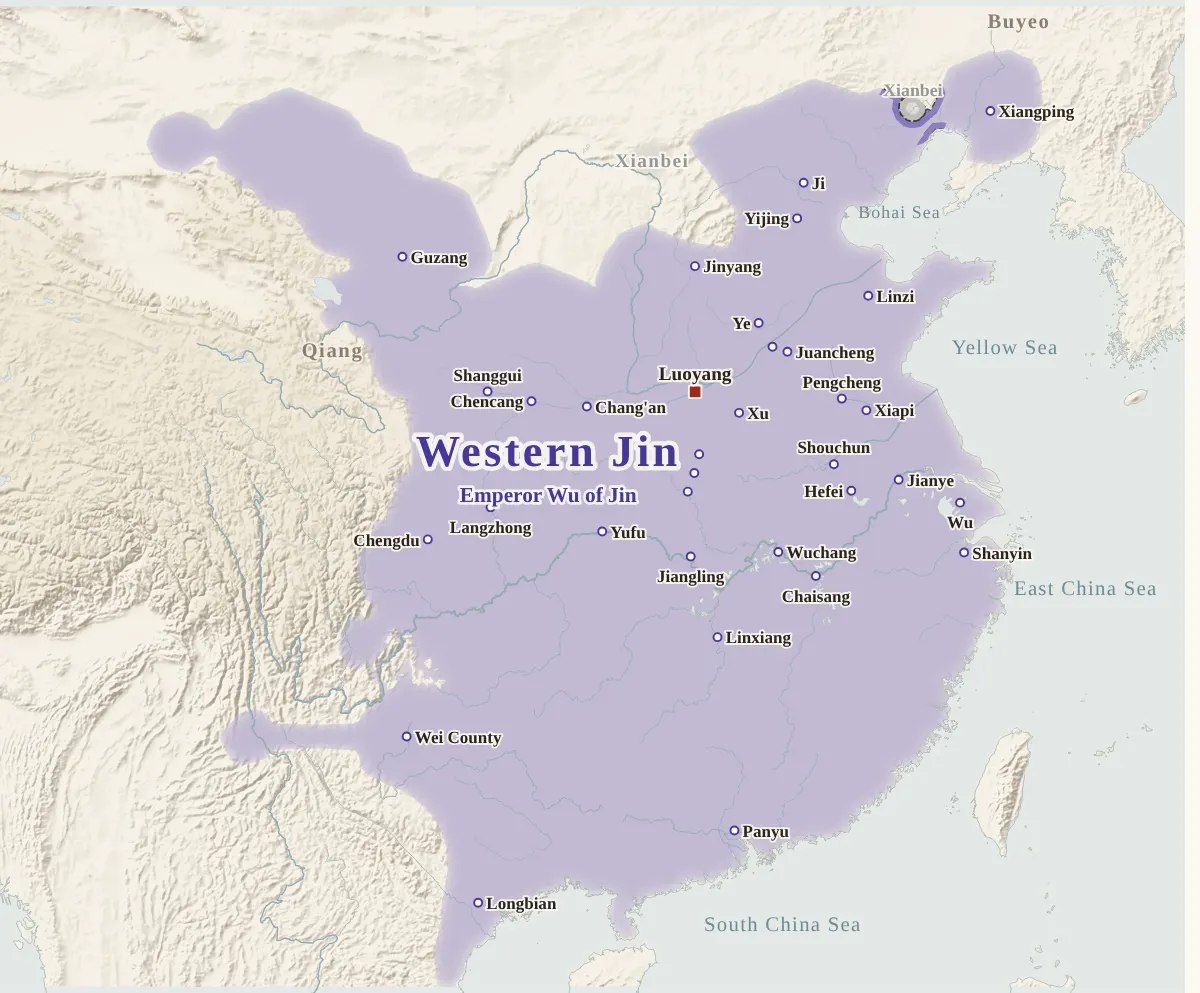
In Cao Wei, Sima Yi killed Cao Shuang and others in 249, and in 254 Sima Shi deposed the emperor Cao Fang, and Sima Zhao, who succeeded him as grand general, became King of Jin. When Sima Zhao died in 265, his son Emperor Wu of Jin succeeded him as King of Jin, and early in 266 he received the throne by abdication from Cao Huan of Cao Wei and entered the Luoyang Palace.
Course
In 279 Western Jin sent more than two hundred thousand troops forward from east and west to attack Eastern Wu, and the next year it made Sun Hao surrender and destroyed Eastern Wu. When Emperor Wu of Jin fell ill, the empress's father Yang Jun suppressed an edict appointing Sima Liang, Prince of Ru'nan, as regent, and the empress drew up an edict appointing Yang Jun regent. In 290 Emperor Wu died and Emperor Hui of Jin took the throne, and the next year Yang Jun was put to death, and Empress Jia forged an edict to depose the empress dowager and had Sima Wei, Prince of Chu, kill Sima Liang and others.
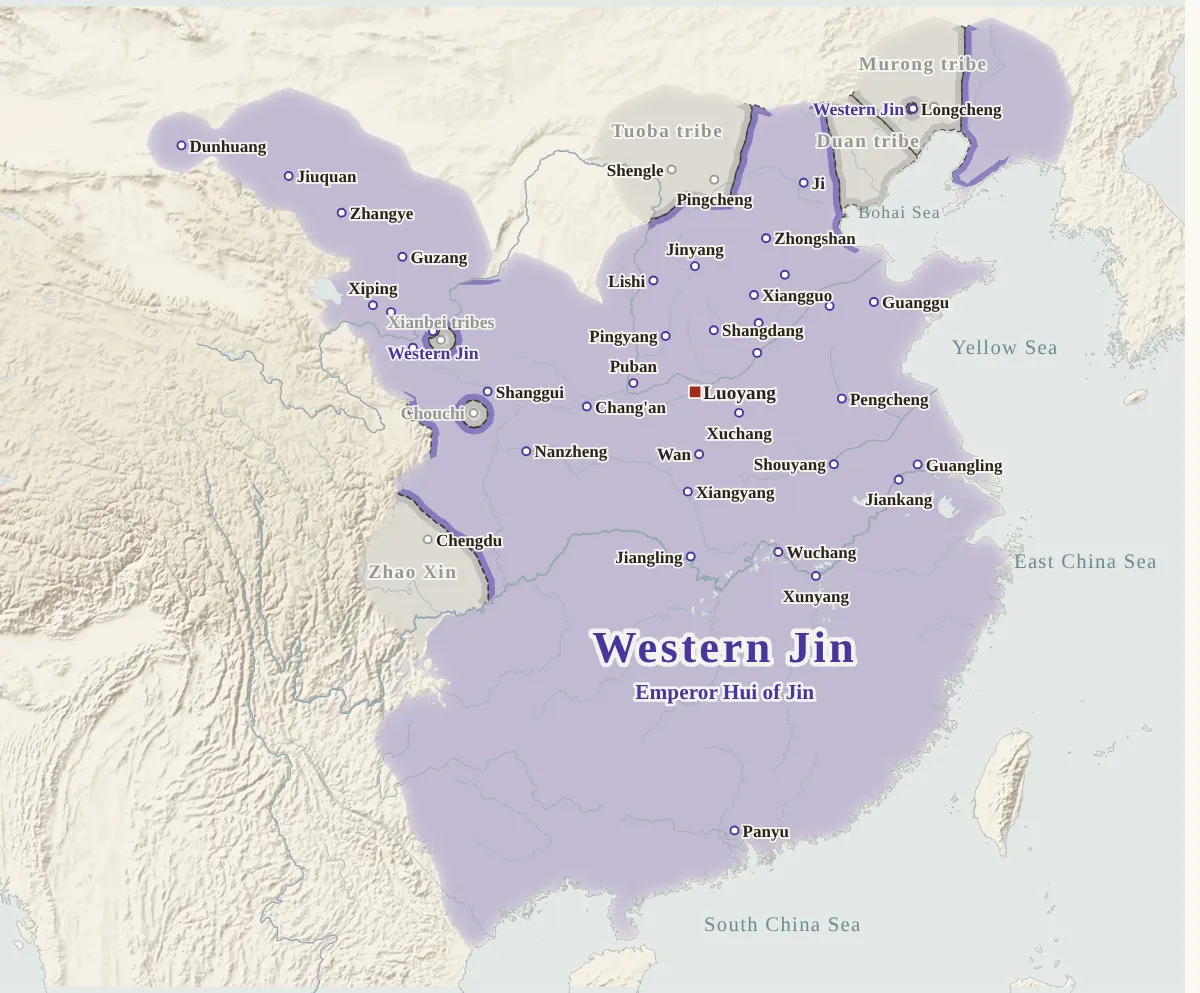
In 300 Empress Jia killed the crown prince, but she was soon deposed by Sima Lun, Prince of Zhao, and others. The next year Sima Lun seized the throne from Emperor Hui, but when Sima Jiong, Prince of Qi, raised troops, the princes rose in response, and after more than 60 days of fighting in which nearly a hundred thousand were killed, Emperor Hui returned to the throne and Sima Lun was ordered to take his own life. In 304 Emperor Hui set out to attack Sima Ying, Prince of Chengdu, and was defeated at Dangyin, and the same year he was carried off to Chang'an by Zhang Fang. The same year Liu Yuan of the Xiongnu proclaimed himself Grand Chanyu at Lishi and rebelled. In 306 the army of Sima Yue, Prince of Donghai, defeated the army of Sima Yong, Prince of Hejian, and Emperor Hui returned to Luoyang, but early in 307 he died.
Under Emperor Huai of Jin, Sima Yue held the government, but after Sima Yue died in 311, Shi Le defeated the Western Jin army and more than a hundred thousand people, Wang Yan among them, died, and the same year Liu Yao and Wang Mi entered Luoyang, the palaces and ancestral temples were burned, and Emperor Huai was carried off to Pingyang.
Fall
Emperor Min of Jin, a grandson of Emperor Wu of Jin, was proclaimed crown prince at Chang'an in 312 and took the throne in 313 when news of Emperor Huai's death arrived, but at that time Chang'an had fewer than a hundred households. In 316, when Liu Yao closed in and Chang'an starved, Emperor Min surrendered riding in a goat-drawn carriage with his upper body bared, and early in the year after next he was killed at Pingyang. In 317 Emperor Yuan of Jin, then Prince of Langya, became King of Jin and set up the ancestral temples and the altars of soil and grain at Jiankang, and the next year, on receiving news of Emperor Min's death, he took the throne as emperor.
Translated from the Japanese text of this site, which is written from the official histories. Years are the Western calendar years of the dates, as in English reference works.