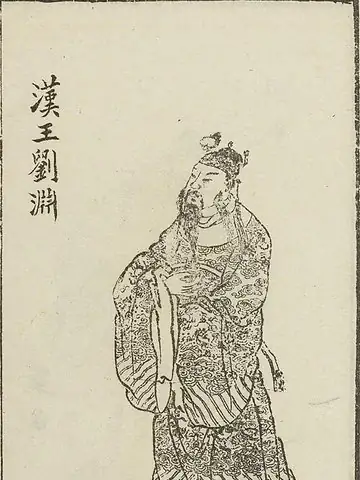
Facts
Liu Yuan reigned for 1 year (308–310) and died of natural causes (age unknown). 1st ruler of Han Zhao.
- Reign
- 2 November 308 – 29 August 310 (1st ruler of Han Zhao)
- Length of reign
- 1 year
- Born
- Unknown
- Died
- 29 August 310
- Age at accession
- Unknown
- Age at death
- Unknown
- Cause of death
- Natural causesNatural death or illness (including old age)
- Path to the throne
- Self-proclaimedFounded the titleClaimed the imperial title without receiving the throne from an earlier ruler (e.g. Emperor Gaozu of Han, Emperor Guangwu of Han, Hongwu Emperor)
- Posthumous name
- 前趙光文帝 Qián Zhào Guāngwéndì
- Temple name
- 前趙高祖 Qián Zhào Gāozǔ
- Personal name
- 劉淵 Liú Yuān
- Wade–Giles
- Ch'ien Chao Kuang-wen-ti · Liu Yüan
Life
In brief
The historians' comment in the Book of Jin calls Liu Yuan an outstanding man, saying that no one could rival him while the imperial clansmen were killing one another, and in the same passage it describes his not keeping Confucian ways at a distance and his acceptance of upright men as stealing benevolence and righteousness together.
Road to the throne
From his youth he loved learning, and he was fond of the Zuo Commentary on the Spring and Autumn Annals and the military methods of Sunzi and Wu Qi. He said that he had always despised Sui He and Lu Jia for having no martial skill and Zhou Bo and Guan Ying for having no letters, and he also trained in the martial arts and excelled at archery. While he was in Luoyang as a hostage, Emperor Wu of Jin took a liking to him, but Kong Xun and others opposed giving Liu Yuan military command, arguing that those of a different kind must have a different heart. According to the chronicle of Liu Yuan in the Book of Jin, when seeing off Wang Mi as he returned east, he wept, saying that he had no desire for office and feared he would die in Luoyang; hearing of this, Prince You of Qi urged that he be done away with, but Emperor Wu accepted Wang Hun's assurance. After his father's death he succeeded him as Commander of the Left Division, and when he became Chief Commandant of the Northern Division he made the laws and punishments clear and gave freely of his wealth, so that outstanding men of the Five Divisions and renowned Confucian scholars from afar gathered to him. As Jin fell into disorder in the War of the Eight Princes, his grand-uncle Liu Xuan and others secretly put him forward as Grand Chanyu; he won over Prince Ying of Chengdu and was made Northern Chanyu, and after returning to Zuoguo City he gathered a following of fifty thousand within twenty days. When Prince Ying fled in defeat, Liu Yuan called him a worthless slave but still meant to rescue him as he had promised; Liu Xuan and others remonstrated with him, and he said that emperors and kings have no fixed origin and that it depends only on where virtue bestows it. In 304, reasoning that as a nephew of the Han house he could carry on as a younger brother succeeds an elder brother, he named his state Han, took the title King of Han, and posthumously honoured Liu Shan of Shu Han as Emperor Xiaohuai.
Reign and death
He summoned Chen Yuanda, who had not answered his earlier invitation, and when he said that Chen should have come sooner, Chen replied that he had avoided a rank beyond his due, and Liu Yuan was greatly pleased. He ascended the throne as emperor in 308, and according to the chronicle in the Book of Jin and the Zizhi Tongjian he later moved his capital from Puzi to Pingyang, whereas the annals of Emperor Huai in the Book of Jin place his proclamation as emperor at Pingyang. He sent his son Liu Cong and Wang Mi to attack Luoyang, but Liu Cong suffered a heavy defeat in a night attack that followed a false surrender by the Administrator of Hongnong, and Liu Yuan met the returning army in plain mourning clothes. He made Lady Shan empress and his son Liu He crown prince. In 310, when his illness grew grave, he had Liu Huanle and others receive his testamentary edict, and then he died.
Translated from the Japanese text of this site, which is written from the official histories. Years are the Western calendar years of the dates, as in English reference works. Months are omitted because the histories use the Chinese lunar calendar.