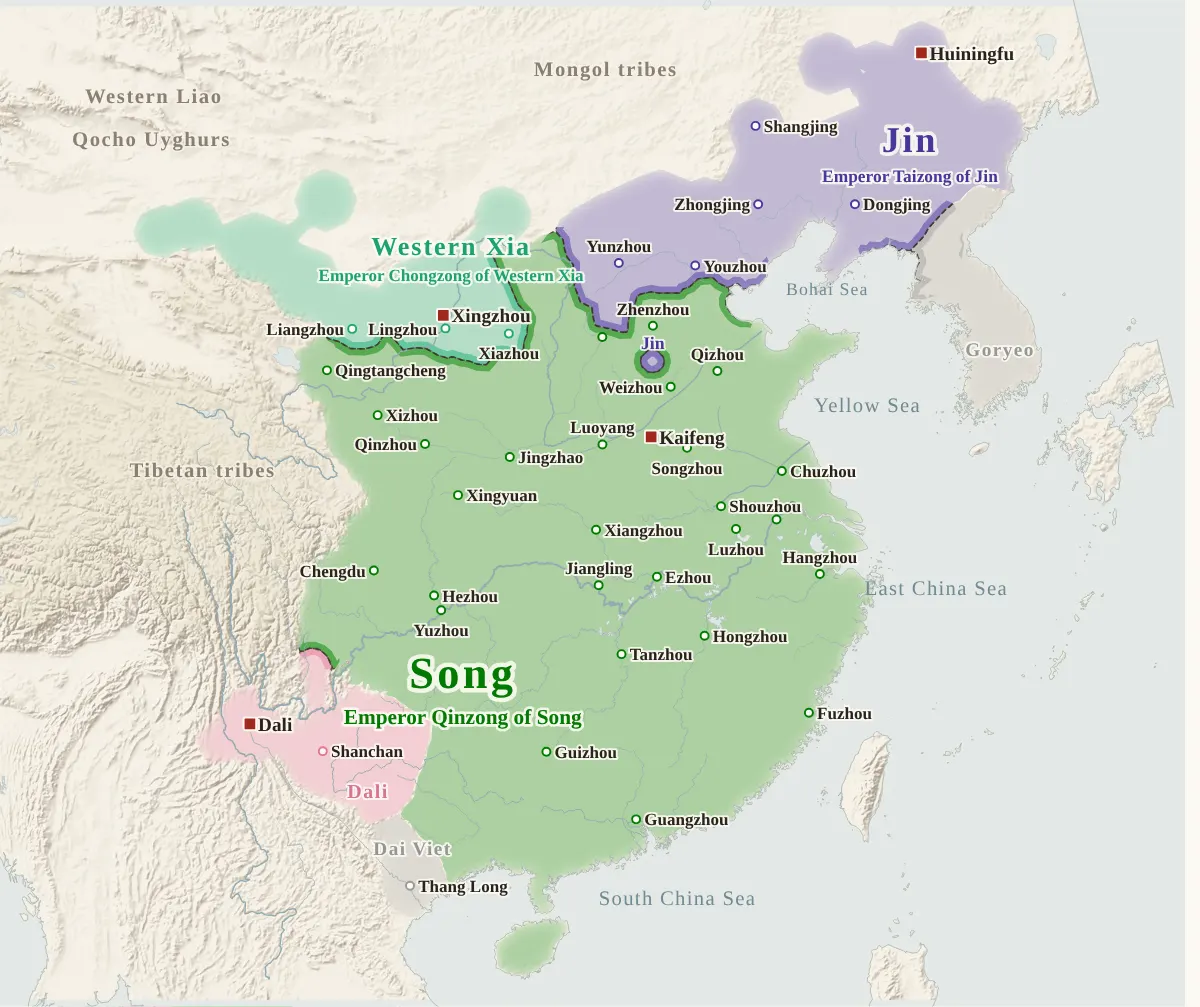
Emperors of the Jin dynasty 金
The emperors of Jin (1115–1234) in order of accession, from Emperor Taizu of Jin to Emperor Mo of Jin.
- Emperors
- 10 emperors
Emperors in order
- 1stEmperor Taizu of Jin金太祖 Jīn Tàizǔ完顏旻 Wányán Mín1115–1123 · 8 years · Natural causes, age 551115–11238 yearsNatural causes, age 55
- 2ndEmperor Taizong of Jin金太宗 Jīn Tàizōng完顏晟 Wányán Shèng1123–1135 · 11 years · Natural causes, age 59–601123–113511 yearsNatural causes, age 59–60
- 3rdEmperor Xizong of Jin金熙宗 Jīn Xīzōng完顏亶 Wányán Dǎn1135–1150 · 14 years · Assassinated, age 301135–115014 yearsAssassinated, age 30
- 4thWanyan Liang金海陵王 Jīn Hǎilíngwáng完顏亮 Wányán Liàng1150–1161 · 11 years · Assassinated, age 38–391150–116111 yearsAssassinated, age 38–39
- 5thEmperor Shizong of Jin金世宗 Jīn Shìzōng完顏雍 Wányán Yōng1161–1189 · 27 years · Natural causes, age 65–661161–118927 yearsNatural causes, age 65–66
- 6thEmperor Zhangzong of Jin金章宗 Jīn Zhāngzōng完顏璟 Wányán Jǐng1189–1208 · 19 years · Natural causes, age 401189–120819 yearsNatural causes, age 40
- 7thWanyan Yongji金衛紹王 Jīn Wèishàowáng完顏永濟 Wányán Yǒngjì1208–1213 · 4 years · Assassinated1208–12134 yearsAssassinated
- 8thEmperor Xuanzong of Jin金宣宗 Jīn Xuānzōng完顏珣 Wányán Xún1213–1224 · 10 years · Natural causes, age 601213–122410 yearsNatural causes, age 60
- 9thEmperor Aizong of Jin金哀宗 Jīn Āizōng完顏守緒 Wányán Shǒuxù1224–1234 · 10 years · Suicide (incl. forced), age 351224–123410 yearsSuicide (incl. forced), age 35
- 10thEmperor Mo of Jin金末帝 Jīn Mòdì完顏承麟 Wányán Chénglín1234 · less than a day · Killed in battle1234less than a dayKilled in battle
Rise and fall of the Jin dynasty
Rise
Aguda of the Jurchen, Emperor Taizu of Jin, succeeded Kangzong as dubojilie in 1113, and when he defeated the Liao army at Ningjiang Prefecture the next year he was urged to call himself emperor, but he declined, saying that taking the great title after a single victory would make him look shallow. In 1115, on the same day that his ministers offered him an honorific title, he took the throne as emperor and named his state the Great Jin.
Course
Jin then took Huanglong Prefecture and crushed the army of Emperor Tianzuo of Liao at Hubudagang, and in 1120 it received the surrender of the Liao Supreme Capital. After entering Yanjing, Emperor Taizu of Jin died in 1123, and his younger brother by the same mother, Emperor Taizong of Jin, took the throne, built his capital at Huining and raised it from a zhou to a fu. In 1125 Loushi captured Emperor Tianzuo of Liao, and Jin went on to take the Song capital; in 1127 it reduced Emperor Huizong of Song and Emperor Qinzong of Song to commoners and set up Zhang Bangchang as emperor of the Great Chu.
When Taizong died in 1135, Emperor Xizong of Jin, Taizu's legitimate grandson, took the throne. In 1139 Xizong put Zongpan, Zongjun and Talan to death for plotting rebellion, and in 1149 he killed Changsheng, Prince of Zuo, and his younger brother, as well as Empress Peiman and others. Wanyan Liang, who killed that same Xizong and took the throne, had more than seventy descendants of Taizong, among others, put to death, and in 1153 he moved the capital to Yanjing and renamed it Zhongdu. In 1161, while Wanyan Liang was invading the Song in person, Emperor Shizong of Jin took the throne at Liaoyang, and Wanyan Liang was killed at the Guazhou ferry when the troops of Yuanyi and others turned against him. In 1173 Shizong had songs sung in the Jurchen language and admonished the crown prince and the princes that learning nothing but the customs of the Han people was forgetting their roots. In 1206, in the reign of Emperor Zhangzong of Jin, Jin in turn attacked the Song, on the grounds that the Song had broken the treaty and sent out troops.
In 1211, when Genghis Khan invaded, the Jin army suffered a great defeat at Huihebao and lost the Juyong Pass. In 1213, after Hushahu had Wanyan Yongji killed, Emperor Xuanzong of Jin was brought in and took the throne. In 1214 Xuanzong gave a daughter of Wanyan Yongji in marriage to Genghis Khan and sued for peace, and the same year he decided to move south to Bianjing and set out from Zhongdu. The next year Zhongdu fell.
Fall
In 1232 the Jin army suffered a great defeat against the Mongol army at Sanfengshan, and it never recovered afterwards. Emperor Aizong of Jin left Bianjing and attacked Weizhou but failed, fled to Guide, and in 1233 entered Caizhou, but the Song supplied troops and grain for the Mongol attack on Caizhou. In 1234 Aizong passed the throne to Chenglin, Emperor Mo of Jin, the marshal of the eastern front, and when the city was breached right afterwards he hanged himself; Chenglin too was soon killed by soldiers in the turmoil, and Jin came to an end.
Translated from the Japanese text of this site, which is written from the official histories. Years are the Western calendar years of the dates, as in English reference works.