Skip to content

Emperor Shizong of Jin

He was the Jin emperor who took the throne at Liaoyang in the midst of Wanyan Liang's southern campaign, made peace with the Song and gave the people rest, and was later called a little Yao or Shun.
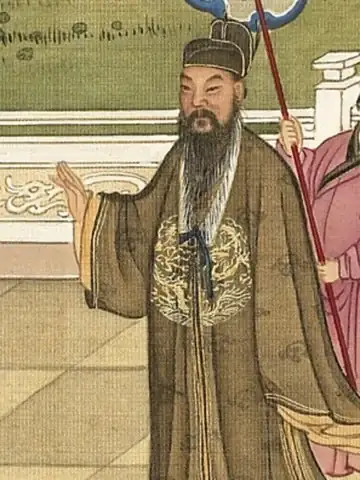
Portrait of Emperor Shizong of Jin

Jin · 5th ruler

Reigned 1161–1189 (27 years)

金世宗 Other names ›

Facts

Emperor Shizong of Jin reigned for 27 years (1161–1189), taking the throne at 37 or 38, and died of natural causes at 65 or 66. 5th ruler of Jin.

Reign
27 October 1161 – 20 January 1189 (5th ruler of Jin)
Length of reign
27 years
Born
1123
Died
20 January 1189
Age at accession
37–38
Age at death
65–66
Cause of death
Natural causesNatural death or illness (including old age)
Path to the throne
Proclaimed by supportersFounded the titleDid not receive the throne from an earlier ruler, and did not claim it on their own initiative but was set up by others (e.g. the emperors of the Southern Ming)
Predecessor
Wanyan Liang
Era names
  • 大定 Dàdìng (proclaimed 1161)
Temple name
金世宗 Jīn Shìzōng
Personal name
完顏雍 Wányán Yōng
Wade–Giles
Chin Shih-tsung · Wan-yen Yung

Life

Road to the throne

A grandson of Emperor Taizu of Jin and a son of Ruizong, he was originally named Wulu, and his annals record that he had an imposing appearance and that he was ranked first in the state at mounted archery. According to the biography of Empress Zhaode in the History of Jin, while he was at Jinan, his wife Lady Wulinda was summoned by Wanyan Liang, and reasoning that if she died at Jinan her husband would be killed, she obeyed the summons and took her own life at Liangxiang. In 1161 Khitan tribesmen rose in revolt, and he, then liushou of the Eastern Capital, learning that his deputy Gao Cunfu was seeking to harm him, gathered his officials at the Qing'an Temple on Li Shi's advice and seized Gao Cunfu. When the troops of the southern campaign came over to him and his officials and the armies urged him to take the throne, he declined for a long time, then took the throne and changed the era name to Dading. It was only after this that Wanyan Liang was assassinated at Yangzhou.

Reign and death

In 1173 he had songs in the Jurchen language performed and admonished the crown prince and the princes that to learn only the customs of the Han was to forget their roots. In 1174 he regretted, as the one occasion on which he had deceived his own conscience, that he had known of a private favour sought by the Commissioner of Military Affairs Yongzhong and had not pursued it. In 1176, seeing a drunken man who had fallen from his donkey by the roadside during a hawking outing, he had him taken home, and in 1181 he ordered that music in the markets must not be banned on account of the mourning for the Yuan Consort. In 1185 he held a banquet at his old homeland of the Upper Capital, and since no one sang the native songs he sang one himself, his voice failing at a line recalling his ancestors, and he wept when the song was over. In the same year, angered that the Pingzhang zhengshi Xiang, the attendant Pingshan and others had shot a pregnant hare, he had Pingshan beaten with a staff, admonished Xiang and banned the shooting of hares. In the same year, when the crown prince Yungong died, he wept bitterly for a long time at the news. In 1187, when he spoke of having reduced his meals and his chief ministers said that the Son of Heaven naturally had his own standards, he replied that the Son of Heaven was only a man. Early in 1189 he fell ill, entrusted Tudan Kening and the others who came to see him with supporting the imperial grandson and heir, and died that year in the Fu'an Hall. The appraisal in his annals praises him for practising frugality himself and keeping rewards and punishments reliable, while regretting that his ministers clung to their ease and could not follow his good example. The Da Jin Guozhi likewise describes him as lenient and humane and broad-minded, and records that the people of the north called him a little Yao or Shun.

Translated from the Japanese text of this site, which is written from the official histories. Years are the Western calendar years of the dates, as in English reference works. Months are omitted because the histories use the Chinese lunar calendar.

During the reign

Number of times each event is recorded in the official histories. How each item is counted

Era name changes
1
General amnesties
5
Empresses installed
0
Crown princes deposed
0
Personal campaigns
0
Rebellions suppressed
2
Rebellions faced
4
Capital relocations
0

Emperors of Jin

All 10 emperors of Jin