Emperors of the Ming Xia dynasty 夏
The emperors of Ming Xia (1362–1371) in order of accession, from Ming Yuzhen to Ming Sheng.
- Emperors
- 2 emperors
Rise and fall of the Ming Xia dynasty
Rise
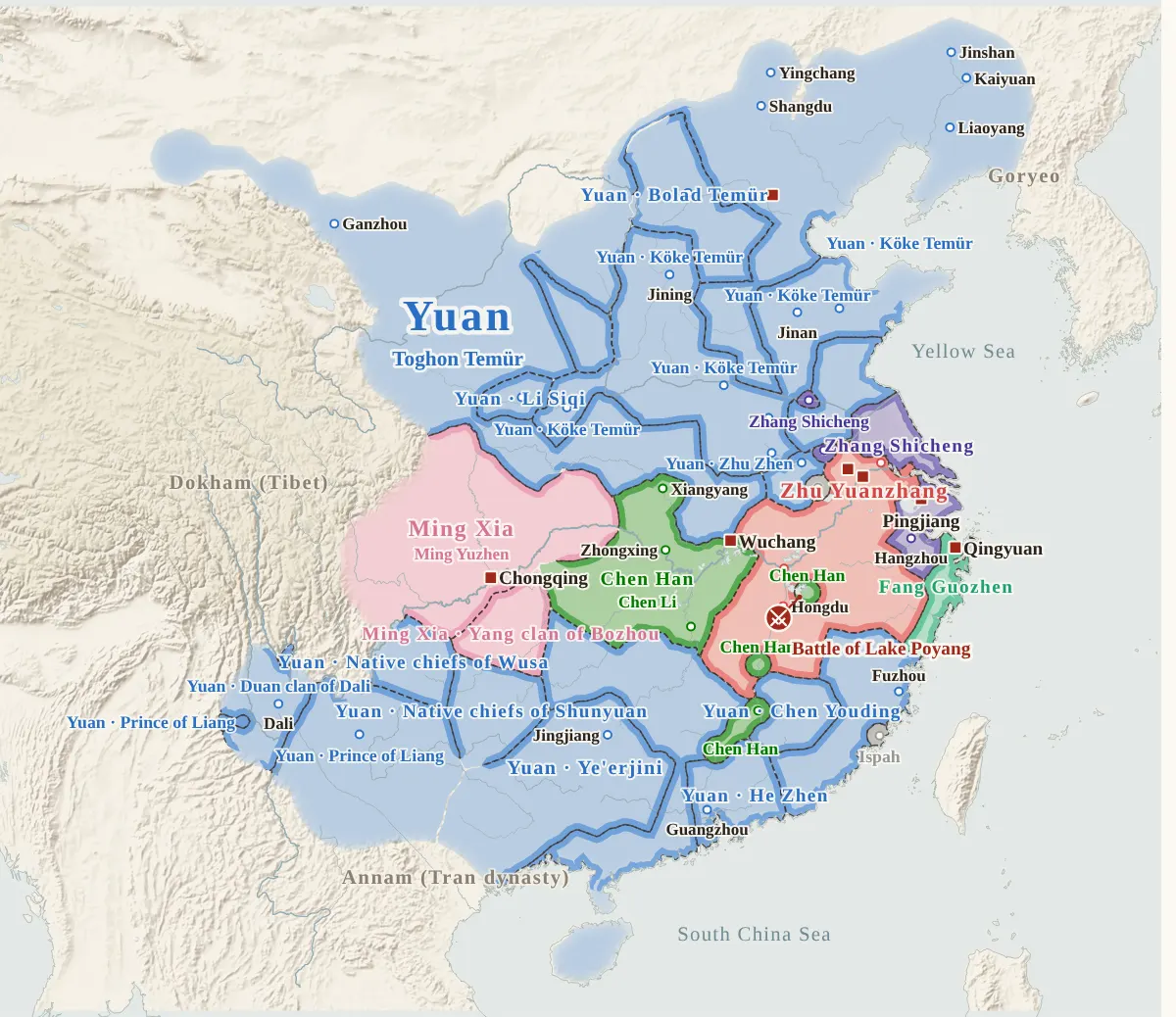
Ming Yuzhen, a general in Xu Shouhui's camp, followed a plan of his officer Dai Shou in 1357, attacked Chongqing and drove out the Yuan commander guarding it. When Chen Youliang killed Xu Shouhui and set himself up in 1360, Ming Yuzhen blocked Qutang with troops, cut off contact with Chen Youliang and made himself King of Longshu. In 1362 Ming Yuzhen accepted the advice of Liu Zhen, took the imperial throne at Chongqing and named his state Xia.
Course
On the counsel of Liu Zhen, Ming Xia set up an Imperial Academy, opened the jinshi examination and fixed taxes at one tenth. Of the armies that invaded Yunnan in 1363, the army of Wan Sheng, which had gone deep, was struck back the next year by the Yuan Prince of Liang and turned back.
When Ming Yuzhen died in 1366, Ming Sheng, aged 10 (East Asian reckoning), succeeded him, and his mother, Lady Peng, heard state affairs as empress dowager. Before long strife broke out, in which, among other things, the senior minister Wan Sheng was killed, and after that the high ministers held real power.
Fall
In 1369 Yang Jing of the Ming urged Ming Sheng to submit, but he did not comply. In 1371 the Ming attacked Shu along two routes, by water and by land, and when the Qutang Pass too was broken through, Ming Sheng surrendered on the word of his mother, Lady Peng. Ming Sheng was made Marquis Guiyi, and the next year, 1372, he was moved to Goryeo together with Chen Li of Chen Han.
Translated from the Japanese text of this site, which is written from the official histories. Years are the Western calendar years of the dates, as in English reference works.