Emperors of the Ming dynasty 明
The emperors of Ming (1368–1644) in order of accession, from Hongwu Emperor to Chongzhen Emperor, including Yongle Emperor.
- Emperors
- 16 emperors
Emperors in order
- 1stHongwu Emperor洪武帝 Hóngwǔ Dì朱元璋 Zhū Yuánzhāng1368–1398 · 30 years · Natural causes, age 691368–139830 yearsNatural causes, age 69
- 2ndJianwen Emperor建文帝 Jiànwén Dì朱允炆 Zhū Yǔnwén1398–1402 · 4 years · Disputed1398–14024 yearsDisputed
- 3rdYongle Emperor永樂帝 Yǒnglè Dì朱棣 Zhū Dì1402–1424 · 22 years · Natural causes, age 63–641402–142422 yearsNatural causes, age 63–64
- 4thHongxi Emperor洪熙帝 Hóngxī Dì朱高熾 Zhū Gāochì1424–1425 · 264 days · Natural causes, age 461424–1425264 daysNatural causes, age 46
- 5thXuande Emperor宣德帝 Xuāndé Dì朱瞻基 Zhū Zhānjī1425–1435 · 9 years · Natural causes, age 36–371425–14359 yearsNatural causes, age 36–37
- 6th, 8thEmperor Yingzong of Ming正統帝 Zhèngtǒng Dì朱祁鎮 Zhū Qízhèn1435–1449; restored 1457–1464 · 21 years · Natural causes, age 36–371435–1449; restored 1457–146421 yearsNatural causes, age 36–37
- 7thJingtai Emperor景泰帝 Jǐngtài Dì朱祁鈺 Zhū Qíyù1449–1457 · 7 years · Disputed, age 28–291449–14577 yearsDisputed, age 28–29
- 9thChenghua Emperor成化帝 Chénghuà Dì朱見深 Zhū Jiànshēn1464–1487 · 23 years · Natural causes, age 39–401464–148723 yearsNatural causes, age 39–40
- 10thHongzhi Emperor弘治帝 Hóngzhì Dì朱祐樘 Zhū Yòutáng1487–1505 · 17 years · Natural causes, age 341487–150517 yearsNatural causes, age 34
- 11thZhengde Emperor正德帝 Zhèngdé Dì朱厚照 Zhū Hòuzhào1505–1521 · 15 years · Natural causes, age 291505–152115 yearsNatural causes, age 29
- 12thJiajing Emperor嘉靖帝 Jiājìng Dì朱厚熜 Zhū Hòucōng1521–1567 · 45 years · Natural causes, age 591521–156745 yearsNatural causes, age 59
- 13thLongqing Emperor隆慶帝 Lóngqìng Dì朱載坖 Zhū Zàijì1567–1572 · 5 years · Natural causes, age 351567–15725 yearsNatural causes, age 35
- 14thWanli Emperor萬曆帝 Wànlì Dì朱翊鈞 Zhū Yìjūn1572–1620 · 48 years · Natural causes, age 561572–162048 yearsNatural causes, age 56
- 15thTaichang Emperor泰昌帝 Tàichāng Dì朱常洛 Zhū Chángluò1620 · 29 days · Disputed, age 37–38162029 daysDisputed, age 37–38
- 16thTianqi Emperor天啓帝 Tiānqǐ Dì朱由校 Zhū Yóujiào1620–1627 · 6 years · Natural causes, age 21–221620–16276 yearsNatural causes, age 21–22
- 17thChongzhen Emperor崇禎帝 Chóngzhēn Dì朱由檢 Zhū Yóujiǎn1627–1644 · 16 years · Suicide (incl. forced), age 331627–164416 yearsSuicide (incl. forced), age 33
Rise and fall of the Ming dynasty
Rise
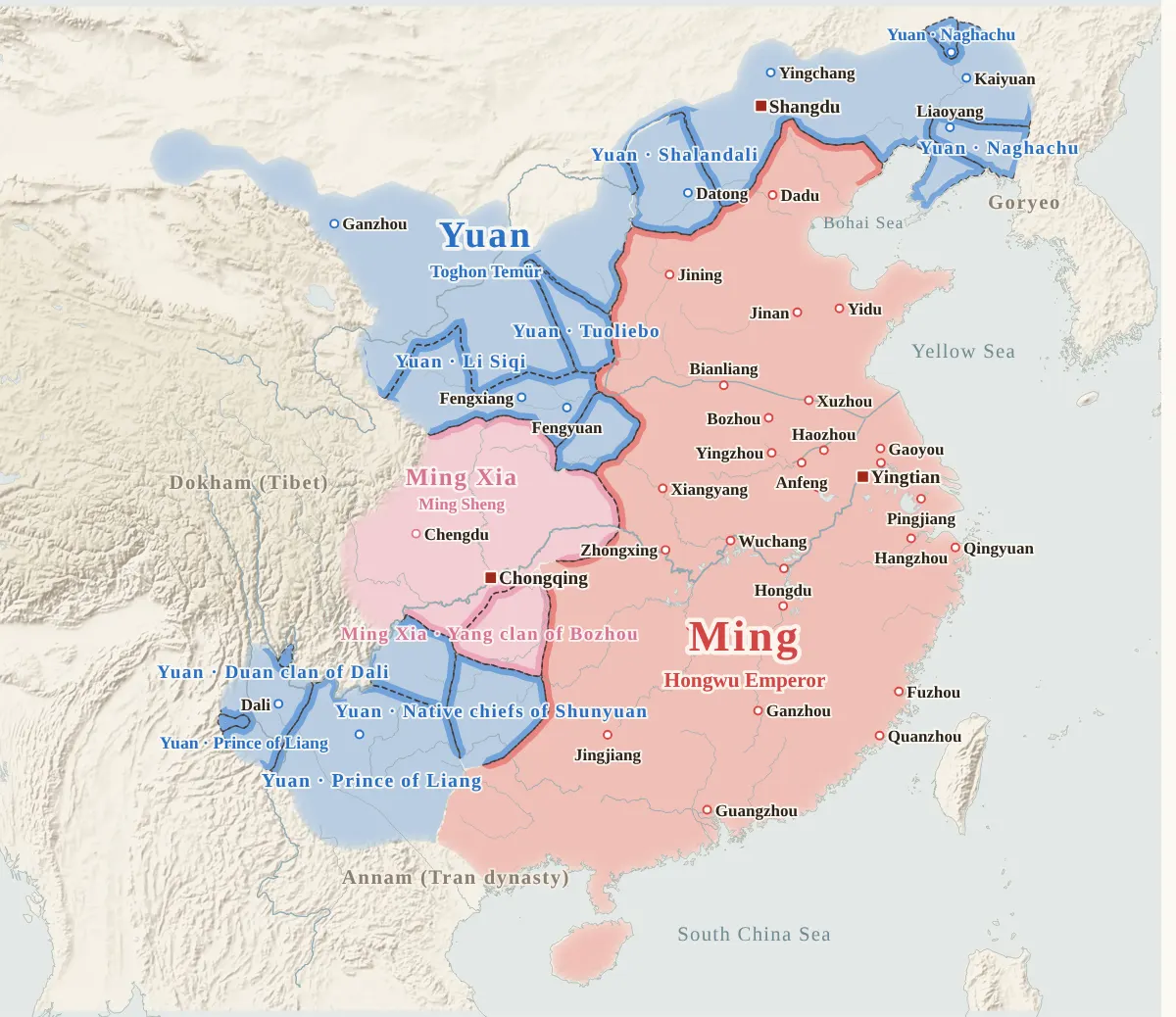
Zhu Yuanzhang, who had joined the army of Guo Zixing, which rose in arms at Haozhou at the end of the Yuan, crossed the Yangtze and took Caishi and Taiping, defeated Chen Youliang on Lake Poyang in 1363, and in 1367 his general Xu Da captured Zhang Shicheng. During those years, in 1364, he was put forward by his officials and took the position of King of Wu, and in 1368 he took the imperial throne as the Hongwu Emperor and named his state Ming. The same year Yingtian was made Nanjing, and Xu Da's army entered the Yuan capital.
Course
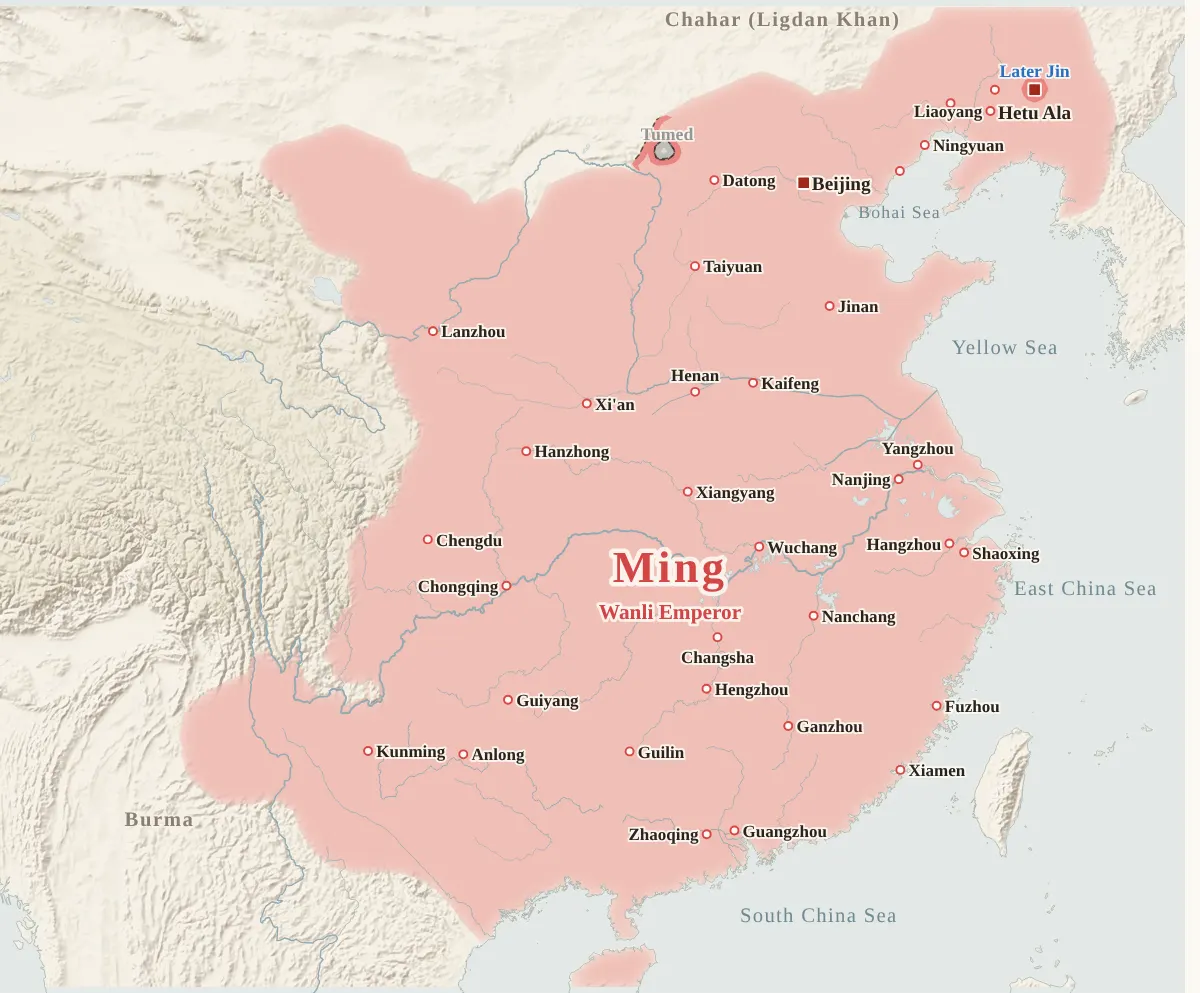
In 1380 the Hongwu Emperor put the chancellor Hu Weiyong to death for treason, then abolished the Secretariat and the post of chancellor and divided the business of government among the Six Ministries, and in 1395 he forbade his successors to restore the post of chancellor. After the death of the Hongwu Emperor, in the reign of his grandson the Jianwen Emperor, the princes who were the emperor's uncles were reduced to commoners one after another, and in 1399 the Prince of Yan at Beiping rose in arms, and in 1402 he took the capital, Nanjing, and ascended the throne as the Yongle Emperor. The Yongle Emperor sent Zheng He and others to the Western Ocean in 1405, and in 1420 he proclaimed to the realm that Beijing would be the capital. The Grand Secretaries, who had been no more than advisers, were held in higher regard from the reigns of the Hongxi Emperor and the Xuande Emperor, and the power of the Grand Secretariat grew day by day; in the reign of the Jiajing Emperor, Xia Yan and Yan Song became chancellors in all but name, but the drafts of the Grand Secretariat were decided by the vermilion endorsements of the eunuchs, and the power of the chancellor passed to the eunuchs.
In 1449 Emperor Yingzong of Ming led a campaign in person against Esen of the Oirats, and was defeated and captured at Tumu. In Beijing his younger brother, the Jingtai Emperor, took the throne, and Yu Qian and others drove back the army of Esen, which had closed in, but in 1457 Shi Heng and others restored Emperor Yingzong of Ming to the throne. In the palace, the Chenghua Emperor set up the Western Depot in 1477 and had the eunuch Wang Zhi gather intelligence, and in 1506 the Zhengde Emperor put the eunuch Liu Jin in charge of the Directorate of Ceremonial.
In 1571 the Longqing Emperor enfeoffed Altan Khan as Prince Shunyi, and tribute markets were opened at three garrisons on the northern frontier. At the beginning of the reign of the Wanli Emperor, Zhang Juzheng directed the government and the state came close to wealth and strength, but later the emperor shut himself away deep in the palace and stopped meeting his ministers, and from 1596 he sent eunuchs to various places to open mines and collect taxes. In the reign of the Tianqi Emperor the eunuch Wei Zhongxian wielded power as he pleased, and in 1625 Yang Lian and other Donglin officials died in prison.
Fall
In 1644 the Chongzhen Emperor rejected both moving south and sending the crown prince to Nanjing. The same year the army of Li Zicheng, who had called himself king at Xi'an and named his state the Great Shun, took Beijing, and the Chongzhen Emperor died on Wansui Hill. Soon Qing troops entered Beijing through the Shanhai Pass, and in Nanjing the Prince of Fu, a grandson of the Wanli Emperor, was set up as emperor.
Translated from the Japanese text of this site, which is written from the official histories. Years are the Western calendar years of the dates, as in English reference works.