Emperors of the Yuan dynasty 元
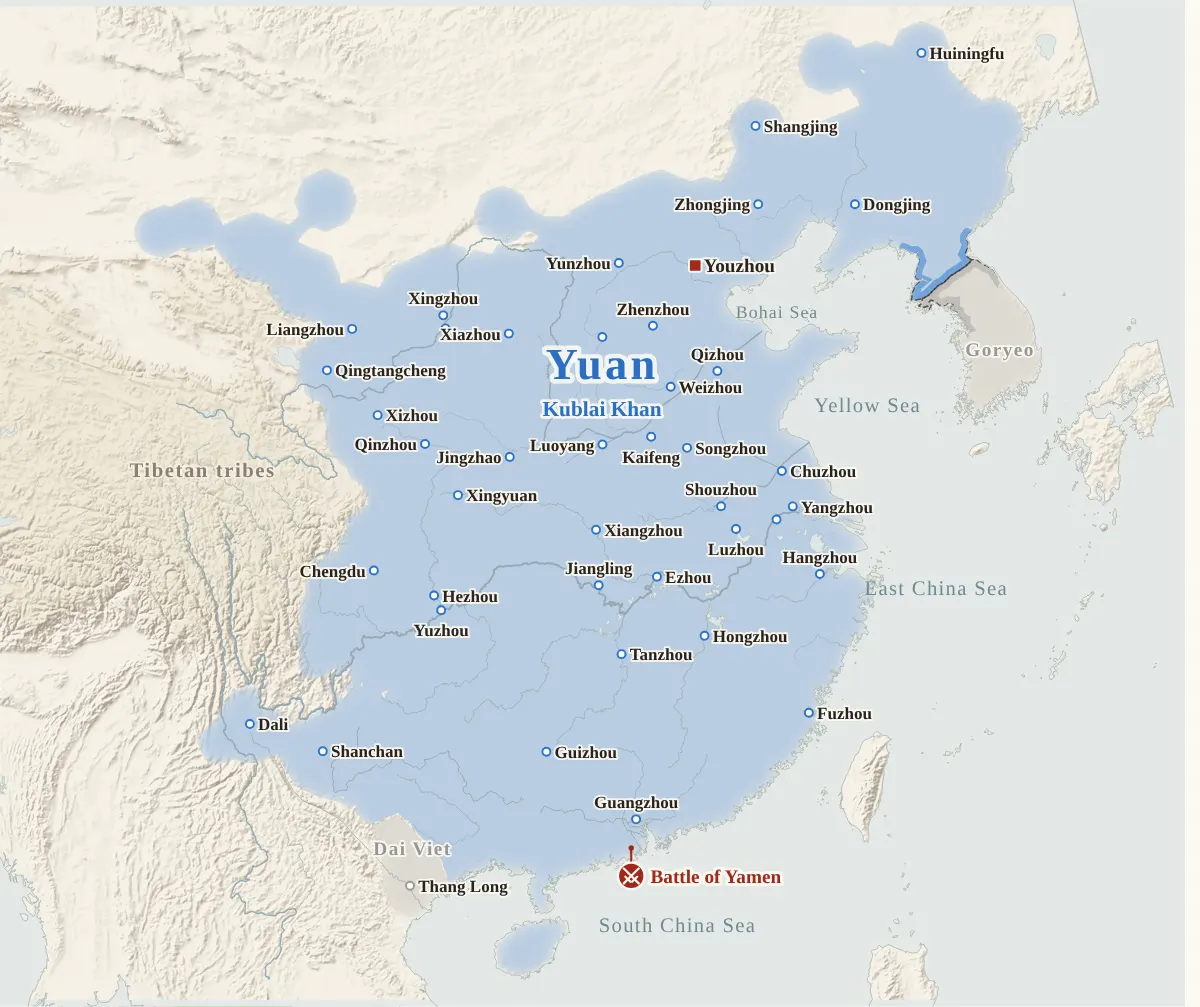
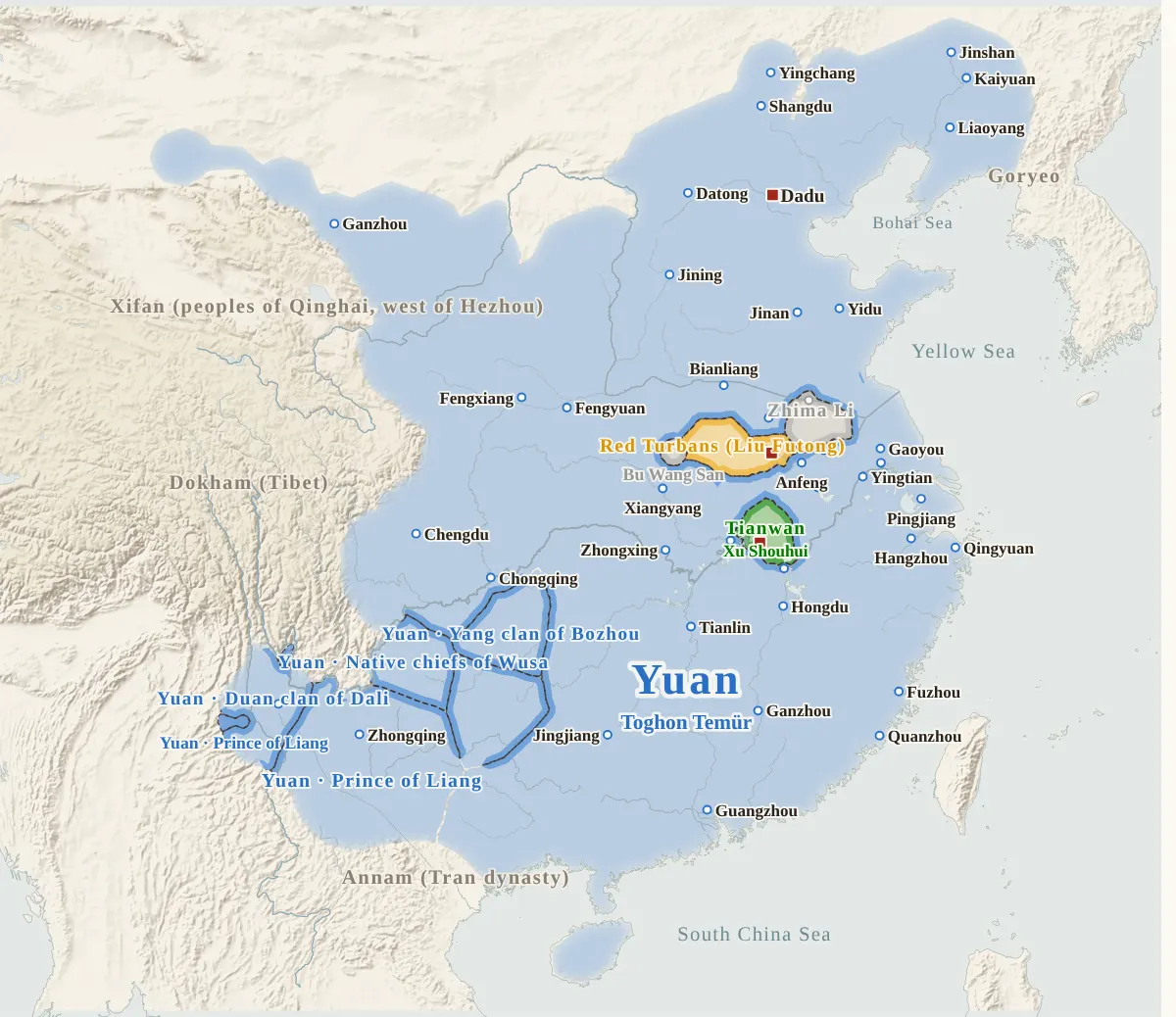
The emperors of Yuan (1260–1370) in order of accession, from Kublai Khan to Toghon Temür.
- Rulers
- 15 rulers
Rulers in order
- 1stGenghis Khan鐵木真1206–1227 · Did not take the title of emperor1206–1227Did not take the title of emperor
- 2ndÖgedei Khan窩闊台1229–1241 · Did not take the title of emperor1229–1241Did not take the title of emperor
- 3rdGüyük Khan貴由1246–1248 · Did not take the title of emperor1246–1248Did not take the title of emperor
- 4thMöngke Khan蒙哥1251–1259 · Did not take the title of emperor1251–1259Did not take the title of emperor
- 5thKublai Khan元世祖 Yuán Shìzǔ忽必烈 Hūbìliè1260–1294 · 33 years · Natural causes, age 781260–129433 yearsNatural causes, age 78
- 6thTemür Khan元成宗 Yuán Chéngzōng鐵穆耳 Tiěmù'ěr1294–1307 · 12 years · Natural causes, age 411294–130712 yearsNatural causes, age 41
- 7thKülüg Khan元武宗 Yuán Wǔzōng海山 Hǎishān1307–1311 · 3 years · Natural causes, age 291307–13113 yearsNatural causes, age 29
- 8thAyurbarwada Buyantu Khan元仁宗 Yuán Rénzōng愛育黎拔力八達 Àiyùlíbálìbādá1311–1320 · 8 years · Natural causes, age 341311–13208 yearsNatural causes, age 34
- 9thGegeen Khan元英宗 Yuán Yīngzōng碩德八剌 Shuòdébālá1320–1323 · 3 years · Assassinated, age 201320–13233 yearsAssassinated, age 20
- 10thYesün Temür元泰定帝 Yuán Tàidìngdì也孫鐵木兒 Yěsūntiěmù'ér1323–1328 · 4 years · Natural causes, age 34–351323–13284 yearsNatural causes, age 34–35
- 11thRagibagh Khan元天順帝 Yuán Tiānshùndì阿速吉八 Āsùjíbā1328 · 44 days · Unknown132844 daysUnknown
- 12th, 14thTugh Temür元文宗 Yuán Wénzōng圖帖睦爾 Tútiēmù'ěr1328–1329; restored 1329–1332 · 3 years · Natural causes, age 281328–1329; restored 1329–13323 yearsNatural causes, age 28
- 13thKusala元明宗 Yuán Míngzōng和世㻋 Héshìlà1329 · 184 days · Assassinated, age 281329184 daysAssassinated, age 28
- 15thRinchinbal Khan元寧宗 Yuán Níngzōng懿璘質班 Yìlínzhìbān1332 · 52 days · Natural causes, age 6133252 daysNatural causes, age 6
- 16thToghon Temür元惠宗 Yuán Huìzōng妥懽帖睦爾 Tuǒhuāntiēmù'ěr1333–1370 · 36 years · Natural causes, age 491333–137036 yearsNatural causes, age 49
Rise and fall of the Yuan dynasty
Rise
Temüjin of the Mongol tribe gathered the princes and officials at the source of the Onon River in 1206, took the throne and was given the honorific title Genghis, and later, in 1234, in the reign of Ögedei (Taizong), the Jin fell. In 1259 word of the death of Möngke (Xianzong) reached his younger brother Kublai, to whom he had entrusted military and civil affairs in the Han lands south of the desert, and the next year, 1260, Kublai was put forward by the princes at Kaiping and took the imperial throne as Kublai Khan. Kublai Khan fought his younger brother Ariq Böke, whom the old officials had put forward, and after Ariq Böke came to him in 1264, Kublai Khan fixed the name of the state as the Great Yuan in 1271.
Course
As capitals, Kaiping, which Liu Bingzhong had been ordered to build, was made Shangdu, and the new city built at Yan was named Dadu. At court the Secretariat handled the business of government, the Bureau of Military Affairs held military command and the Censorate oversaw officials, while in the regions branch secretariats and other offices were set up; Mongols were made the heads of offices, and Han people and southerners were placed below them. In the south the Southern Song empress dowager and the boy emperor surrendered in 1276, and in 1279 Zhao Bing, the Prince of Wei, who had fled as far as Yashan, also threw himself into the sea and died. Troops were sent against Japan in 1274 and 1281, and the second time the ships were struck by wind and waves and the expedition suffered a great defeat.
After Kublai Khan died in 1294, struggles over the throne among the imperial clan and high officials broke out again and again. In 1307 Ahutai and others, who had tried to have the empress of Temür Khan take charge of the government, were put to death and Külüg Khan took the throne, and in 1313, in the reign of the next emperor, Ayurbarwada Buyantu Khan, it was decided to hold the civil service examinations, and in 1315 the metropolitan examination for jinshi was held. In 1323, on the way back from Shangdu, Gegeen Khan and the chancellor Baizhu were killed at Nanpo by Tieshi and others. When Yesün Temür died in 1328, fighting broke out between Ragibagh Khan, set up at Shangdu, and the side of Tugh Temür, set up at Dadu, and Shangdu surrendered. The next year, 1329, Kusala, who had taken the throne in the north, died suddenly four days after entertaining Tugh Temür, and Tugh Temür took the throne again at Shangdu.
In 1351, in the reign of Toghon Temür, Liu Futong of Yingzhou rose in arms with the red turban as his emblem. In 1356, on the grounds that armed risings had broken out throughout the realm, Toghon Temür issued an edict blaming himself.
Fall
In 1368, as the Ming armies drew near, Toghon Temür ignored remonstrances, left Dadu at midnight and fled north, and the Ming army entered Dadu. Toghon Temür died at Yingchang in 1370, and the same year Yingchang too was attacked by the Ming army; his grandson Maidilibala was captured, and the crown prince escaped with a dozen or so horsemen. The Ming gave Toghon Temür the title Shundi, holding that he had known the Mandate of Heaven and withdrawn.
Translated from the Japanese text of this site, which is written from the official histories. Years are the Western calendar years of the dates, as in English reference works.