Emperors of the Qin dynasty 秦
The emperors of Qin (221–207 BC) in order of accession, from Qin Shi Huang to Qin Er Shi.
- Emperors
- 2 emperors
Rise and fall of the Qin dynasty
Rise
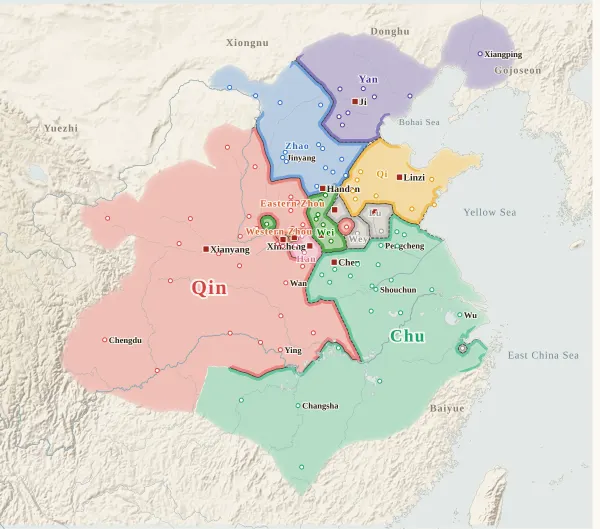
Qin was a state that had had its capital at Xianyang since the reign of Duke Xiao, and as King of Qin, Qin Shi Huang began by capturing the King of Han in 230 BC, went on to subdue Zhao, Wei, Chu and Yan, and in 221 BC brought the King of Qi to submission and united the realm. The King of Qin had his ministers deliberate on a new title; joining the character huang to the title di of the rulers of high antiquity, he called himself huangdi, emperor, abolished posthumous names, and ruled that he himself would be the First Emperor and that later generations would be counted as the Second and the Third.
Course
After unification Qin rejected a proposal to set up the ruler's sons as kings in the distant lands, divided the realm into 36 commanderies, and placed a governor, a commandant and an overseer in each. It made the laws, the weights and measures, the axle width of carts and the written script uniform, gathered the weapons of the realm at Xianyang and melted them down, and cast bells and 12 metal statues.
Qin Shi Huang made tours through the realm and set up stones on mountains, and in the north he had Meng Tian attack the Hu and take the land south of the Yellow River and build the Great Wall from Lintao to Liaodong. In 213 BC he had the histories other than the records of Qin and the Odes and Documents held among the people burned, and the next year he put more than 700,000 convicts to work on the Epang Palace and the tomb at Mount Li and had more than 460 scholars of Xianyang who were said to have broken the prohibitions buried alive.
In 210 BC Qin Shi Huang died at Shaqiu on the way back from a tour. On Li Si's judgment the death of Qin Shi Huang was kept secret, and meanwhile Zhao Gao plotted with Huhai and Li Si to forge the late emperor's last edict, set up Huhai, the youngest son, as crown prince, and sent written orders for the deaths of the eldest son, Fusu, and the general Meng Tian. Mourning was announced only after the party reached Xianyang, and Huhai succeeded to the throne as Qin Er Shi. Qin Er Shi killed high ministers and princes and resumed work on the Epang Palace, and the law was applied ever more harshly.
Fall
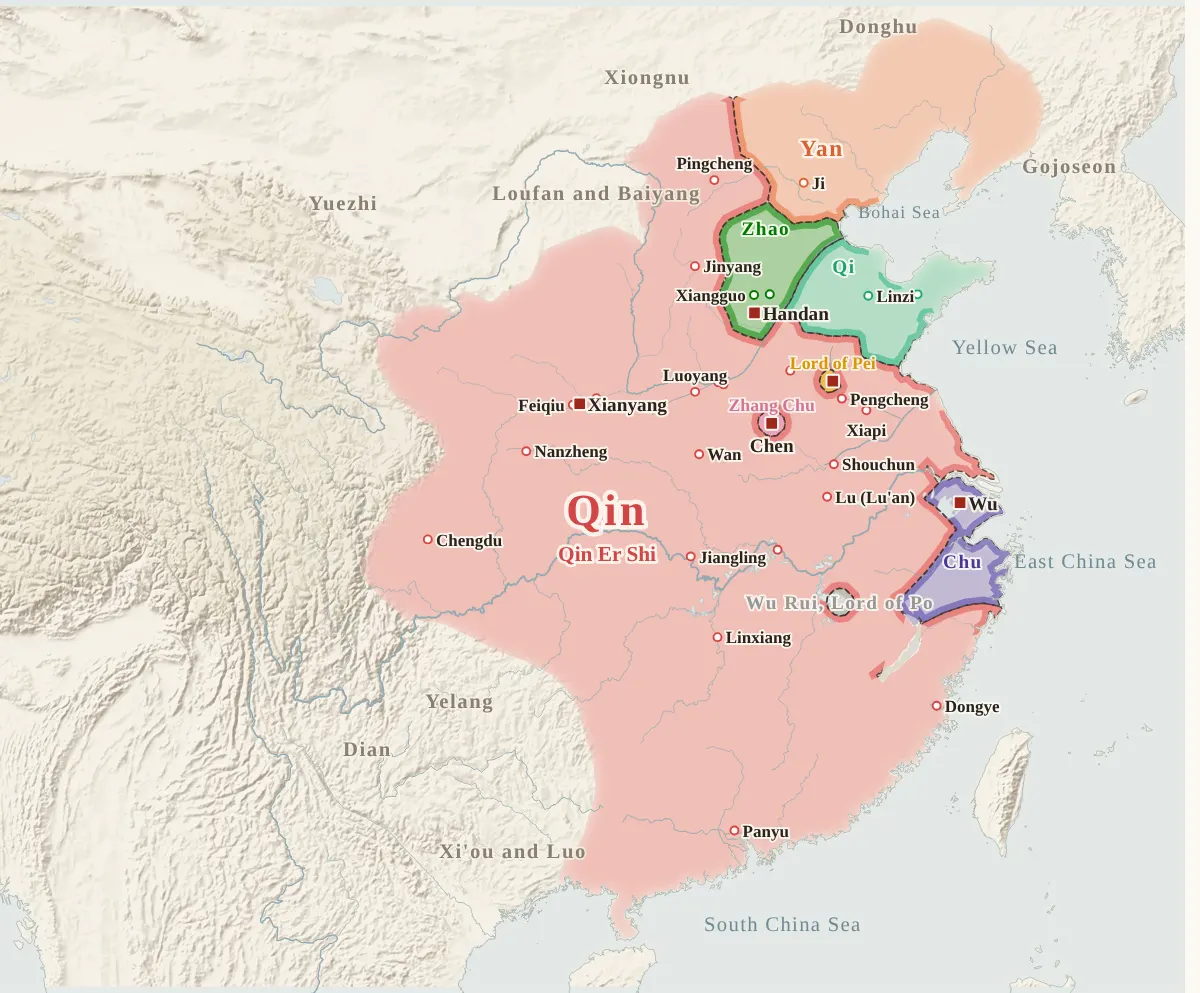
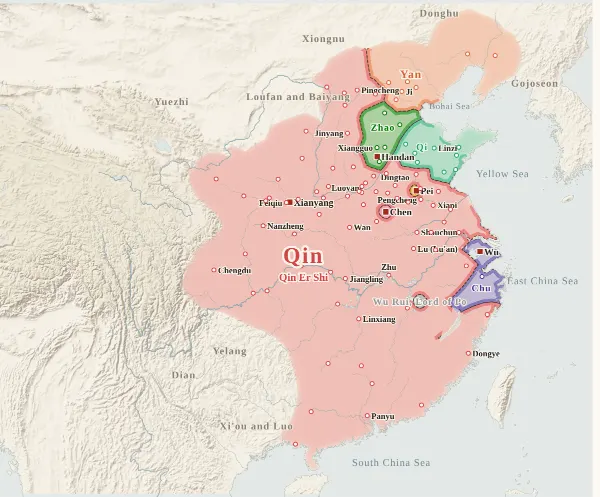
In 209 BC Chen Sheng and Wu Guang, who were going to miss their deadline on the way to garrison the frontier, rose in arms; in the commanderies and counties of the east men killed their officials and joined them one after another, and kings were set up in many places. Zhang Han made soldiers of the convicts at work on Mount Li and defeated the rebels, but in 207 BC Xiang Yu relieved Julu and captured the Qin general Wang Li, and afterwards Zhang Han and others also led their troops over to the lords in surrender. In the capital, Yan Le, Zhao Gao's son-in-law, who had plotted with him, led soldiers into the Wangyi Palace, and Qin Er Shi killed himself. Zhao Gao, saying that the six states had again become independent and the territory of Qin had shrunk, abolished the title of emperor and set up Prince Ziying as King of Qin. Ziying stabbed Zhao Gao to death, but soon afterwards he surrendered to Emperor Gaozu of Han, who had entered through the Wu Pass. Xiang Yu killed Ziying, who had surrendered, carried out a massacre in Xianyang, and burned the palaces of Qin. The land of Qin was divided into three, and five years later the realm was settled under the Western Han.
Translated from the Japanese text of this site, which is written from the official histories. Years are the Western calendar years of the dates, as in English reference works.
Qin year by year on the map
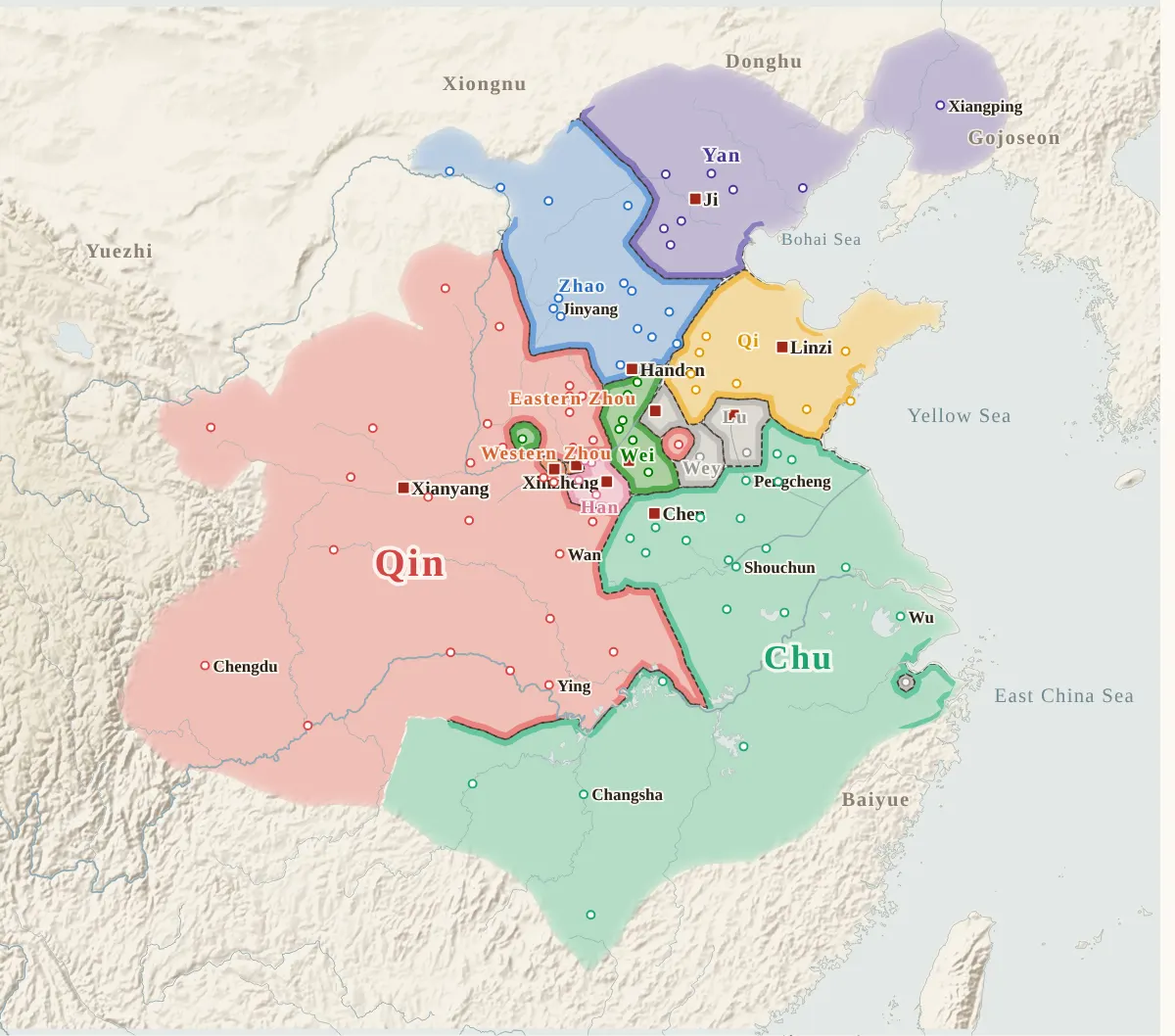 Map of the Warring States260–221 BC · move year by year and see who held each city
- 260 BCBattle of Changping
- 257 BCLord Xinling lifts the siege of Handan
- 256 BCWestern Zhou submits to Qin
- 249 BCEastern Zhou falls
- 247 BCKing Zheng of Qin takes the throne
- 241 BCFive states join forces against Qin
- 230 BCHan falls
- 228 BCHandan falls
- 225 BCWei falls
- 223 BCChu falls
- 222 BCYan and Dai fall
- 221 BCQi surrenders and Qin unifies China