Qin Shi Huang
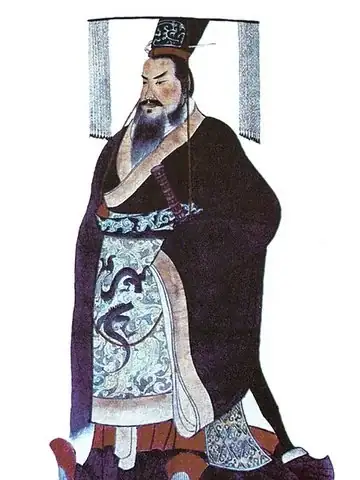
Qin · Qin and Western Han · 1st ruler
秦始皇 Qín Shǐhuáng嬴政 Yíng Zhèng
Wade–Giles: Ch'in Shih-huang · Ying Cheng
Reigned 221–210 BC (10 years)
Reigned 10 years (221–210 BC). Died at 50 (East Asian reckoning) of natural causes. 1st ruler of Qin.
Facts
- Reign
- 221 BC – 10 September 210 BC (1st ruler of Qin)
- Length of reign
- 10 years
- Born
- 259 BC
- Died
- 10 September 210 BC
- Age at accession
- 39
- Age at death
- 50
- Cause of death
- Natural causesNatural death or illness (including old age)
- Path to the throne
- Succession (circumstances unrecorded)Founded the titleSucceeded the previous ruler of the same regime, but the primary sources do not say who decided it (e.g. Qin Shi Huang, Emperor Taizong of Song)
- Predecessor
- 莊襄王 (did not claim the title of emperor)
- Successor
- Qin Er Shi
Ages are given in East Asian reckoning (sui): a person is one year old at birth and gains a year at each New Year, so the figure is one or two years higher than the Western age.
Life
In brief
He conquered the six rival states, unified the realm, and was the first ruler to change his title from king to emperor. He divided the realm into 36 commanderies and standardized weights and measures, axle widths, and the written script.
Road to the throne
The basic annals of the Shiji make him the son of King Zhuangxiang of Qin, and record that he was born after King Zhuangxiang, while a hostage in Zhao, took a concubine of Lü Buwei as his wife. The biography of Lü Buwei in the same Shiji tells a story that Lü Buwei presented the concubine, whom he knew to be pregnant, to Zichu (later King Zhuangxiang), and that she hid this and bore the child. The three classic commentaries gloss the length of this pregnancy as twelve months, two months longer than usual, and the Zizhi Tongjian writes that she carried the child for a year before giving birth. If the story is true, she would have been carrying Lü Buwei's child for about a year; this site follows the basic annals and gives King Zhuangxiang as his father. When King Zhuangxiang died, he was made king of Qin.
Reign and death
On the advice of Li Si he had histories other than the records of Qin, and the Odes and Documents held by private people, burned, and when the fangshi magicians fled he grew angry and had more than 460 scholars who had broken his bans buried alive at Xianyang. His eldest son Fusu, who remonstrated against this, was sent away to Meng Tian on the northern frontier. On his last tour he fell ill at the Pingyuan ford and wrote a letter to Fusu telling him to join the mourning and hold the funeral at Xianyang, but he died at Shaqiu before the letter was handed to a messenger. Zhao Gao, Huhai and Li Si kept his death secret, destroyed the letter, falsely claimed to have received a testamentary edict making Huhai crown prince, and sent Fusu and Meng Tian letters ordering them to die. Neither the basic annals nor the biography of Li Si states in its own narrative that the letter to Fusu named him as successor. In the biography of Li Si, Zhao Gao tells Li Si that the letter instructed Fusu to receive the coffin at Xianyang and be set up as heir. The basic annals record that on the journey back the body began to smell in the heat, and that salted fish were loaded onto the carriages to cover the odor.
Translated from the Japanese text of this site, which is written from the official histories. Years are given in the Western calendar; months are omitted because the histories use the Chinese lunar calendar.
During the reign
Number of times each event is recorded in the official histories. How each item is counted
- Era name changes
- 0
- General amnesties
- 0
- Empresses installed
- 0
- Crown princes deposed
- 0
- Personal campaigns
- 0
- Rebellions suppressed
- 0
- Rebellions faced
- 0
- Capital relocations
- 0