Emperors of the Western Han dynasty 漢
The emperors of Western Han (202 BC – AD 6) in order of accession, from Emperor Gaozu of Han to Emperor Ping of Han, including Emperor Wu of Han.
- Emperors
- 14 emperors
Emperors in order
- 1stEmperor Gaozu of Han漢高祖 Hàn Gāozǔ劉邦 Liú Bāng202–195 BC · 7 years · Natural causes, age 60–61202–195 BC7 yearsNatural causes, age 60–61
- 2ndEmperor Hui of Han漢惠帝 Hàn Huìdì劉盈 Liú Yíng195–188 BC · 7 years · Natural causes, age 21–22195–188 BC7 yearsNatural causes, age 21–22
- 3rdEmperor Qianshao of Han漢前少帝 Hàn Qiánshàodì188–184 BC · 3 years · Assassinated188–184 BC3 yearsAssassinated
- 4thEmperor Houshao of Han漢後少帝 Hàn Hòushàodì劉弘 Liú Hóng184–180 BC · 4 years · Executed184–180 BC4 yearsExecuted
- 5thEmperor Wen of Han漢文帝 Hàn Wéndì劉恆 Liú Héng180–157 BC · 22 years · Natural causes180–157 BC22 yearsNatural causes
- 6thEmperor Jing of Han漢景帝 Hàn Jǐngdì劉啓 Liú Qǐ157–141 BC · 15 years · Natural causes, age 46–47157–141 BC15 yearsNatural causes, age 46–47
- 7thEmperor Wu of Han漢武帝 Hàn Wǔdì劉徹 Liú Chè141–87 BC · 54 years · Natural causes, age 68–69141–87 BC54 yearsNatural causes, age 68–69
- 8thEmperor Zhao of Han漢昭帝 Hàn Zhāodì劉弗陵 Liú Fúlíng87–74 BC · 13 years · Natural causes, age 19–2087–74 BC13 yearsNatural causes, age 19–20
- 9thMarquis of Haihun漢廢帝 Hàn Fèidì劉賀 Liú Hè74 BC · 27 days · Unknown74 BC27 daysUnknown
- 10thEmperor Xuan of Han漢宣帝 Hàn Xuāndì劉詢 Liú Xún74–48 BC · 25 years · Natural causes, age 4274–48 BC25 yearsNatural causes, age 42
- 11thEmperor Yuan of Han漢元帝 Hàn Yuándì劉奭 Liú Shì48–33 BC · 15 years · Natural causes48–33 BC15 yearsNatural causes
- 12thEmperor Cheng of Han漢成帝 Hàn Chéngdì劉驁 Liú Ào33–7 BC · 25 years · Natural causes, age 43–4433–7 BC25 yearsNatural causes, age 43–44
- 13thEmperor Ai of Han漢哀帝 Hàn Āidì劉欣 Liú Xīn7–1 BC · 6 years · Natural causes, age 23–247–1 BC6 yearsNatural causes, age 23–24
- 14thEmperor Ping of Han漢平帝 Hàn Píngdì劉衎 Liú Kàn1 BC – AD 6 · 5 years · Disputed, age 131 BC – AD 65 yearsDisputed, age 13
Rise and fall of the Western Han dynasty
Rise
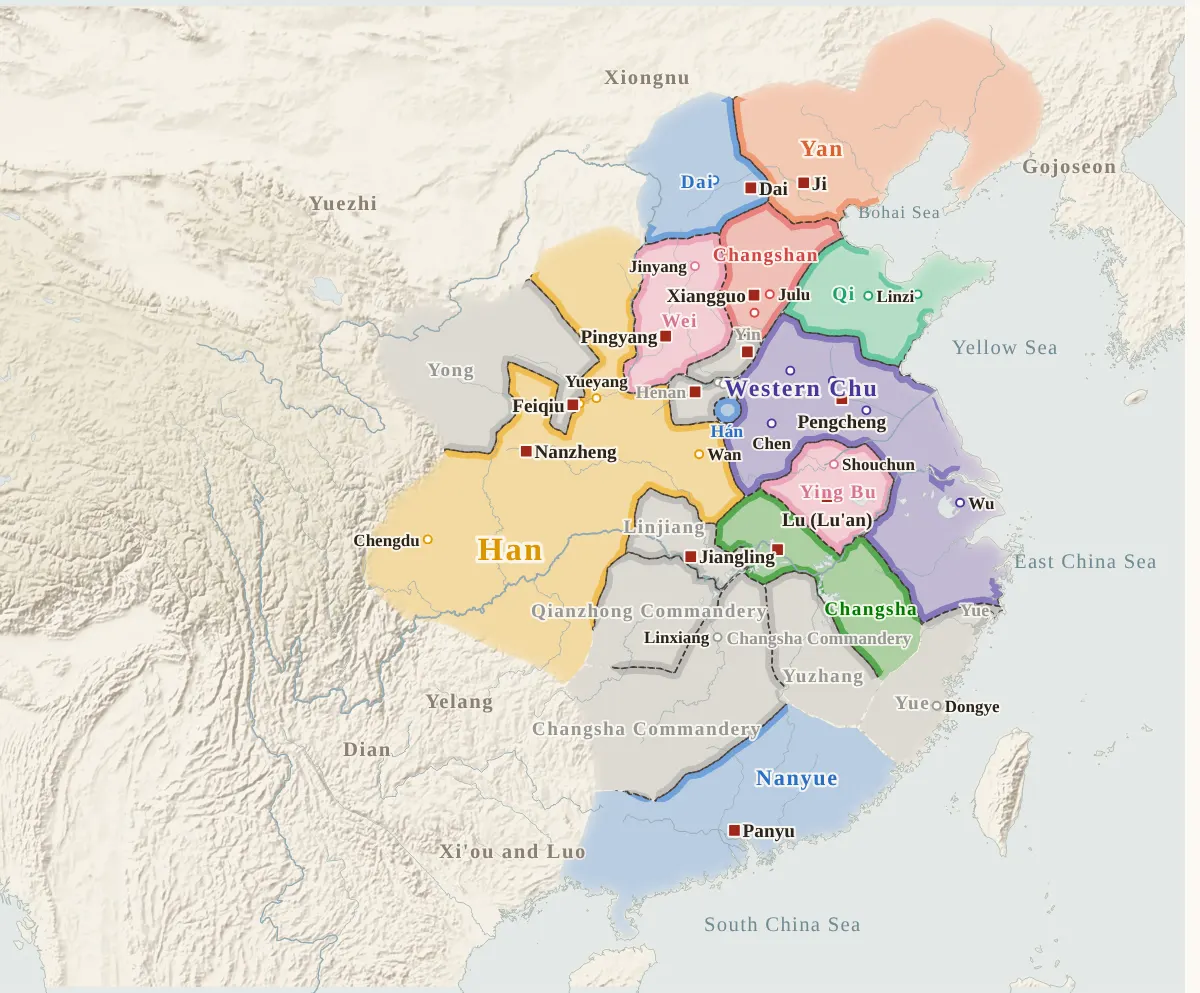
In 206 BC Xiang Yu made Emperor Gaozu of Han, who had raised troops at Pei and entered Guanzhong, King of Han, gave him Ba, Shu and Hanzhong, and had him make Nanzheng his capital. In 202 BC Emperor Gaozu of Han defeated Xiang Yu at Gaixia, and he took the throne after the vassal kings and others offered him the honorific title of emperor. The capital was first placed at Luoyang, but on the advice of Lou Jing and Zhang Liang it was decided to move it to Guanzhong, and in 200 BC it was moved from Yueyang to Chang'an.
Course
Emperor Gaozu of Han arrested Han Xin, the King of Chu, and demoted him to Marquis of Huaiyin. In 196 BC Han Xin in Chang'an and Peng Yue, the King of Liang, were both destroyed together with their kin on charges of treason, and Emperor Gaozu of Han himself attacked Qing Bu, the King of Huainan, who had rebelled. When Emperor Hui of Han died, members of the Lü clan were put in command of the Southern and Northern Armies at the chancellor's request, and from the reign of the next emperor, Emperor Qianshao of Han, all orders came from Empress Dowager Lü. When Empress Dowager Lü died in 180 BC, Chen Ping, Zhou Bo and others destroyed the Lü clan and welcomed Emperor Wen of Han, who was King of Dai, and they also killed Emperor Houshao of Han and his younger brothers on the grounds that they were not sons of Emperor Hui of Han.
Emperor Wen of Han abolished the mutilating punishments, remitted the tax on fields, and concluded a heqin peace with the Xiongnu. In the reign of Emperor Jing of Han, Chao Cuo memorialized that the lands of the vassal kings be reduced, and in 154 BC seven kings, including the Kings of Wu and Chu, raised troops. Emperor Jing of Han had Chao Cuo beheaded as an apology to the seven states, but generals including Zhou Yafu defeated the seven states; the King of Wu was beheaded and the other six kings killed themselves. Emperor Wu of Han set aside the hundred schools and honored the Six Classics, and he sent Wei Qing and Huo Qubing against the Xiongnu; in the fighting of 119 BC the dead of the two Han armies, too, numbered in the tens of thousands. In the witchcraft affair of 91 BC, the crown prince beheaded Jiang Chong and raised troops, tens of thousands died in Chang'an, and the empress and the crown prince killed themselves. Emperor Wu of Han rejected a memorial proposing military farms at Luntai, issued an edict expressing deep remorse for the past, and sent out no more troops after that.
When Emperor Zhao of Han died without an heir, Huo Guang, the General-in-Chief who had assisted him, brought in Liu He, the King of Changyi (the Marquis of Haihun), soon deposed him, and set up Emperor Xuan of Han, a great-grandson of Emperor Wu of Han. After Huo Guang's death Emperor Xuan of Han took charge of the government himself, and he destroyed the Huo clan on the grounds that it had plotted rebellion. In the reign of Emperor Yuan of Han, affairs of state great and small were decided through the eunuch Shi Xian, and in the reign of Emperor Cheng of Han, the emperor's maternal uncle Wang Feng became Grand Marshal and General-in-Chief and the Wang clan took over the government of the state.
Fall
When Emperor Ai of Han died without an heir, Wang Mang, who had become Grand Marshal, brought in Emperor Ping of Han and took charge of the government, received the title Duke Anhan, and set up his daughter as empress. When Emperor Ping of Han died early in AD 6, Wang Mang governed in place of the Son of Heaven by an edict of the grand empress dowager, and he then set up Ying, a great-great-grandson of Emperor Xuan of Han, as crown prince with the title Ruzi. In AD 7 Zhai Yi, the governor of Dong Commandery, raised troops, proclaiming that Wang Mang had poisoned Emperor Ping of Han, but he was defeated the same year. In AD 8 Wang Mang received the document from the golden casket at the Gao Temple, took the throne as Son of Heaven, and named the state Xin. The next year Ruzi was enfeoffed as Duke of Ding'an, and he descended from the hall, faced north, and called himself a subject.
Translated from the Japanese text of this site, which is written from the official histories. Years are the Western calendar years of the dates, as in English reference works.