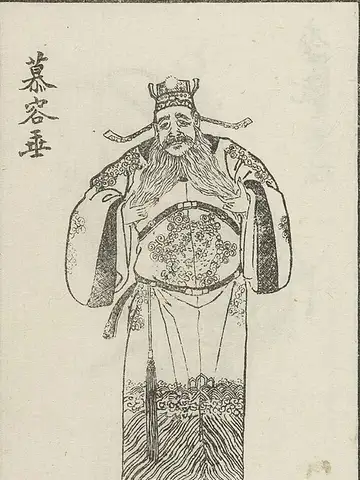
Facts
Murong Chui reigned for 10 years (386–396), taking the throne at 59 or 60, and died of natural causes at 69 or 70. 1st ruler of Later Yan.
- Reign
- 15 March 386 – 2 June 396 (1st ruler of Later Yan)
- Length of reign
- 10 years
- Born
- Unknown
- Died
- 2 June 396
- Age at accession
- 59–60
- Age at death
- 69–70
- Cause of death
- Natural causesNatural death or illness (including old age)
- Path to the throne
- Self-proclaimedFounded the titleClaimed the imperial title without receiving the throne from an earlier ruler (e.g. Emperor Gaozu of Han, Emperor Guangwu of Han, Hongwu Emperor)
- Posthumous name
- 後燕成武帝 Hòu Yàn Chéngwǔdì
- Temple name
- 後燕世祖 Hòu Yàn Shìzǔ
- Personal name
- 慕容垂 Mùróng Chuí
- Wade–Giles
- Hou Yen Ch'eng-wu-ti · Mu-jung Ch'ui
Life
In brief
The historians' comment in the Book of Jin says that he was a hero by nature and served Fu Jian with all his strength, while also saying that a wolf's heart stays wild of itself.
Road to the throne
He was the fifth son of Murong Huang of Former Yan and was his father's favourite, and his father always said that this boy was broad-minded and would either ruin a family or make one; the heir, Murong Jun, resented this. In 369 he defeated Huan Wen of Eastern Jin at Fangtou and his fame grew, but Murong Ping and others plotted to have him put to death. According to the Zizhi Tongjian, when urged to strike first he refused, saying he would rather die than have kin kill one another, and he later fled to Fu Jian of Former Qin. Fu Jian came out to the outskirts of the city to meet him and took his hand, and did not follow Wang Meng's advice to kill him. In 383, when Fu Jian came to him for refuge after his defeat at the Fei River, his son Murong Bao and his younger brother Murong De urged him to do away with Fu Jian, but Murong Chui answered Bao that if Heaven abandoned Fu Jian there would be many chances, told De that he had not yet finished repaying Fu Jian's kindness, and handed the troops back to Fu Jian. He then killed Fu Feilong, who had been sent to watch over him, crossed the Yellow River, and proclaimed himself King of Yan at Xingyang. At Xingtang he buried alive the whole following of the Dingling, whose chief clerk had beheaded his master and surrendered. In 386 he made Zhongshan his capital, took the throne as emperor, and made Murong Bao crown prince.
Reign and death
According to the Zizhi Tongjian and other sources, when Guang Zuo, who had once voiced to Fu Jian suspicions of Murong Chui, surrendered, Murong Chui pardoned him and treated him as before, and on meeting him shed tears as he spoke of the generosity he himself had received from Fu Jian. According to the biographies of exemplary women in the Book of Jin, his empress, Duan Yuanfei, warned him that the crown prince was not the man to rescue the realm in hard times, but he rejected her advice, and when she raised it again, he asked whether she wanted to make him a Duke Xian of Jin. Saying that even in his old age the wisdom at the bottom of his bag was enough to win, he attacked Murong Yong of Western Yan, and in 394 he captured him and put him to death. In 395 he sent the crown prince, Murong Bao, against Northern Wei, but at Canhe the Wei army fell on them by surprise and the whole army broke and fled. The next year he set out himself at the head of a large army, and a detached force took Pingcheng. At Canhe he saw the bones on the battlefield of the year before piled up like a mountain and held a memorial rite, and as all the soldiers wailed, he coughed up blood in shame and anger and fell ill. He died in 396 at Juyang in Shanggu.
Translated from the Japanese text of this site, which is written from the official histories. Years are the Western calendar years of the dates, as in English reference works. Months are omitted because the histories use the Chinese lunar calendar.