Hou Jing
Hou Jing, who had defected from Eastern Wei to Liang, rebelled in 548, took the Liang capital the next year, and seized the throne in 552, but was killed later that same year.
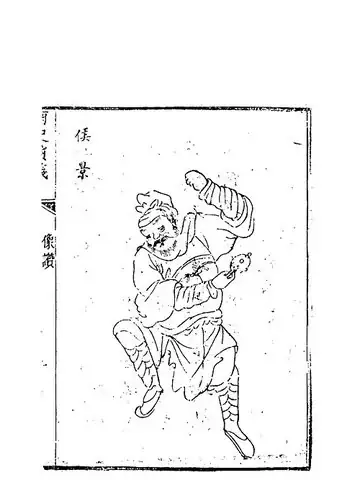
Facts
Hou Jing reigned for 121 days (552) and was assassinated. 1st ruler of Han (Hou Jing).
- Reign
- 1 January 552 – May 552 (1st ruler of Han (Hou Jing))
- Length of reign
- 121 days
- Born
- Unknown
- Died
- May 552
- Age at accession
- Unknown
- Age at death
- Unknown
- Cause of death
- AssassinatedKilled by officials, relatives, eunuchs or others within the same regime (including poisoning)
- Path to the throne
- Abdication from another dynastyReceived the throne from an emperor of another family or regime in a change of dynasty led by the new emperor (e.g. Cao Pi, Yang Jian, Zhao Kuangyin)
- Predecessor
- Xiao Dong
- Era names
- 太始 Tàishǐ (proclaimed 552)
- Personal name
- 侯景 Hóu Jǐng
- Wade–Giles
- Hou Ching
Life
In brief
The historians' comment in the Book of Liang calls him a petty nobody and judges the harm he did to be worse even than that of Wang Mang, Dong Zhuo and others.
Road to the throne
According to the Book of Liang, he was brave and fierce and skilled at mounted archery, and though cruel he kept his troops under strict discipline and shared out the treasure he seized among his officers and men. The History of the Southern Dynasties says that his right leg was short, that riding and archery were not his strengths, and that he achieved things through his wits and stratagems. According to the Book of Liang, when the gravely ill Gao Huan summoned him by letter, he feared disaster and in 547 defected to Liang. The History of the Southern Dynasties and the Zizhi Tongjian treat that letter as a forgery by Gao Cheng. Emperor Wu of Liang overrode the objections, accepted him and made him Prince of Henan. According to the History of the Southern Dynasties and the Zizhi Tongjian, when Emperor Wu refused his request to marry into the Wang or Xie clans, he angrily said that he would give the daughters of the people of Wu to slaves. According to the Book of Liang, in 548, fearing what he heard of Liang making peace with Eastern Wei, he allied with Xiao Zhengde, who resented the court, raised troops, and set Xiao Zhengde up as emperor. In 549 he took Taicheng and had an audience with Emperor Wu, but could not answer when questioned, and according to the Book of Liang, after leaving he said that he had been cowed that day.
Reign and death
When Emperor Wu died in grief and anger, Hou Jing set up Emperor Jianwen of Liang, but after his defeat at Baling in 551 he followed the advice of Wang Wei, deposed Emperor Jianwen in favour of Xiao Dong, and soon afterward had Emperor Jianwen killed. The Zizhi Tongjian also writes that Wang Wei, fearing slander from Princess Liyang, had for some time been urging Hou Jing to get rid of Emperor Jianwen. In 552 he made Xiao Dong yield the throne to him, took the throne himself, and changed the era name to Taishi. According to the Book of Liang, when he was asked for the names of his ancestors so that seven ancestral temples could be established, he answered that he remembered only his father's name, and was secretly laughed at. He was suspicious and cruel, and sometimes had the hands and feet of those he put to death cut off first. After he took the throne, Wang Wei did not allow him to go about freely, and he grew despondent. In 552, when Hou Zijian, whom he himself had ordered to fight on the water, was heavily defeated by Wang Sengbian, he took to his bed with the covers pulled over him and lamented that a mistake had killed him. When Wang Wei remonstrated with him, he said that perhaps Heaven was destroying him, told Wang Wei to hold the city, and said that he would fight one more decisive battle, and after long hesitation he fled east with his two sons. Defeated at Songjiang, he pushed his sons into the water on his way out to sea, and according to the biography of Yang Kan in the Book of Liang, he was killed by Yang Kun, who had the boat steered toward Jingkou.
Translated from the Japanese text of this site, which is written from the official histories. Years are the Western calendar years of the dates, as in English reference works. Months are omitted because the histories use the Chinese lunar calendar.
During the reign
Number of times each event is recorded in the official histories. How each item is counted
- Era name changes
- 1
- General amnesties
- 1
- Empresses installed
- 0
- Crown princes deposed
- 0
- Personal campaigns
- 0
- Rebellions suppressed
- 1
- Rebellions faced
- 3
- Capital relocations
- 0