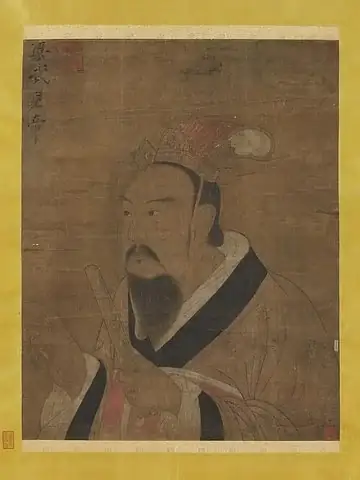
In brief
The historians' comment in the Book of Liang holds that he opened a period of prosperity not seen since Wei and Jin, while judging that in his late years he entrusted government to Zhu Yi and others and brought on the rebellion.
Road to the throne
According to the overall assessment in the Book of Liang, he lost his mother young and took no water for three days, and when his father died he hurried back, traveling day and night, and each time he wept he vomited blood. In 500, when his eldest brother Xiao Yi was killed by Xiao Baojuan, he raised troops at Xiangyang. He joined with Xiao Yingzhou of Jingzhou, and Yingzhou's side set the Prince of Nankang up as emperor at Jiangling. When he laid siege to Jiankang, Zhang Ji and others killed Xiao Baojuan and sent his head to him. He became the Prince of Liang, and in 502 he received Southern Qi's abdication and took the throne.
Reign and death
According to the overall assessment, he read books late into the night and wrote a great deal. In winter he rose before dawn to attend to government business, and his hands became chapped; he wore cloth robes, drank no wine, and used no music except on ritual occasions. He ate one meal a day, and his meals were only bean soup and coarse food. According to the biography of He Chen, he was angered by He Chen's criticism of the government of the day and rebuked him, and set out his own frugality, so that He Chen made no further criticism. From 527 on he repeatedly offered himself at the Tongtai Temple, and the high officials sometimes bought him back with money. In 547, Hou Jing of Eastern Wei sought to submit with thirteen prefectures. According to the biography of Zhu Yi, Xie Ju and others opposed it, and the emperor hesitated, but Zhu Yi, who had sounded out his true intent, urged him on, and he accepted, thinking too of his dream of pacifying the Central Plains. The next year Hou Jing rose in revolt, Xiao Zhengde, the Prince of Linhe, defected to him, and in 549 the palace city fell. According to the biography of Xiao Que, when the fall was reported to him, he lamented that he had gained it himself and lost it himself, and asked what there was to regret. According to the biography of Hou Jing in the Book of Liang, Hou Jing could not answer when the emperor questioned him, and he withdrew, saying that the heavenly majesty was not to be violated. The biography of Hou Jing in the History of the Southern Dynasties adds a dialogue and says that the emperor bowed his head and said nothing when Hou Jing answered that nothing under heaven was not his own. The annals in the Book of Liang say that, as what he asked for was not supplied, he fell ill from grief and anger, while the biography of Hou Jing says that even his meals were cut back. The History of the Southern Dynasties and the Zizhi Tongjian write that he asked for honey and could not get it, and said ho, ho twice and died. The story that Bodhidharma told him there was no merit does not appear in the Book of Liang, the History of the Southern Dynasties, the Book of Wei, the History of the Northern Dynasties, or the Zizhi Tongjian.
Translated from the Japanese text of this site, which is written from the official histories. Years are the Western calendar years of the dates, as in English reference works. Months are omitted because the histories use the Chinese lunar calendar.