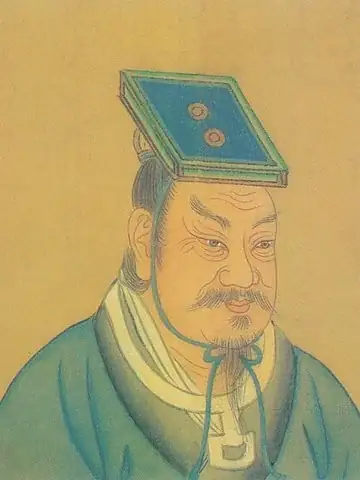
Road to the throne
His childhood name was Jinu, and he was born in 363. His mother died on the day of his birth, and because the family was poor, his mother's sister weaned her own child in order to raise him. Before he made his way in the world he cut reeds himself, and after he rose to high rank he gave his daughter the patched clothes his wife, Lady Zang, had sewn by hand, telling her to show them to anyone who became arrogant and extravagant. When Sun En's rebellion broke out in 399, he joined the army of Liu Laozhi, and early in 400 he fought hard, wielding a long sword. In 404 he raised troops at Jingkou against Huan Xuan, who had usurped the throne, and was chosen as leader of the alliance; he drove Huan Xuan from Jiankang, and Huan Xuan was beheaded as he fled. In 410 he took Guanggu in Southern Yan, capturing Murong Chao, and early in 411 he drove back Lu Xun, who had advanced on Jiankang while he was away. In the fighting against Lu Xun, he beheaded Xu Chite for leaving his post and also beheaded Wei Shunzhi for withdrawing without rescuing his own side, and his meritorious officials trembled. He destroyed Liu Yi and Zhuge Changmin, who had plotted with him against Huan Xuan, and when Han Yanzhi, in a reply refusing to come over to his side, rebuked him for having deceived Liu Fan and Zhuge Changmin with sweet words and then attacked them, he sighed that this was how one should serve a master. In 417 he destroyed Later Qin and entered Chang'an, but after he withdrew, Guanzhong was taken by Helian Bobo. Emperor An of Jin died in 419, and in 420 Liu Yu took the throne by abdication from Emperor Gong of Jin. The biography of Wang Shaozhi in the Book of Song says that Liu Yu had Wang Shaozhi poison Emperor An, while the Zizhi Tongjian says he had Wang Shaozhi strangle Emperor An.
Reign and death
He paid his respects every morning to his stepmother, Empress Dowager Xiao, but when she asked that his younger brother Liu Daolian be made Inspector of Yangzhou, he refused, saying Liu Daolian was not equal to the post. Emperor Gong of Jin, whom he had made Prince of Lingling, died in 421. The annals of the Book of Song say only that Liu Yu mourned him, but the biography of Chu Shudu in the Book of Song, the Book of Jin and the Zizhi Tongjian say that soldiers sent by Liu Yu killed him, and the History of the Southern Dynasties also presents the death as the will of Liu Song. According to the Book of Song, he was plain and simple, with few desires, and went about in wooden clogs. Later, when his grandson Emperor Xiaowu of Liu Song had his living quarters torn down, he gave no answer to a palace attendant who praised Liu Yu's frugality, and said that it would have been more than enough for a country old man. When his illness grew grave in 422, he warned the crown prince to be on guard against Xie Hui, and then died.
Translated from the Japanese text of this site, which is written from the official histories. Years are the Western calendar years of the dates, as in English reference works. Months are omitted because the histories use the Chinese lunar calendar.