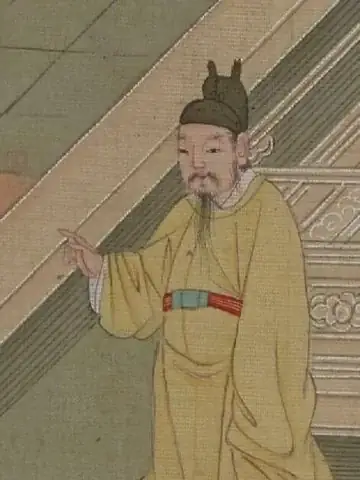
In brief
The Zizhi Tongjian describes him as quick-witted and swift to decide, excellent in learning and writing, and skilled at mounted archery, but with no limit to his desires.
Road to the throne
He was born in 430 and became Prince of Wuling in 435. In 453 his elder brother Liu Shao, the crown prince, entered the palace with the troops of the Eastern Palace, and Emperor Wen was killed. Liu Jun, who was then out at Wuzhou in Xiyang, led his troops to attack Liu Shao, and Liu Yixuan, Prince of Nanqiao, and Zang Zhi also raised troops. When Liu Yigong, Prince of Jiangxia, came over to his side and offered him the imperial title, he took the throne at Xinting. Soon afterwards he pacified the capital, and Liu Shao and the others were all put to death.
Reign and death
In the following year, 454, the Chancellor Liu Yixuan rose in arms. The biography of Liu Yixuan gives as causes the urging of Zang Zhi and Liu Jun's debauchery with Liu Yixuan's daughters, and says that Liu Yixuan had planned to act in the autumn or winter but raised his troops in haste because Lu Shuang rebelled first. Liu Yixuan died at Jiangling. The annals say that he was granted death, while his biography says that he was killed by Zhu Xiuzhi. He handled the affairs of government himself rather than entrusting them to his ministers, and decided major matters of appointment, punishment, and reward in consultation with his confidants Dai Faxing and Chao Shangzhi. He was displeased when Yan Jun, whom he had treated generously since before he took the throne, remonstrated against his building projects. According to the biography of Yan Jun, he later dismissed Yan Jun from office after Yan Jun let his resentment be known, then used the rebellion of Liu Dan, Prince of Jingling, to implicate him in a crime, and had him granted death in prison. In 459, when Liu Dan, Prince of Jingling, rebelled at Guangling, he personally led the Six Armies out as far as the Xuanwu Hall in the capital. When the city fell, the adult men inside it were put to death. According to the Zizhi Tongjian, he ordered that everyone be killed regardless of age, and at Shen Qingzhi's request those five chi tall or shorter were spared, but more than 3000 people were still killed. After his favourite, Lady Yin, the Shuyi, died in 462, according to the Zizhi Tongjian he was so stricken with grief that he considerably neglected the affairs of government. He often visited her tomb with his ministers, and made Liu Deyuan Inspector of Yuzhou after Liu Deyuan, told that he would be rewarded if he wept with grief, wailed aloud. The Zizhi Tongjian records that he undertook extensive palace building and that in his last years he was greedy for wealth and drunk all day, but that whenever matters were reported to him he composed his bearing. He died in the Yuzhu Hall in 464. Neither the annals in the Book of Song and the History of the Southern Dynasties nor the Zizhi Tongjian gives the cause of his death. The historians' comment in the Book of Song judges harshly that the Daming years were bent on exhausting the lives of the people.
Translated from the Japanese text of this site, which is written from the official histories. Years are the Western calendar years of the dates, as in English reference works. Months are omitted because the histories use the Chinese lunar calendar.