Zhu Wen
He was the emperor who surrendered to Tang from Huang Chao's army, built up his strength, and then received Tang's abdication and founded Later Liang.
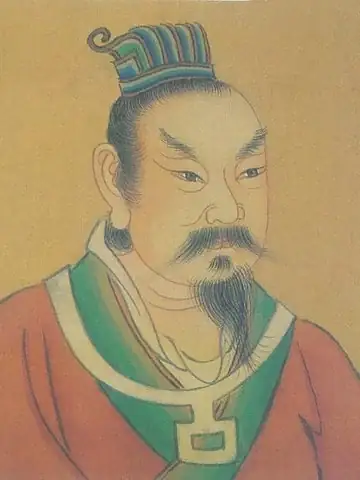
Later Liang · Five Dynasties and Ten Kingdoms · 1st ruler
Reigned 907–912 (5 years)
後梁太祖 Other names ›
Facts
Zhu Wen reigned for 5 years (907–912), taking the throne at 54, and was assassinated. 1st ruler of Later Liang.
- Reign
- May 907 – 18 July 912 (1st ruler of Later Liang)
- Length of reign
- 5 years
- Born
- 5 December 852
- Died
- 18 July 912
- Age at accession
- 54
- Age at death
- Unknown
- Cause of death
- AssassinatedKilled by officials, relatives, eunuchs or others within the same regime (including poisoning)
- Path to the throne
- Abdication from another dynastyReceived the throne from an emperor of another family or regime in a change of dynasty led by the new emperor (e.g. Cao Pi, Yang Jian, Zhao Kuangyin)
- Predecessor
- Emperor Ai of Tang
- Successor
- Zhu Yougui
- Era names
- 開平 Kāipíng (proclaimed 907)
- 乾化 Qiánhuà (proclaimed 911)
- Temple name
- 後梁太祖 Hòu Liáng Tàizǔ
- Personal name
- 朱全忠 Zhū Quánzhōng
- Wade–Giles
- Hou Liang T'ai-tsu · Chu Ch'üan-chung
Life
In brief
Ouyang Xiu, in the New History of the Five Dynasties, called the wickedness of Liang, which arose from bandits and destroyed Tang, extreme, while acknowledging that its strength was that of a tiger and a wolf: heroes rose, yet could not blunt its edge in the least.
Road to the throne
He entered Huang Chao's army together with his elder brother, but in 882 he killed Huang Chao's supervising officer, surrendered to Wang Chongrong of Hezhong, and was granted the name Quanzhong by Emperor Xizong of Tang. According to the New History of the Five Dynasties, when he boasted to the mother he had brought to him that, unlike his father, who had never passed the examinations, her son had become a military commissioner, she reproached him for not thinking of the orphan of the brother who had died in Huang Chao's army, and he wept and apologized. His wife Lady Zhang was wise, and even the violent Zhu Wen feared her. When he was about to behead his eldest son Youyu, she ran barefoot into the courtyard, clasped Youyu and wept, and his anger eased. In 904, according to the annals of the New History of the Five Dynasties and the biography of Zhu Yougong in the Old History of the Five Dynasties, Zhu Wen had Zhu Yougong and others assassinate Emperor Zhaozong of Tang. According to the Zizhi Tongjian, in 905 the Tang ministers Pei Shu and others were demoted and ordered to take their own lives because of Liu Can's slander, and Zhu Wen gathered them and more than 30 demoted court officials at Baima Station, killed them in a single night, and threw the bodies into the Yellow River. The biographies of the six ministers of Tang in the New History of the Five Dynasties place this in 906, saying that Liu Can, catering to the will of the Prince of Liang, had seven of them put to death. In 907 he received Tang's abdication, took the throne, and named the state Liang.
Reign and death
He fought with Li Cunxu of Hedong, and the Liang army was defeated at Luzhou in 908 and at Baixiang in 911. His eldest brother Quanyu, drunk at a gambling game in the palace, shouted that Zhu Wen had been a commoner and had still destroyed the three-hundred-year state of Tang, and that Quanyu would live to see Zhu Wen's clan exterminated. According to the New History of the Five Dynasties, Zhu Wen became dissolute after the death of Lady Zhang, and, taking no second wife, summoned the wives of his sons to attend on him, favoring above all Lady Wang, the wife of his adopted son Youwen. According to the Zizhi Tongjian, when his illness grew grave he lamented that when he died his sons would be no match for Taiyuan. According to the Zizhi Tongjian, his son Yougui, because many of those who had been demoted had later been put to death, took fright when he learned that he was to be sent out to Laizhou, and entered the bedchamber with the guard troops of Han Qing, the commander of the army; Yougui's follower Feng Ting'e stabbed Zhu Wen in the belly. Yougui concealed the death, and later announced it and took the throne.
Translated from the Japanese text of this site, which is written from the official histories. Years are the Western calendar years of the dates, as in English reference works. Months are omitted because the histories use the Chinese lunar calendar.
During the reign
Number of times each event is recorded in the official histories. How each item is counted
- Era name changes
- 2
- General amnesties
- 2
- Empresses installed
- 0
- Crown princes deposed
- 0
- Personal campaigns
- 3
- Rebellions suppressed
- 4
- Rebellions faced
- 5
- Capital relocations
- 1
Emperors of Later Liang
- 1stZhu Wen後梁太祖 Hòu Liáng Tàizǔ · 朱全忠 Zhū Quánzhōng907–912 · 5 years · Assassinated907–9125 yearsAssassinated
- Zhu Yougui朱友珪 Zhū Yǒuguī912–913 · 238 days · Suicide (incl. forced)912–913238 daysSuicide (incl. forced)
- 2ndZhu Youzhen後梁末帝 Hòu Liáng Mòdì · 朱友貞 Zhū Yǒuzhēn913–923 · 10 years · Suicide (incl. forced), age 35913–92310 yearsSuicide (incl. forced), age 35