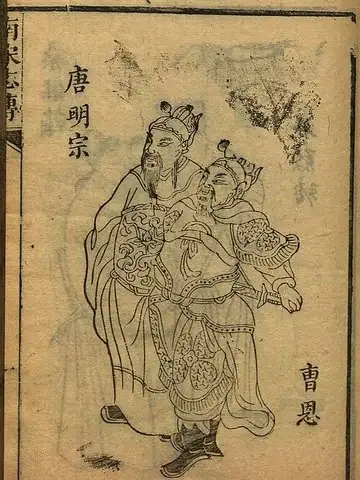
Road to the throne
According to the New History of the Five Dynasties and the Zizhi Tongjian, he was originally of foreign stock and had no surname (the Zizhi Tongjian calls him a Hu man), his childhood name was Miaojilie, and he became the adopted son of Li Keyong. The New History of the Five Dynasties says that the name Siyuan was given to him by Keyong. In 926, when he set out to put down the rebellion at Weizhou, soldiers mutinied outside the city of Yedu and pressed him to become emperor of Hebei; he wept and refused, but with blades held to him he was forced into the city. According to the Old History of the Five Dynasties, he later got out of the city and, persuaded by An Chonghui and others, headed for the capital. On hearing that Li Cunxu had died, he wept bitterly and entered Luoyang, and rejecting calls to change the name of the dynasty, he took the throne before the coffin as a younger brother succeeding his elder brother.
Reign and death
According to the Zizhi Tongjian, every night he burned incense and prayed to Heaven that, since he was a Hu man who had only been put forward because of the disorder, it would soon bring forth a sage to be ruler of the people. According to the discussion in the New History of the Five Dynasties, he cut back the palace women and court entertainers, and when he was asked to add vermilion paint in repairing a hall that had burned, he sighed that Heaven had used fire to warn him. According to the Zizhi Tongjian, he could not read, and An Chonghui, who read the memorials for him, could not fully understand them either, so at Chonghui's request he created posts of academician and appointed Feng Dao and others to them. Chonghui was dismissed in 931, and Li Siyuan sent an envoy to Hezhong with orders to put him to death if he had disloyal intentions (the biography in the New History of the Five Dynasties says to deal with him together with Li Congzhang). The biographies of An Chonghui in the Old History of the Five Dynasties and the New History of the Five Dynasties, and the Zizhi Tongjian, say that Li Congzhang struck him on the head with a mallet, while the annals of the Old History of the Five Dynasties say only that he was ordered by edict to die together with his wife and sons. In 933, on seeing a petition asking that his son Li Congrong be made crown prince, Li Siyuan, according to the biographies of his family in the New History of the Five Dynasties, was displeased and said that if the officials wanted to set up a crown prince, he would retire to Hedong. The Zizhi Tongjian says that he wept. Later, when he fell gravely ill, according to the Zizhi Tongjian, Congrong, believing that his father had died and fearing that he would not become the successor, tried to enter the palace with troops. Li Siyuan wept and left it to Kang Yicheng to deal with the matter, and had the palace gates shut. Congrong was defeated and killed, and Li Siyuan, grieved and shocked, grew more gravely ill and died soon after.
Translated from the Japanese text of this site, which is written from the official histories. Years are the Western calendar years of the dates, as in English reference works. Months are omitted because the histories use the Chinese lunar calendar.