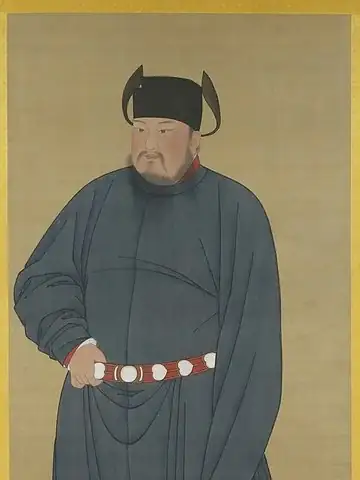
In brief
The historians' comment in the Old History of the Five Dynasties says that he won the realm by hard fighting, yet how quickly he lost it, and names among the causes of his failure that outside the palace actors threw the government into disorder, while inside it the hen announced the dawn.
Road to the throne
In 908 he succeeded his father as Prince of Jin on his father's death, and had his uncle Li Kening, who had plotted a rebellion, put to death by men lying in ambush. In 923 he took the throne as emperor at Weizhou and named his state Tang, and in the same year he entered Bianzhou and destroyed Later Liang.
Reign and death
According to the New History of the Five Dynasties, he loved actors and called himself Li Tianxia. Once, when he called out asking where Li Tianxia was, the actor Jing Xinmo slapped him on the cheek and told him there was only one Li Tianxia, and he was greatly pleased. Guo Chongtao, who in 925 had attacked Shu together with the emperor's son Jiji, was killed there. According to the Zizhi Tongjian, Li Cunxu told Meng Zhixiang to put Guo Chongtao to death, but granted his request to investigate first. The biography of Guo Chongtao in the Old History of the Five Dynasties also records that Li Cunxu then ordered Ma Yangui to act against Guo Chongtao together with Jiji if Guo Chongtao stayed on in Shu. When the empress pressed him again, Li Cunxu turned her down, saying that he could not decide while it was unknown whether the reports were true, and the empress herself wrote a directive ordering Jiji to kill Guo Chongtao. The biography of Guo Chongtao in the New History of the Five Dynasties says that the empress had an edict forged. In 926 the Weibo troops rebelled at Beizhou and entered Yedu. Li Siyuan, sent to suppress them, was pressed to take the throne when the army below the city walls mutinied, and was carried into Yedu, but talked his way out of the city. When the chancellors asked that goods from the treasury be given to the army, the empress brought out her dressing cases and the emperor's young offspring and said that they should be sold to provide for the army. In the biographies of the Tang imperial family in the New History of the Five Dynasties Li Cunxu granted the request, while in the annals of the Old History of the Five Dynasties he gave no answer to the memorial and summoned the chancellors. Goods were later handed out, but the soldiers cursed, saying that their wives and children had already starved to death. Around the time Li Siyuan entered Bianzhou, Li Cunxu heard that his armies had scattered and turned back. On the road he told his guards that he would give them all the gold and silver once they reached the capital, but they answered that his gifts came too late, and he could only weep. That same year Guo Congqian, a commander in the palace guard, rose in revolt, and Li Cunxu fought back in person but was struck by a stray arrow and died. Shanyou, a man of the Wufang, piled musical instruments on his body and burned it.
Translated from the Japanese text of this site, which is written from the official histories. Years are the Western calendar years of the dates, as in English reference works. Months are omitted because the histories use the Chinese lunar calendar.