Guo Wei
Once a leading minister of Later Han, he founded Later Zhou in 951 and was an emperor who valued frugality.
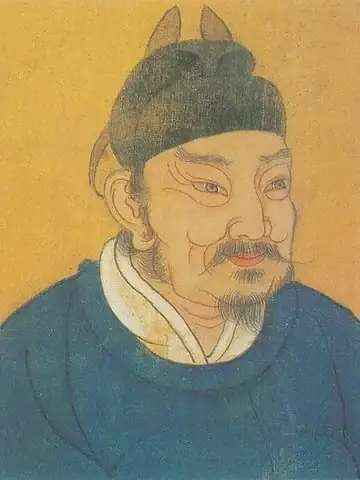
Facts
Guo Wei reigned for 3 years (951–954), taking the throne at 46, and died of natural causes at 49. 1st ruler of Later Zhou.
- Reign
- 13 February 951 – 22 February 954 (1st ruler of Later Zhou)
- Length of reign
- 3 years
- Born
- 10 September 904
- Died
- 22 February 954
- Age at accession
- 46
- Age at death
- 49
- Cause of death
- Natural causesNatural death or illness (including old age)
- Path to the throne
- Abdication from another dynastyReceived the throne from an emperor of another family or regime in a change of dynasty led by the new emperor (e.g. Cao Pi, Yang Jian, Zhao Kuangyin)
- Predecessor
- Liu Chengyou
- Successor
- Chai Rong
- Era names
- 廣順 Guǎngshùn (proclaimed 951)
- 顯德 Xiǎndé (proclaimed 954)
- Temple name
- 後周太祖 Hòu Zhōu Tàizǔ
- Personal name
- 郭威 Guō Wēi
- Wade–Giles
- Hou Chou T'ai-tsu · Kuo Wei
Life
In brief
The historians' comment in the Old History of the Five Dynasties holds that his diligence and thrift deserve praise from first to last, and adds the criticism of commentators that in putting the two Wangs to death he was marred by suspicion and cruelty.
Road to the throne
He was a native of Yaoshan in Xingzhou, and lost his father to the wars as a child. As a young man he answered Li Jitao's call for recruits; once, drunk, he made a butcher in the market cut meat for him and berated him, and when the butcher bared his belly and asked whether he dared stab him, he stabbed him in the belly. He urged Liu Zhiyuan to take the throne, received his charge at his deathbed, and became Commissioner of Military Affairs. In 950 Liu Chengyou and his close associates sent down a secret edict to have Guo Wei killed. In the Old History of the Five Dynasties, when Guo Wei told his officers to take his head, they asked to rid the ruler's side of evil men; in the New History of the Five Dynasties and the biography of Wei Renpu in the History of Song, Guo Wei, on Wei Renpu's advice, rewrote the edict and so enraged the officers. The Zizhi Tongjian records both Wei Renpu's words that he should not sit and wait for death and Guo Wei's words about his head. The family he had left in the capital was killed, and Liu Chengyou too was killed in the turmoil. The annals of Zhou in the New History of the Five Dynasties make the plundering after the entry into the capital Guo Wei's own act, while biographies in the same book, the Old History of the Five Dynasties and the Zizhi Tongjian attribute it to the troops. The latter two also record that Wang Jun had allowed ten days of plunder, presenting this as Guo Wei's instruction, and that on the advice of Wang Yin and others those who plundered were beheaded to stop it. Setting out on a northern campaign at news of a Khitan invasion, Guo Wei was acclaimed by his officers and men at Chanzhou, and in 951 he took the throne and named his state Zhou.
Reign and death
On taking the throne he stopped the presentation of rare delicacies and had vessels of jewels and jade smashed, asking what use an emperor had for such things. In 952, on his way back from the campaign against Murong Yanchao, he bowed in worship at the shrine of Confucius in Qufu. In 953 he gave the government-held estates to their tenant farmers. The Old History of the Five Dynasties explains that he had known the abuses of the state farms from his years among the common people. He called his meritorious minister Wang Jun elder brother and treated him leniently, but when Wang Jun grew overbearing he had him confined and demoted to Shangzhou, where Wang Jun died. Wang Yin, who came to court with troops, was also seized by the ailing Guo Wei, sentenced to exile, and killed once he had left the capital. The New History of the Five Dynasties says that Guo Wei suspected him of disloyal intent, while the biography of Wang Yin in the Old History of the Five Dynasties says that Wang Yin had power enough to overawe his sovereign. Guo Wei died in 954. While still living he had ordered the Prince of Jin to bury him in paper clothes and an earthenware coffin. By his testamentary edict, Chai Rong, the Prince of Jin, his wife's nephew and adopted son, took the throne before his coffin.
Translated from the Japanese text of this site, which is written from the official histories. Years are the Western calendar years of the dates, as in English reference works. Months are omitted because the histories use the Chinese lunar calendar.
During the reign
Number of times each event is recorded in the official histories. How each item is counted
- Era name changes
- 2
- General amnesties
- 2
- Empresses installed
- 0
- Crown princes deposed
- 0
- Personal campaigns
- 1
- Rebellions suppressed
- 2
- Rebellions faced
- 2
- Capital relocations
- 0
Emperors of Later Zhou
- 1stGuo Wei後周太祖 Hòu Zhōu Tàizǔ · 郭威 Guō Wēi951–954 · 3 years · Natural causes, age 49951–9543 yearsNatural causes, age 49
- 2ndChai Rong後周世宗 Hòu Zhōu Shìzōng · 柴榮 Chái Róng954–959 · 5 years · Natural causes, age 37954–9595 yearsNatural causes, age 37
- 3rdEmperor Gong of Later Zhou後周恭帝 Hòu Zhōu Gōngdì · 柴宗訓 Chái Zōngxùn959–960 · 190 days · Unknown, age 19–20959–960190 daysUnknown, age 19–20