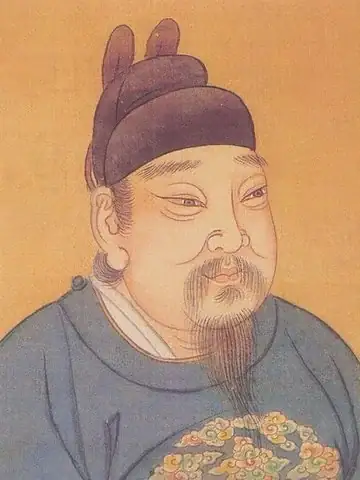
In brief
In the New History of the Five Dynasties, Ouyang Xiu praises him as perceptive and resolute, while the historians' comment in the Old History of the Five Dynasties calls him the heroic ruler of his age but records that his punishments were too severe.
Road to the throne
His original surname was Chai, and he was the son of the elder brother of Guo Wei's wife, Lady Chai; born in 921 at Xingzhou, he went as a child with his aunt and grew up in Guo Wei's household. At a time when the household of the sonless Guo Wei had fallen on hard times, he was valued for his prudence and sincerity, entrusted with the household's affairs, and adopted as a son. In 950, during the uprising of Li Ye and others, his wife, Lady Liu, who was in the capital, was killed. Of his sons, the New History of the Five Dynasties says that three were killed, while the Old History of the Five Dynasties says that his son Zongyi was killed at the end of Later Han. In 953 he was made Prince of Jin, and when Guo Wei died in 954, a testamentary edict was issued while the death was still kept secret, and he took the throne before the coffin.
Reign and death
Soon after his accession, when Northern Han and the Khitan attacked, he overrode the objections of Feng Dao to lead the campaign in person, and at Gaoping, as the generals of the right wing fled, he himself led his personal cavalry to direct the battle and won a great victory. After the battle he had more than seventy officers who had fled, among them Fan Aineng and He Hui, beheaded, and arrogant generals and idle soldiers alike learned fear. Whenever he flew into a violent rage, his wife, Lady Fu, would always calmly intercede. In 955 he abolished temples that had no imperially granted name plaque, and required those taking monastic vows to have their parents' permission and to pass an examination on the scriptures. According to the Zizhi Tongjian, he had copper vessels and Buddhist statues held by the people handed over to the government so that coins could be cast, and said that if his own body could save the people, he would not begrudge it. From 956 he campaigned in person against Southern Tang, received the surrender of Shouzhou, and in 958 brought Huainan under control, gaining fourteen prefectures and sixty counties. According to the annals in the Old History of the Five Dynasties, he read Yuan Zhen's memorial on equalizing the land, had it drawn up as a chart, and distributed it to the circuits in order to equalize taxes. In 959 he campaigned north against Liao and took the surrender of Waqiao Pass and other places without a fight. When an attack on Youzhou was discussed, the generals opposed it. According to the annals in the Old History of the Five Dynasties, he did not listen, fell ill that night, and called it off; according to the Zizhi Tongjian, he sent the vanguard ahead to Gu'an but fell ill that same day and stopped. He died soon after returning to the capital. The Old History of the Five Dynasties places his death in the Wansui Hall, and the New History of the Five Dynasties in the Zide Hall. The historians' comment in the Old History of the Five Dynasties and the Zizhi Tongjian write that he later came to regret the severity of his punishments himself, and that in his last years he gradually became more lenient.
Translated from the Japanese text of this site, which is written from the official histories. Years are the Western calendar years of the dates, as in English reference works. Months are omitted because the histories use the Chinese lunar calendar.