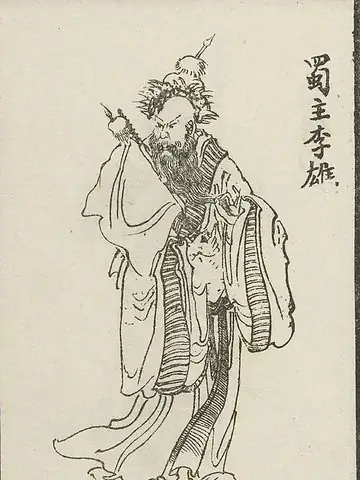
Facts
Li Xiong reigned for 28 years (306–334), taking the throne at 31 or 32, and died of natural causes at 59 or 60. 3rd ruler of Cheng Han.
- Reign
- July 306 – 11 August 334 (3rd ruler of Cheng Han)
- Length of reign
- 28 years
- Born
- Unknown
- Died
- 334
- Age at accession
- 31–32
- Age at death
- 59–60
- Cause of death
- Natural causesNatural death or illness (including old age)
- Path to the throne
- Self-proclaimedFounded the titleClaimed the imperial title without receiving the throne from an earlier ruler (e.g. Emperor Gaozu of Han, Emperor Guangwu of Han, Hongwu Emperor)
- Posthumous name
- 成漢武帝 Chéng Hàn Wǔdì
- Temple name
- 成漢太宗 Chéng Hàn Tàizōng
- Personal name
- 李雄 Lǐ Xióng
- Wade–Giles
- Ch'eng Han Wu-ti · Li Hsiung
Life
In brief
The chronicle of Li Xiong in the Book of Jin records that he was lenient by nature and kept punishments simple, and that when Fu Cheng and Wei Wen, Di men who had wounded his mother, came over to him, he pardoned them all and treated them generously.
Road to the throne
According to the chronicle, his mother, Lady Luo, conceived him after dreaming that a great snake coiled around her body, and she used to say that if either of her two sons died first, the one who remained would surely rise to high rank. When Li Te rose in arms he made Li Xiong General of the Front, and after Li Liu died Li Xiong became Grand Commander, Grand General, and Governor of Yi Province, which the chronicle presents as titles he took for himself, while the Zizhi Tongjian says he was put forward by his followers. When Luo Shang, the Western Jin Inspector of Yi Province, abandoned the city by night and fled, Li Xiong took Chengdu. In 304, at the firm urging of his generals, he took the title King of Chengdu, abolished the laws of Western Jin, and laid down seven articles of law. Later, at the urging of Fan Changsheng, he ascended the imperial throne, an event the annals of Emperor Hui in the Book of Jin place in 305 and the Zizhi Tongjian in 306.
Reign and death
According to the chronicle, state funds fell short and many obtained office by presenting gold and silver, but when Yang Bao remonstrated, Li Xiong humbly apologized, and when he struck his officials while drunk, he also stopped at a single word from Yang Bao. When his mother died, he trusted the words of shamans and went so far as to want to leave her unburied, but he heeded the remonstrance of Zhao Su; he also insisted on three years of mourning, but Ren Hui reasoned with him, and he was lifted to his feet and returned to governing. He made good use of men of talent and brought Yi Province under control, and while the realm was in great disorder Shu alone was at peace, people came over to him one after another, and taxes were light. He founded schools, appointed official historians, and in his spare time from government never let a book leave his hands. When he sent his elder brother's sons Li Han and Li Zhi against Yang Nandi and they were defeated, he went without food for several days and blamed himself deeply. The chronicle names the lack of ceremony in his state and the lack of salaries for officials as causes of failure. According to the chronicle, he had more than ten sons, but holding that the groundwork had been laid by the achievements of his father and that the throne should have passed to his elder brother of the legitimate line, he made his brother's son Li Ban crown prince, and Li Xiang wept that disorder would begin from this. When his illness grew grave and his old wounds festered, his own sons, Li Yue among them, kept away, but Li Ban stayed at his side day and night and sucked out the pus. The chronicle says he died six days after a sore formed on his head and dates this to 333, while the annals of Emperor Cheng of Jin, the Huayang Guozhi, and the Zizhi Tongjian give 334.
Translated from the Japanese text of this site, which is written from the official histories. Years are the Western calendar years of the dates, as in English reference works. Months are omitted because the histories use the Chinese lunar calendar.