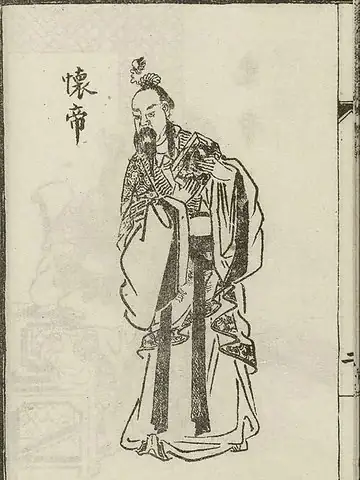
Facts
Emperor Huai of Jin reigned for 4 years (307–311), taking the throne at 21 or 22, and was executed at 28 or 29. 5th ruler of Western Jin.
- Reign
- 11 January 307 – 13 July 311 (5th ruler of Western Jin)
- Length of reign
- 4 years
- Born
- Unknown
- Died
- 14 March 313
- Age at accession
- 21–22
- Age at death
- 28–29
- Cause of death
- ExecutedPut to death by a hostile power, a successor regime or a conqueror, as a public act
- Path to the throne
- Designated heirSucceeded the previous ruler of the same regime, who had chosen the heir (by testament, naming a crown prince, etc.)
- Posthumous name
- 晉懷帝 Jìn Huáidì
- Personal name
- 司馬熾 Sīmǎ Chì
- Wade–Giles
- Chin Huai-ti · Ssu-ma Ch'ih
Life
In brief
Xun Song, the Director of the Palace Library, judged that in a time of peace he could have been a good ruler who upheld the established order, but because he succeeded after the turmoil and the Prince of Donghai monopolized the government, he met the calamity of exile without having committed the faults of a bad ruler.
Road to the throne
In the reign of Emperor Hui, when the imperial clan was in conflict, he shut his gates, cut off dealings with guests, and devoted himself to histories, earning a good name. Early in 305 he was made imperial heir-brother, but because Sima Tan, Prince of Qinghe, had formerly been crown prince, he was afraid and nearly declined, accepting at the urging of Xiu Su, the Director of Documents. When Emperor Hui died, Empress Yang, since she could not become empress dowager, called Sima Tan to the palace, but when Sima Tan had reached the Shangshu Pavilion, the Palace Attendant Hua Hun and others hurriedly summoned the imperial heir-brother.
Reign and death
After taking the throne he held court in the Taiji Hall and at every banquet discussed affairs of state and the classics with the officials, and Fu Xuan exclaimed that today they saw the age of Emperor Wu of Jin once more. He entrusted the government to Sima Yue, Prince of Donghai, but in time began to attend to the affairs of state himself, and Sima Yue, displeased, left for Xuchang. In 309 Sima Yue brought troops into the palace and seized Miao Bo and others, the emperor's confidants, before the emperor's eyes; the emperor took their hands and wept, but Miao Bo and the others were killed. In 311 he sent Gou Xi a secret edict to attack Sima Yue, but Sima Yue died within the year, and Shi Le defeated the Jin army, with the deaths of more than a hundred thousand people, Wang Yan among them. Trying to escape from starving Luoyang, he went out of a palace gate on foot, but was set upon by bandits and turned back. The same year Luoyang fell and he was sent to Pingyang; the annals say he was made Duke of Kuaiji, while the Zizhi Tongjian says he was first made Duke of Ping'e and later Duke of Kuaiji Commandery. According to the chronicle of Liu Cong in the Book of Jin, when Liu Cong asked at a banquet why the Jin imperial family had fought among its own kin, Emperor Huai of Jin answered that it was the will of Heaven so that Han might receive the mandate. At a banquet in 313 Liu Cong had him wear blue clothes and pour wine, and resented the loud weeping of Yu Min and other former Jin officials, after which Emperor Huai of Jin was killed. That the reason was a report that Yu Min and others were plotting to rise in support of Liu Kun is given by the chronicle and the Zizhi Tongjian, while the Book of Wei gives the plot itself as the reason, and only the chronicle says he was poisoned. The discussion by Gan Bao cited in the historians' comment of the Book of Jin judges that he gained the throne in the wake of turmoil but was held in check by powerful ministers.
Translated from the Japanese text of this site, which is written from the official histories. Years are the Western calendar years of the dates, as in English reference works. Months are omitted because the histories use the Chinese lunar calendar.