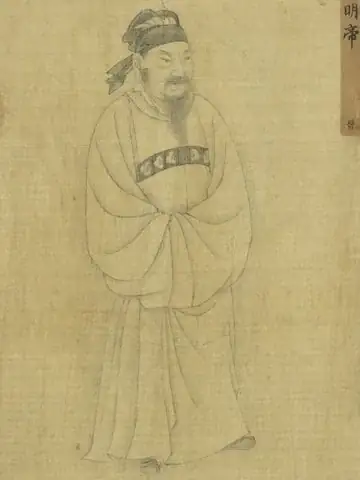
Facts
Emperor Ming of Jin reigned for 2 years (323–325), taking the throne at 22 or 23, and died of natural causes at 25 or 26. 2nd ruler of Eastern Jin.
- Reign
- 4 January 323 – 18 October 325 (2nd ruler of Eastern Jin)
- Length of reign
- 2 years
- Born
- Unknown
- Died
- 18 October 325
- Age at accession
- 22–23
- Age at death
- 25–26
- Cause of death
- Natural causesNatural death or illness (including old age)
- Path to the throne
- Designated heirSucceeded the previous ruler of the same regime, who had chosen the heir (by testament, naming a crown prince, etc.)
- Posthumous name
- 晉明帝 Jìn Míngdì
- Temple name
- 晉肅祖 Jìn Sùzǔ
- Personal name
- 司馬紹 Sīmǎ Shào
- Wade–Giles
- Chin Ming-ti · Ssu-ma Shao
Life
In brief
The Book of Jin describes him as intelligent and decisive when the moment came, and says that although his reign was short, he divided the power of the upper Yangtze and his designs were far-reaching.
Road to the throne
He was the eldest son of Emperor Yuan; his mother was Lady Xun, a palace attendant, and Sima Pei was his younger brother by the same mother. As a child he was asked whether the sun or Chang'an was farther away, and the next day he gave the opposite answer and explained his reasons, astonishing Emperor Yuan. According to the biography of Prince Xiao of Langya, Emperor Yuan let Wang Dao know that he wished to set up Sima Pei, but Wang Dao answered that the elder son should be set up, and the position of crown prince was settled. After becoming crown prince he was by nature deeply filial, loved literary composition and also trained in martial arts, and treated Wang Dao, Yu Liang, Wen Jiao and others with close favor. In 322, when the government troops were defeated in Wang Dun's rebellion, he set out to fight a decisive battle himself, but Wen Jiao cut the harness strap of his carriage and stopped him. Early in 323, the day after Emperor Yuan died, he took the throne; he made his mother, whom Emperor Yuan had come to neglect, Lady of Jian'an, and within that same year brought her into the palace and served her generously.
Reign and death
At the burial of Emperor Yuan he walked barefoot all the way to the tomb. According to the annals of Emperor Ming, in 324, when Wang Dun was preparing to raise troops, Emperor Ming rode in secret on a fine horse to spy on his camp. Wang Dun said that a yellow-bearded Xianbei slave had come and sent men after him, but Emperor Ming shook off his pursuers with a seven-jeweled whip and horse dung cooled with water. The same year, when Wang Han, Qian Feng and others advanced in place of the ailing Wang Dun, Emperor Ming led the Six Armies himself and set up camp; his troops crossed the river at night and routed the enemy at Yuecheng at dawn, and Wang Dun died soon afterward. After the rebellion, on the deliberation of the officials, Wang Dun's body was dug up and beheaded, but on Xi Jian's advice Emperor Ming allowed the family to bury it, and he decreed that Wang Dun's clan would not be held guilty. According to the annals of Emperor Xuan in the Book of Jin, when he heard from Wang Dao how Sima Yi had laid the foundations of Jin and about the killing of Cao Mao, he pressed his face down on the couch and said that in that case the fortunes of Jin could hardly last long. In 325 he named his son Sima Yan crown prince, and when his illness grew serious the same year, he had Sima Yang, Wang Dao, Yu Liang and others receive his testamentary edict to assist the crown prince, and he died in the Eastern Hall. His edict of the previous day laments that he was leaving the world without having wiped away a great shame, and orders that his body be dressed in ordinary clothes and buried simply.
Translated from the Japanese text of this site, which is written from the official histories. Years are the Western calendar years of the dates, as in English reference works. Months are omitted because the histories use the Chinese lunar calendar.